




A Comparative Evaluation of the Detection and Tracking Capability Between Novel Event-Based and Conventional Frame-Based Sensors
This research establishes a fundamental understanding of the characteristics of event-based sensors and applies it to the development of a detection and tracking algorithm.

The detection and tracking of moving objects in free space is an area of computer vision that has benefited greatly from years of research and development. To date, there are many different algorithms available with new and improved revisions being developed on a regular basis. With such maturity, it is not surprising that such algorithms provide very effective solutions in a wide range of applications. There are, however, select scenarios in which traditional detection and tracking algorithms break down. In many cases it is not attributable to the algorithm, but rather the fundamental operation of a frame-based sensor.
Despite extensive research, traditional frame-based algorithms remain tied to predefined frame rates that lead to image artifacts such as motion blur and sensor characteristics such as low dynamic range, speed limitations and the requirement to process large data files often filled with copious amounts of redundant data.
Event-based sensors, also known as silicon retinas or neuromorphic sensors, are revolutionary optical sensors that operate fundamentally differently to traditional frame-based sensors and offer the potential of a novel solution to these challenges. Inspired by the functionality of a biological retina, these sensors are driven by changes in low-light intensity and not by artificial frame rates and control signals. Within these sensors each pixel behaves both asynchronously and independently, enabling events to be generated with microsecond resolution in response to localized optical changes as they occur.
As noted, event-based sensors specifically aim to mimic the biological retina and subsequent vision processing of the brain. While the retina is the photosensitive tissue of the eye, for it to work properly the entire eyeball is needed. Figure (a) shows a schematic crosssection of a typical eye. Light entering the eye passes through the cornea and into the first of two humors. The aqueous humor is a clear mass that connects the cornea with the lens, helping to maintain the shape of the cornea. Between the aqueous humor and lens lies the iris, a colored ring of muscle fibers. The iris forms an adjustable aperture, called the pupil, which is actively adjusted to ensure a relatively constant amount of light enters the eye at all times.
While the cornea has a fixed curvature, the shape of the lens can be actively moulded to adjust the eye’s focal length as needed. On the back side of the lens is the vitreous humor that again helps to maintain the shape of the eye. Light entering the pupil then forms an inverted image on the retina. The retina contains the photosensitive rods and cones and is a relatively smooth, curved layer with two distinct points; the fovea and optic disc. Densely populated with cone cells, the fovea is positioned directly opposite the lens and is largely responsible for color vision. The optic disc, a blind spot in the eye, is where the axons of the ganglion cells leave the eye to form the optic nerve.
From the photoreceptors, neural responses pass through a series of linking cells, called bipolar, horizontal and amacrin cells (see Figure (b)). These cells combine and compare the responses from individual photoreceptors before transmitting the signals to the retinal ganglia cells. The linkage between neighboring cells provides a mechanism for spatial and temporal filtering, facilitating relative, rather than absolute, judgment of intensity, emphasizing edges and temporal changes in the visual field of view. It is the network of photoreceptors, horizontal cells, bipolar cells, amacrin cells and ganglion cells that can discriminate between useful information to be passed to the brain, and redundant information that is best discarded immediately.
This work was done by James P. Boettiger of the RAAF for the Air Force Institute of Technology. For more information, download the Technical Support Package below. AFRL-0299
This Brief includes a Technical Support Package (TSP).
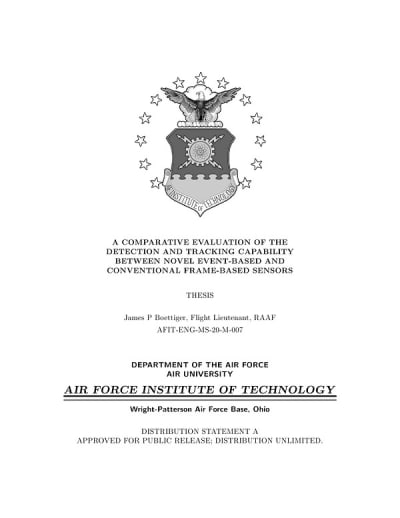
A Comparative Evaluation of the Detection and Tracking Capability Between Novel Event-Based and Conventional Frame-Based Sensors
(reference AFRL-0299) is currently available for download from the TSP library.
Don't have an account?
More From SAE Media Group
Photonics & Imaging Technology
Optical Modules
Medical Design Briefs
A New Generation of Artificial Retinas Based on 2D Materials
Medical Design Briefs
Ultra-Sensitive, Small Optomechanical Ultrasound Sensor

Sensor Technology
Nano Flashlight Enables New Applications of Light
Aerospace & Defense Tech Briefs
Multimode Optical Fiber Sensing
Photonics & Imaging Technology
Novel Light-Field Sensor for 3D Scene Construction Has Unprecedented Angular Resolution
Aerospace & Defense Tech Briefs
Frequency Agile Plasmonic Antennas and Sensors
Aerospace & Defense Tech Briefs
Co-Prime Frequency and Aperture Design for HF Surveillance, Wideband Radar Imaging, and Nonstationary Array Processing
Tech Briefs
Turning Diamond into Metal
Photonics & Imaging Technology
A Marriage of Light-Manipulation Technologies
Motion Design
Soft Sensor Boosts Fingertip Sensitivity for Robots
Aerospace & Defense Tech Briefs
Towards Greater Sensitivity: A Brief FTIR and Infrared-Based Cavity Ring Down Spectroscopy Comparative Study
Aerospace & Defense Tech Briefs
Low-Cost Ground Sensor Network for Intrusion Detection
Medical Design Briefs
Direct-to-Brain Bionic Eye
Sensor Technology
Sensors Eliminate Sparking Risk in Hydrogen Vehicles

Aerospace & Defense Tech Briefs
Fabrication and Electrical Characterization of Correlated Oxide Field Effect Switching Devices for High Speed Electronics
Photonics & Imaging Technology
Visualizing Value at the Speed of Light
Tech Briefs
Products of Tomorrow
Tech Briefs
Blue-Light Imaging Sees Through Fire
Photonics & Imaging Technology
Backside Illumination Gets Fast
Photonics & Imaging Technology
Lens-Free Fluorescent Microscope
Medical Design Briefs
Tiny Chip-Based Device Performs Ultrafast Modulation of X-Rays

Sensor Technology
Smart Windows Self-Illuminate on Rainy Days
Medical Design Briefs
Sensor Uses Computer Vision-Based Optical Strain Technology
Overview
The document is a Master's thesis by Flight Lieutenant James P. Boettiger, conducted at the Air Force Institute of Technology, focusing on the comparative evaluation of detection and tracking capabilities between novel event-based sensors and conventional frame-based sensors. The research spans from September 2018 to March 2020 and aims to address the limitations of traditional frame-based technology, which suffers from issues such as motion blur, low dynamic range, speed limitations, and high data storage requirements.
Event-based sensors operate differently from frame-based sensors; they respond asynchronously to changes in light intensity, allowing for unique advantages such as low power consumption, reduced bandwidth requirements, high temporal resolution, and high dynamic range. This asynchronous operation enables event-based sensors to capture rapid movements without the blurring that often affects frame-based systems.
The thesis presents a comparative assessment of object detection and tracking capabilities using both sensor types. A basic frame-based algorithm was developed and tested against two different event-based algorithms. The first approach involved parsing event-based pseudo-frames through standard frame-based algorithms, while the second constructed target tracks directly from filtered events. The findings indicate that while effective detection and tracking were demonstrated, the research did not identify an ideal event-based solution to completely replace existing frame-based technology. However, it highlighted the significant potential and value in further exploring event-based sensor technology.
The document also includes sections on the background and literature review, discussing biological inspirations for sensor design, the types of event-based sensors, and the advantages of event-based over frame-based sensors. The research underscores the importance of continued investigation into event-based technology, suggesting that its disruptive nature could lead to substantial advancements in sensor capabilities.
Overall, the thesis contributes to the understanding of how event-based sensors can enhance detection and tracking in various applications, particularly in defense contexts, and encourages further research to fully realize their potential. The distribution statement indicates that the document is approved for public release, ensuring that the findings can be shared with a broader audience interested in sensor technology advancements.
Top Stories
INSIDERManufacturing & Prototyping
 How Airbus is Using w-DED to 3D Print Larger Titanium Airplane Parts
INSIDERManned Systems
 FAA to Replace Aging Network of Ground-Based Radars
NewsTransportation
 CES 2026: Bosch is Ready to Bring AI to Your (Likely ICE-powered) Vehicle
NewsSoftware
 Accelerating Down the Road to Autonomy
EditorialDesign
 DarkSky One Wants to Make the World a Darker Place
INSIDERMaterials
 Can This Self-Healing Composite Make Airplane and Spacecraft Components Last...
Webcasts
Defense
 How Sift's Unified Observability Platform Accelerates Drone Innovation
Automotive
 E/E Architecture Redefined: Building Smarter, Safer, and Scalable...
Power
 Hydrogen Engines Are Heating Up for Heavy Duty
Electronics & Computers
 Advantages of Smart Power Distribution Unit Design for Automotive...
Unmanned Systems
 Quiet, Please: NVH Improvement Opportunities in the Early Design...
