




Custom Data Logger for Real-Time Remote Field Data Collections
Compact, energy efficient instruments have the same functionality as a personal computer.
The U.S. Army Corps of Engineers (USACE), CHL, FRF, had a need for a remote real-time data collection system to control instruments and log and communicate data from five observing stations in the Currituck Sound Estuary, NC1. These stations, referred to as the Currituck Sound Array (CSA), collect a suite of meteorological and oceano-graphic data including wind, air temperature, humidity, incoming solar radiation (above and below water), waves, currents, water level, salinity, and water temperature, as well as turbidity and many other water quality parameters. This array of instruments has a variety of control commands, sample routines, and output data formats. Additionally, the CSA was designed to act as a natural laboratory for estuarine research and as an instrument and model test bed. These capabilities required a reliable and flexible system that would allow easy modification of sampling schemes, the ability to log as many as 15 instruments with a single logger, and allow the incorporation of additional and novel instrumentation with minimal effort and expense.
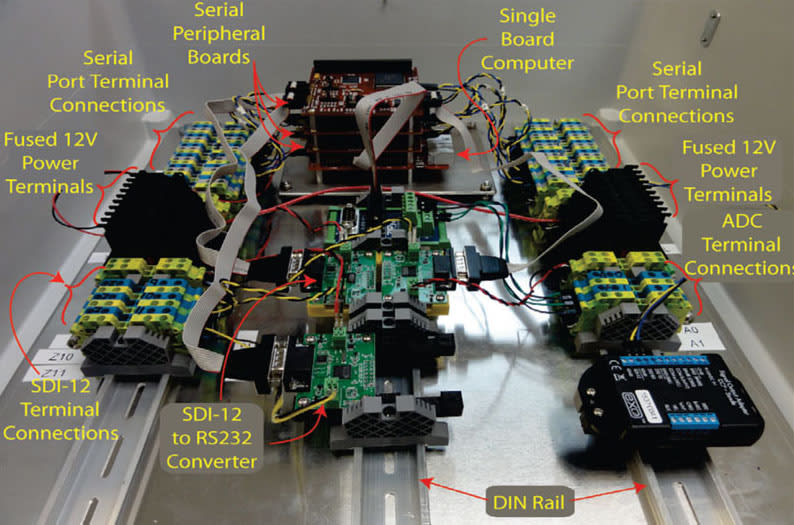
The custom loggers were built upon single board computers (SBC) running the Linux operating system. They effectively have the same functionality as a personal computer, overcoming many of the limitations of off-the-shelf loggers. Additionally, off-the-shelf loggers typically operate on a very limited set of commands. These custom Linux-based loggers have a much more diverse and powerful selection of commands, overcoming many of the unique challenges of real-time data collection with robust code and programmatic “watchdogs” that can automatically make sure the logger, instruments, and communications are operating as intended.
The “brains” of the data loggers are Technologic Systems TS-7250-V2 SBCs. While there are many suitable SBCs on the market, these particular units were chosen based on size, cost, processing power, number of available analog and serial ports, ruggedness, and operating temperature range.
Remote data logging units are typically deployed at exposed locations and housed in small weather-proof enclosures requiring them to be compact, energy efficient, and able to operate at temperature extremes. The TS-7250-V2 is designed for industrial applications making it rugged and reliable. They are compact (10 cm × 11 cm) and operate over a large temperature range (-40°C to 85°C). They are energy efficient, drawing approximately 200 milliamps (mA) at 12 volts (V).
Most meteorologic and oceano-graphic instruments output an analog data signal or communicate via serial communication protocols (e.g., RS232 or RS485). The TS-7250-V2 comes equipped with five channels of analog-to-digital conversion (ADC) and three serial ports. Additionally, up to three PC104 peripheral boards can be added to expand the ADC or serial communication capabilities. Each additional board can add 12 or more ADC channels or four serial ports. In the present configuration of this data logger, three TSER4 serial communication boards (also from Technologic Systems) have been added to expand the logging capabilities to a total of five ADC channels and 14 serial communication ports. One serial port is reserved for direct communications with the unit. In this configuration, all serial communications are RS232.
This work was done by Patrick J. Dickhudt and Kent K. Hathaway for the Army Corps of Engineers. ERDC-0003
This Brief includes a Technical Support Package (TSP).
A Custom Data Logger for Real-Time Remote Field Data Collections
(reference ERDC-0003) is currently available for download from the TSP library.
Don't have an account?
More From SAE Media Group
Tech Briefs
Executive Perspectives: Test & Measurement
Aerospace & Defense Tech Briefs
The Inside Story on Unmanned Vehicle Signal Recorder Technology
Aerospace & Defense Tech Briefs
The Role of Prototype/Test Systems in Next-Generation C5ISR Development
Aerospace & Defense Tech Briefs
In-Flight Real-Time Avionics Adaptation
Aerospace & Defense Tech Briefs
Multi-Agent RF Propagation Simulator
Aerospace & Defense Tech Briefs
Using RISC-V to Simplify Data Logging in Space

Aerospace & Defense Tech Briefs
New Products

Tech Briefs
Smart Sensor Technology for the IoT
Photonics & Imaging Technology
Understanding the New Optical Data Interface
Aerospace & Defense Tech Briefs
Ka-Band Front-End Monolithic Microwave Integrated Circuits (MMICs) and Transmit/Receive (T/R) Modules Testing
Aerospace & Defense Tech Briefs
Space Industry Test Challenges
Tech Briefs
Executive Perspectives: Test & Measurement
Aerospace INSIDER
Argonne AI Tools Power Safer, Faster Aerospace Inspections
Aerospace INSIDER
USB Load Cells
Aerospace INSIDER
TEWS Introduces First VITA 93 QMC Modules

Aerospace & Defense Tech Briefs
Developing a 6DoF Aircraft Munitions Optical Tracking System
Aerospace & Defense Tech Briefs
SAE International Extends Call for Abstracts, Seeks Submissions for AeroTech Conference
Aerospace & Defense Tech Briefs
Using Ruggedized Test Equipment to Solve Jet Engine Problems
Aerospace & Defense Tech Briefs
New AFRL Chamber Enhances Equipment Performance in Extreme Environments
Tech Briefs
Vote for Tech Briefs Product of the Year 2021
Aerospace Manufacturing and Machining INSIDER
Army Launches CMOSS Prototyping Competition for Computer Chassis and Cards
Tech Briefs
Seeing Is Communicating

Tech Briefs
Radiation-Hardened Gain Digitizer
Tech Briefs
Crew Activity Analyzer
Aerospace & Defense Tech Briefs
Understanding the “Black Art” of RF and Microwave Switching
Overview
The document discusses the development and implementation of a custom-built data logger designed for real-time remote field data collection by the U.S. Army Corps of Engineers (USACE), specifically the Coastal and Hydraulics Laboratory (CHL). The need for such a system arose from the limitations of commercially available loggers, which were found inadequate due to issues like insecure communication, insufficient serial ports, and high latency in remote communications.
The custom data logger is based on the TS-7250-V2 single board computer, which utilizes a Marvell PXA168 1066MHz ARM CPU and runs on Debian Linux. This setup allows for programming flexibility, supporting multiple languages including C, PERL, PHP, and Python. The majority of the data collection code was developed in PERL, leveraging existing, rigorously tested code to save time and ensure reliability.
The data logger is designed to control and log data from over 20 instruments simultaneously, making it a powerful tool for monitoring various environmental parameters such as wind, temperature, humidity, and water quality in the Currituck Sound Estuary, NC. The system facilitates real-time data collection, enabling rapid detection and repair of instrument failures, minimizing data loss, and allowing for adjustments to optimize data resolution during deployments.
The document outlines the general structure of the data collection code, which includes initializing variables, defining subroutines, and executing data collection loops. It emphasizes the importance of secure communications and robust programming to ensure the reliability of data transmission to shore stations.
Additionally, the document highlights the physical design of the data logger, including terminal connections and lightning protection measures. The logger is equipped with fused terminal blocks for power connections and transient voltage suppression devices to protect against lightning strikes, ensuring the safety and longevity of the equipment.
In conclusion, the custom data logger represents a significant advancement over off-the-shelf solutions, providing a flexible, reliable, and secure platform for real-time data collection. It serves as a valuable resource for USACE researchers and planners, with the potential for adaptation to a wide range of additional instruments and applications. The authors offer to share their experiences, programs, and detailed parts lists to assist others in developing similar systems.
Top Stories
INSIDERAerospace
 How Airbus is Using w-DED to 3D Print Larger Titanium Airplane Parts
NewsAutomotive
 Microvision Aquires Luminar, Plans Relationship Restoration, Multi-industry Push
INSIDERManned Systems
 A Next Generation Helmet System for Navy Pilots
INSIDERDesign
 New Raytheon and Lockheed Martin Agreements Expand Missile Defense Production
ArticlesManned Systems
 Accelerating Down the Road to Autonomy
NewsPower
 Ford Announces 48-Volt Architecture for Future Electric Truck
Webcasts
Electronics & Computers
 Cooling a New Generation of Aerospace and Defense Embedded...
Test & Measurement
 Battery Abuse Testing: Pushing to Failure
Internet of Things
 A FREE Two-Day Event Dedicated to Connected Mobility
Unmanned Systems
 Quiet, Please: NVH Improvement Opportunities in the Early Design Cycle
Transportation
 Advantages of Smart Power Distribution Unit Design for Automotive &...
Aerospace
 Sesame Solar's Nanogrid Tech Promises Major Gains in Drone Endurance