




Hydrodynamic Drag Force Measurement of a Functionalized Surface Exhibiting Superhydrophobic Properties
Comparing the skin friction drag effects of a superhydrophobic flat plate to an untreated flat plate of the same material and geometry.
With superhydrophobic properties being extended to a variety of metallic substrates through the process of ablation due to femto-second laser surface processing (FLSP), it is important to understand the hydrodynamic benefits of such a material, as well as its resiliency. This research focuses on the skin friction drag effects of a superhydrophobic flat plate compared to an untreated flat plate of the same material and geometry. The resiliency of this material will also be tested through the use of an accelerated corrosion fog chamber using both treated and untreated aluminum samples.
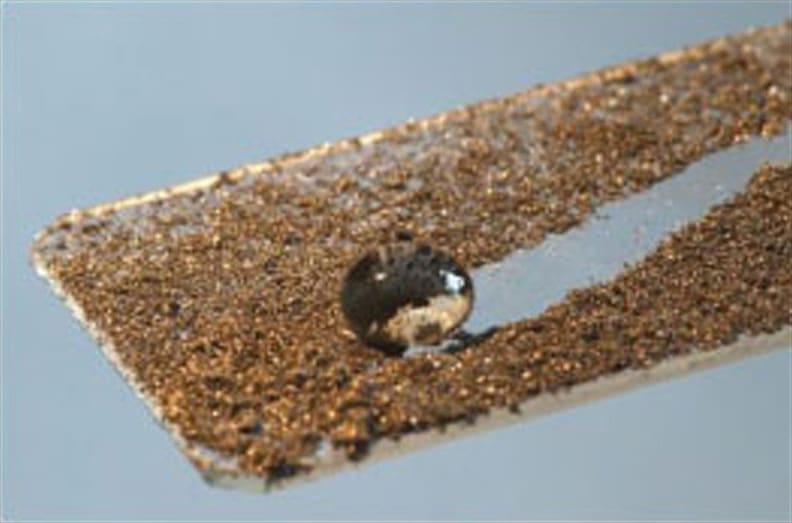
A material is said to be superhydrophobic if the equilibrium contact angle of a water droplet is greater than 150 degrees and the contact hysteresis angle is less than 10 degrees. The idea of extending superhydrophobic properties to a range of materials was first inspired by observing the water repelling and self-cleaning effects of the lotus leaf and a number of other leaves found in nature. Due to the large contact angle, the water droplets center of mass is moved further above the surface causing the droplets to have a rolling action rather than a sliding action. This, combined with the more uniform surface tension of spherical geometry, allows particles to become trapped in the droplet and carried away as seen in Figure 1.

Another important parameter of the superhydrophobic condition, and the primary area of focus for this study, comes from understanding how, in the Cassie state, a material can attain large enough contact angles to be considered superhydrophobic. When looking at the microscale roughness of a surface, if the distance between peaks is such that the static pressure of the water is not capable of overcoming the surface tension of the droplet, the valley will not become wetted. This results in an air-water interface at the material surface.
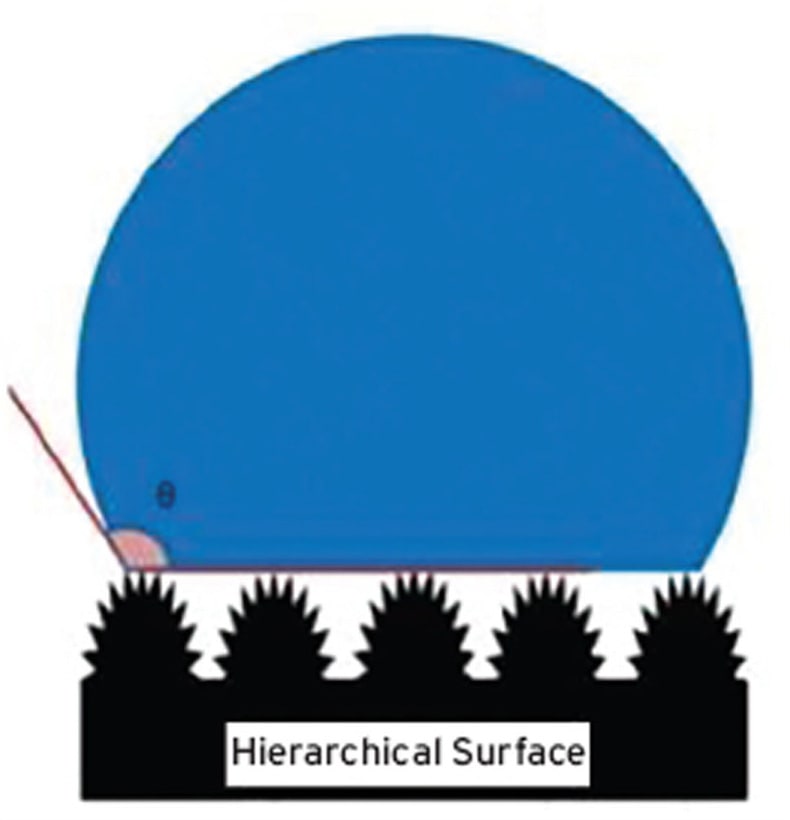
It can be seen from Figure 2, that in the Cassie state the equilibrium contact angle is a result of the proportion to the air-water interface. Revisiting the Lotus leaf effect, when the microscale peaks are combined with nanoscale features, a hierarchical structure is created and the Cassie state is improved by increasing the proportion of the air-water interface and thus increasing the equilibrium contact angle, thereby creating a surface that is near perfectly superhydrophobic, as seen in Figure 3. It is this air-water interface that is of particular interest to researchers and engineers, because of the potential to change fluid-surface interaction by the addition of an air film separation between the surface and the water, therefore altering the hydrodynamic properties.
This work was done by James R. Ley for the Naval Postgraduate School. NPS-0002
This Brief includes a Technical Support Package (TSP).
Hydrodynamic Drag Force Measurement of a Functionalized Surface Exhibiting Superhydrophobic Properties
(reference NPS-0002) is currently available for download from the TSP library.
Don't have an account?
More From SAE Media Group


Tech Briefs
VaCNT Makes Up a Promising Membrane Material
Medical Design Briefs
Simple Method Developed for 3D Biofabrication Based on Bacterial Cellulose


Tech Briefs
Corkscrew Filter Extracts Liquid from Air Charge

Medical Design Briefs
Adhesive Bonding of Plastics in Medical Devices, Part 2: Material Properties of Plastics
Tech Briefs
Engineers Develop New Shape-Memory Material
Aerospace & Defense Tech Briefs
Development of Hydrophobic Coatings for Water-Repellent Surfaces Using Hybrid Methodology


Aerospace & Defense Tech Briefs
Physics-Guided Neural Network for Regularization and Learning Unbalanced Data Sets

Tech Briefs
Color-Changing Dyes Visualize Stress in Plastics
Tech Briefs
A Precision Arm for Mini Robots
Aerospace & Defense Tech Briefs
Wettability Tests of Polymer Films and Fabrics
Motion Design INSIDER
Nimble Dimples: Agile Underwater Vehicles Inspired by Golf Balls
Aerospace & Defense Tech Briefs
Remanufacturing Reimagined: How Selective Electroplating Extends Service Life and Reduces the Cost of Aerospace Components
Aerospace & Defense Tech Briefs
High-Strain-Rate Tests of Epoxy/Aluminum-Powder Composites
Tech Briefs
Capillography of Mats of Nanofibers

Aerospace & Defense Tech Briefs
Reactive, Multifunctional, Micellar, Composite Nanoparticles for Destruction of Bio-Agents


Medical Design Briefs
Thermally Engineering Templates for Highly Ordered Self-Assembled Materials

Tech Briefs
Rubber Material Enables Scratch-Proof Surfaces
Overview
The document is a thesis authored by James R. Ley at the Naval Postgraduate School, completed in December 2016. It focuses on the development and analysis of superhydrophobic surfaces created through femto-second laser processing. The primary objective of the research is to investigate how these specially engineered surfaces can significantly reduce hydrodynamic drag forces when compared to untreated surfaces.
Superhydrophobic surfaces are characterized by their ability to repel water, which is achieved through specific micro- and nano-structuring that enhances their water-repellent properties. The thesis explores the mechanisms behind the creation of these surfaces using advanced laser techniques, which allow for precise control over the surface texture and chemical properties.
The research includes experimental studies that measure the drag reduction capabilities of the superhydrophobic surfaces in various fluid dynamics scenarios. The findings indicate that these surfaces can lead to substantial reductions in drag, which has significant implications for various applications, including marine vessels, pipelines, and other fluid transport systems. By minimizing drag, these surfaces can enhance energy efficiency and performance, leading to potential cost savings and improved operational effectiveness.
In addition to drag reduction, the thesis also addresses the durability of the superhydrophobic surfaces. It examines how these surfaces withstand environmental factors and mechanical wear over time, which is crucial for their practical application in real-world scenarios. The study provides insights into the longevity and reliability of the laser-processed surfaces, ensuring that they maintain their hydrophobic properties under operational conditions.
Overall, Ley's thesis contributes to the understanding of superhydrophobic technology and its potential applications in reducing drag in fluid systems. The research highlights the innovative use of femto-second laser processing as a viable method for creating durable and effective superhydrophobic surfaces, paving the way for future advancements in material science and engineering. The findings underscore the importance of continued exploration in this field to harness the benefits of superhydrophobicity for various industrial applications.
Top Stories
INSIDERManufacturing & Prototyping
 How Airbus is Using w-DED to 3D Print Larger Titanium Airplane Parts
INSIDERManned Systems
 FAA to Replace Aging Network of Ground-Based Radars
NewsTransportation
 CES 2026: Bosch is Ready to Bring AI to Your (Likely ICE-powered) Vehicle
NewsSoftware
 Accelerating Down the Road to Autonomy
EditorialDesign
 DarkSky One Wants to Make the World a Darker Place
INSIDERMaterials
 Can This Self-Healing Composite Make Airplane and Spacecraft Components Last...
Webcasts
Defense
 How Sift's Unified Observability Platform Accelerates Drone Innovation
Automotive
 E/E Architecture Redefined: Building Smarter, Safer, and Scalable...
Power
 Hydrogen Engines Are Heating Up for Heavy Duty
Electronics & Computers
 Advantages of Smart Power Distribution Unit Design for Automotive...
Unmanned Systems
 Quiet, Please: NVH Improvement Opportunities in the Early Design...
