




Army 3-D Prints a Building

The Construction Engineering Research Laboratory in Champaign, Illinois, has successfully three-dimensionally printed a 512 square-foot concrete structure. The structure, called a barracks hut or B-Hut, was printed as a result of a three-year Army Program called the "Automated Construction of Expeditionary Structures." It uses an additive manufacturing process to "print" semi-permanent structures in a theater of operation. The ability to use concrete sourced from readily available materials reduces logistical requirements for the U.S. Army.
"ACES provides a capability to print custom-designed expeditionary structures on-demand, in the field, using locally available materials. ACES will allow the Army to print buildings and other required infrastructure, such as barriers, culverts and obstacles on location," said Dr. Michael Case, CERL ACES program manager.
ACES has the potential to reduce building materials shipped by half and reduce construction manpower requirements by 62 percent when compared to expedient plywood construction.
CERL has also teamed with NASA to make ACES technology more mobile. NASA designed and built a dry goods delivery batching system that was used to print the B-Hut. CERL is currently working with NASA to design, build and test a third-generation concrete printer that will be delivered in September 2017. NASA plans to explore additive construction of extraterrestrial infrastructure in the future.
ERDC has also established a Cooperative Research and Development Agreement with Caterpillar Inc. to explore commercialization of ACES technology, with the potential application for disaster relief operations and conventional construction.
More From SAE Media Group

Tech Briefs
Rising Star Awards 2025 Judges
Aerospace Manufacturing and Machining INSIDER
3D Printing in Combat Zones: A Paradigm Shift for Marine Corps Logistics
Aerospace & Defense Tech Briefs
Industry Invited to Participate in AeroTech Aerospace and Defense Technical Program
Aerospace INSIDER
Advancing Metal Alloy Systems and Processes for Defense Manufacturing
Tech Briefs
RISING STAR AWARDS 2024

Tech Briefs
Regolith-Polymer 3D Printing
Aerospace & Defense Tech Briefs
AIA Predicts Flying Air Taxis, Supersonic Air Travel, and Space Industry for 2050
Aerospace & Defense Tech Briefs
NASA to Establish New Space Technology Research Institutes
Aerospace & Defense Tech Briefs
Lockheed Martin and Arconic Collaborate on 3D Printing and Advanced Aerospace Materials

Tech Briefs
2016 Create the Future Design Contest
Aerospace Manufacturing and Machining INSIDER
Meeting the Demands of Defense Production and Sustainment Through Additive Manufacturing
Aerospace & Defense Tech Briefs
Robotic Rotational Molding Creates New Opportunities for Military and Aerospace Applications
Defense INSIDER
3D-Printed Temporary Use Parts Reduce Downtime for Army Vehicles
Off-Highway Engineering
Additive Manufacturing Is Transforming Mobility Engineering, Driving the Factory of the Future
Aerospace & Defense Tech Briefs
SAE International Issues, Revises Technical Reports for Aerospace Engineering
Aerospace & Defense Tech Briefs
Autonomous Navigation Kits
NASA Spinoff
Super Insulation Requires Super Materials
Aerospace & Defense Tech Briefs
NASA Invites Proposal from Space-Based Large-Scale 3D-Printing Company

Aerospace & Defense Tech Briefs
Portable 3D Printing Factory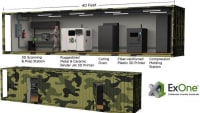
Aerospace & Defense Tech Briefs
Orbex Debuts Innovative Smallsat Launch Vehicle


Off-Highway Engineering
NASA High-Temp Materials, Coatings Enhance Commercial Products
Top Stories
INSIDERManufacturing & Prototyping
 How Airbus is Using w-DED to 3D Print Larger Titanium Airplane Parts
INSIDERManned Systems
 FAA to Replace Aging Network of Ground-Based Radars
NewsTransportation
 CES 2026: Bosch is Ready to Bring AI to Your (Likely ICE-powered) Vehicle
NewsSoftware
 Accelerating Down the Road to Autonomy
EditorialDesign
 DarkSky One Wants to Make the World a Darker Place
INSIDERMaterials
 Can This Self-Healing Composite Make Airplane and Spacecraft Components Last...
Webcasts
Defense
 How Sift's Unified Observability Platform Accelerates Drone Innovation
Automotive
 E/E Architecture Redefined: Building Smarter, Safer, and Scalable...
Power
 Hydrogen Engines Are Heating Up for Heavy Duty
Electronics & Computers
 Advantages of Smart Power Distribution Unit Design for Automotive...
Unmanned Systems
 Quiet, Please: NVH Improvement Opportunities in the Early Design...
