




High Energy Computed Tomographic Inspection of Munitions
Inspection system provides additional level of quality assurance for R&D, reverse engineering, and malfunction investigations.
An advance computed tomography (CT) system was recently built for the U.S. Army Armament Research, Development and Engineering Center, Picatinny Arsenal, NJ, for the inspection of munitions. The system is a charged coupled device (CCD) camera based CT system designated with the name “experimental Imaging Media” (XIM). The design incorporated shielding for use up to 4MeV x-ray photons and integrated two separate cameras into one single field of view (FOV). Other major distinguishing characteristics include its processing functions to digitally piece the two cameras together, use of advanced artifact reduction principles, performing reconstruction simultaneously during acquisition, and its development in accurate beam hardening corrections through digital means.
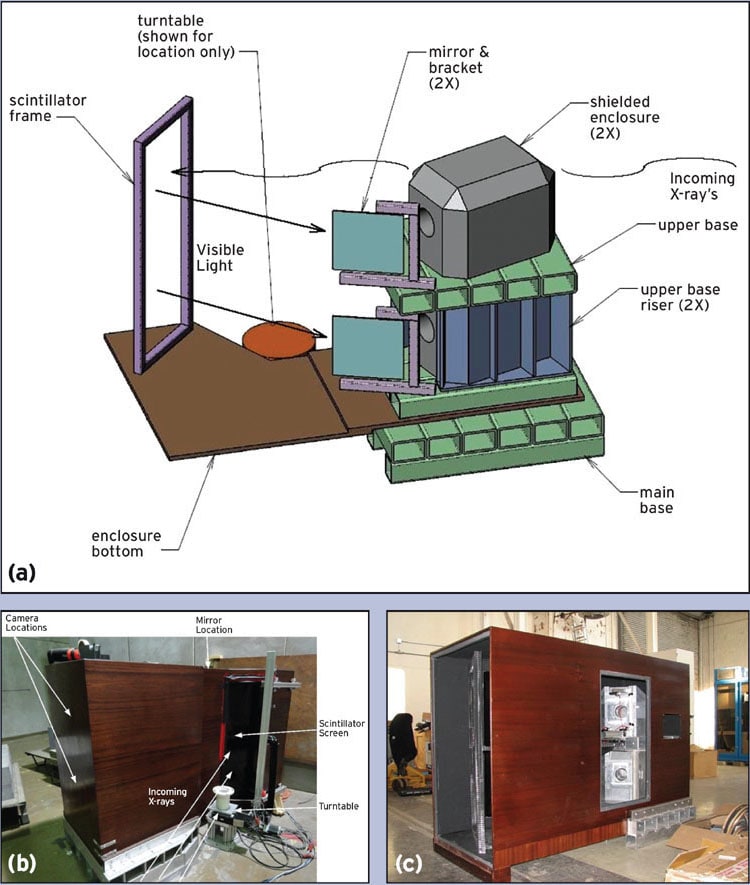
The overall setup of the system, as shown, depicts the internal layout of the cameras, shielding, scintillation screen, and rotational fixture. The general layout is comparative to a common 16-bit CCD camera radiographic imaging system. The x-ray photons pass through the inspection piece and impinge onto a scintillation/phosphor screen where the energy is converted into visible light. From there, the light is redirected off a series of mirrors that allow the cameras to be out of the direct line of sight of the main radiation beam. The light is then focused through the camera lens and into a cooled CCD chip.
At this point, the information is converted and digitized into a radiographic image. This process is repeated for multiple planes/projections as the part is rotated, acquired, and rotated again until enough information is obtained to achieve a volumetric file with a specified resolution. Figure 1a is the internal drawing of the XIM, Figure 1b is a photograph of the layout of the XIM CT system, and Figure 1c is a photograph of the shielded camera housing inside the XIM CT system.
The radiation source matched with the XIM is a Varian M3A dual energy linear accelerator (LINAC) with a 1.2MeV and 3MeV setting. For the purposes of this research, all of the imaging was performed at 3MeV. This was mainly a result of a lower dose rate produced by the accelerator, a loss in conversion efficiency, lower phosphorescence of the conversion screen, and an overall reduction in the signal received by the cameras at 1.2MeV. This issue could have been adjusted for by reducing the source to detector distance (SDD), but to sustain consistent spatial relationships, a fixed SDD was used.
The overall techniques used within this discussion were performed using 360-degree rotation, a SDD of 162.4 in. (4.1 m), a fixed spot size of roughly 2 mm in diameter, and a source to object distance of 152.7 in. (3.9 m). The useable FOV, collimation, exposure/pulse settings, and the positioning of the inspection piece in relation to the floor were optimized as needed in relation to the part under investigation. The achieved spatial resolution ranged from 0.033 in. (0.883 mm) to 0.011 in. (0.279 mm). The number of pixels for each camera was more than 4008 length by 2672 width. The limitation on the resolution was primarily a factor of the final file size of the volume reconstruction and not a general limitation of the imaging portion of the system. The images were acquired with 540 to 720 projections and varied with the use-able FOV to sustain a consistent volume size to prevent processing issues related to the use of a central processing unit based computer.
This work was done by Stephan C. Zuber of Army ARDEC, ESIC Quality Engineering & System Assurance Directorate (QESA). ARL-0202
This Brief includes a Technical Support Package (TSP).
HIGH ENERGY COMPUTED TOMOGRAPHIC INSPECTION OF MUNITIONS
(reference ARL-0202) is currently available for download from the TSP library.
Don't have an account?
More From SAE Media Group
Aerospace & Defense Tech Briefs
CAT Scanner Provides 3D View Inside Nuclear Weapon Components
Tech Briefs
Using Neural Networks for Faster X-Ray Imaging
Photonics & Imaging Technology
Researchers Use Inkjet Printing to Make a Portable Multispectral 3D Camera


Photonics & Imaging Technology
INRS Researchers Design the World’s Fastest UV Camera
Photonics & Imaging Technology
Lunar Lens: First Compact Flat Metalens Images Moon Surface

Photonics & Imaging Technology
Need for Larger Space Telescope Inspires Lightweight Flexible Holographic Lens
Tech Briefs
Plenoptic Camera
Photonics & Imaging Technology
Sussex Researchers Combine Lasers, Computers & THz Waves to Build Camera That Sees ‘Unseen’ Details
Photonics & Imaging Technology
Visualizing Value at the Speed of Light

Photonics & Imaging Technology
Tackling Aircraft Laser Strikes from the Ground
Aerospace & Defense Tech Briefs
Spatial Calibration for Accurate Long Distance Measurement Using Infrared Cameras
Tech Briefs
3D X-Ray Imager for 3D Object Retrieval
Tech Briefs
Sub-Pixel Spatial Resolution Interferometry
Photonics & Imaging Technology
Thermal Imaging: How Does It Work?
Photonics & Imaging Technology
T-Ray Camera Speed Boosted a Hundred Times Over
Aerospace & Defense Tech Briefs
Nominal High-Altitude Electromagnetic Pulse (HEMP) Waveforms
Aerospace & Defense Tech Briefs
Integration of Adaptive Optics Into High-Energy Laser Modeling And Simulation
Photonics & Imaging Technology
Designing Advanced IR Optical Assemblies for UAVs
Photonics & Imaging Technology
Sharper Images: A Breakthrough in Microscopy Resolution
Photonics & Imaging Technology
2021 OEM Photonics & Imaging Directory
Aerospace & Defense Tech Briefs
Spatial Resolution and Contrast of a Focused Diffractive Plenoptic Camera
Aerospace & Defense Tech Briefs
Beam Propagation Model Selection for Millimeter-Wave Directed Energy Weapons
Photonics & Imaging Technology
Sandia’s Nanoantennas Help Detectors See More Heat, Less Noise
Photonics & Imaging Technology
Unlocking the Gate to the Millisecond CT

Overview
The document is a technical overview focused on the application of advanced computed tomography (CT) for inspecting munitions and weapon systems. It highlights the unique advantages of using CT technology in quality assurance processes, particularly during research and development phases, reverse engineering, and malfunction investigations. While CT may not support full-rate production throughput, its ability to provide detailed insights into the internal structures of components is unparalleled, making it a valuable tool for the Department of Defense.
The report emphasizes that CT can enhance the reliability and effectiveness of end products by ensuring that they function correctly. This is particularly crucial in the context of munitions, where safety and performance are paramount. The document outlines the technical capabilities of CT, including its high-resolution imaging and the ability to detect defects that may not be visible through traditional inspection methods.
Additionally, the report discusses the implications of using CT for the U.S. Army and other defense entities, suggesting that the integration of this technology can lead to improved safety standards and operational readiness. The findings presented in the report are based on research conducted by the U.S. Army Armament Research, Development and Engineering Center, and they reflect the ongoing efforts to enhance inspection methodologies within the military.
The document also includes disclaimers regarding the views and opinions expressed, clarifying that they do not necessarily represent official positions of the Department of the Army. It underscores the importance of safeguarding the information contained within the report to prevent unauthorized disclosure.
In summary, this technical overview serves as a comprehensive guide to the benefits and applications of advanced CT in the inspection of munitions, highlighting its role in ensuring quality and safety in defense operations. The insights provided are intended to inform stakeholders about the potential of CT technology to improve inspection processes and contribute to the overall effectiveness of military systems.
Top Stories
NewsRF & Microwave Electronics
 Microvision Aquires Luminar, Plans Relationship Restoration, Multi-industry Push
INSIDERAerospace
 A Next Generation Helmet System for Navy Pilots
INSIDERDesign
 New Raytheon and Lockheed Martin Agreements Expand Missile Defense Production
INSIDERMaterials
 How Airbus is Using w-DED to 3D Print Larger Titanium Airplane Parts
NewsPower
 Ford Announces 48-Volt Architecture for Future Electric Truck
ArticlesAR/AI

Webcasts
Electronics & Computers
 Cooling a New Generation of Aerospace and Defense Embedded...
Automotive
 Battery Abuse Testing: Pushing to Failure
Power
 A FREE Two-Day Event Dedicated to Connected Mobility
Unmanned Systems
 Quiet, Please: NVH Improvement Opportunities in the Early Design Cycle
Automotive
 Advantages of Smart Power Distribution Unit Design for Automotive &...
Energy
 Sesame Solar's Nanogrid Tech Promises Major Gains in Drone Endurance