




New Battery Shuts Down at High Temps, Restarts When Cool
Stanford researchers have developed the first lithium-ion battery that shuts down before overheating, then restarts immediately when the temperature cools. The new technology could prevent the kind of fires that have prompted recalls and bans on a wide range of battery-powered devices, from recliners and computers to navigation systems and hoverboards.

"People have tried different strategies to solve the problem of accidental fires in lithium-ion batteries," said Zhenan Bao, a professor of chemical engineering at Stanford. "We've designed the first battery that can be shut down and revived over repeated heating and cooling cycles without compromising performance."
A typical lithium-ion battery consists of two electrodes and a liquid or gel electrolyte that carries charged particles between them. Puncturing, shorting or overcharging the battery generates heat. If the temperature reaches about 300 degrees Fahrenheit (150 degrees Celsius), the electrolyte could catch fire and trigger an explosion. Several techniques have been used to prevent battery fires, such as adding flame retardants to the electrolyte. In 2014, Stanford engineer Yi Cui created a "smart" battery that provides ample warning before it gets too hot.
"Unfortunately, these techniques are irreversible, so the battery is no longer functional after it overheats," said researcher Yi Cui, an associate professor of materials science and engineering and of photon science. "Clearly, in spite of the many efforts made thus far, battery safety remains an important concern and requires a new approach."
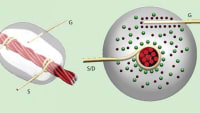
To address the problem Cui, chemical engineering professor Zhenan Bao, and postdoctoral scholar Zheng Chen turned to nanotechnology. Bao recently invented a wearable sensor to monitor human body temperature. The sensor is made of a plastic material embedded with tiny particles of nickel with nanoscale spikes protruding from their surface. For the battery experiment, the researchers coated the spiky nickel particles with graphene, an atom-thick layer of carbon, and embedded the particles in a thin film of elastic polyethylene.
"We attached the polyethylene film to one of the battery electrodes so that an electric current could flow through it," said Chen. "To conduct electricity, the spiky particles have to physically touch one another. But during thermal expansion, polyethylene stretches. That causes the particles to spread apart, making the film nonconductive so that electricity can no longer flow through the battery."
When the researchers heated the battery above 160° F (70° C), the polyethylene film quickly expanded like a balloon, causing the spiky particles to separate and the battery to shut down. But when the temperature dropped back down to 160° F (70° C), the polyethylene shrunk, the particles came back into contact, and the battery started generating electricity again.
"We can even tune the temperature higher or lower depending on how many particles we put in or what type of polymer materials we choose," said Bao. "For example, we might want the battery to shut down at 50° C or 100° C."
To test the stability of the new material, the researchers repeatedly applied heat to the battery with a hot-air gun. Each time, the battery shut down when it got too hot and quickly resumed operating when the temperature cooled.
More From SAE Media Group




Electronics & Sensors INSIDER
Researchers Develop Recyclable, Healable Electronics
Battery Technology
Low-Cost, Fast Production of Solid-State Batteries

Tech Briefs
Longer-Lasting, Recyclable Phone Batteries
Battery Technology
Tough, Solid Electrolyte Battery Component
Battery Technology
Flexible, Thin-Film Battery
Electronics & Sensors INSIDER
Researchers Devise Efficient, Scalable Process for Fabricating MXene Films That Block Electromagnetic Interference
Tech Briefs
Chip Converts Wasted Heat to Usable Energy
Embedded Technology INSIDER
Self-Healing Sensor Brings ‘Electronic Skin’ Closer to Reality

Aerospace & Defense Tech Briefs
Evaluation of the Effects of Hydrogen Peroxide on Common Aircraft Electrical Materials

Embedded Technology INSIDER
New Supercapacitor Could Make Structural Energy Storage A Reality
Tech Briefs
Integrating Fragile 2D Materials into Devices


Embedded Computing INSIDER
Unique Composite Film Could Become Hard Disc of the Future
Battery Technology
3D-Printed Biodegradable Battery
Tech Briefs
Printed Electronics: The Future Is Flexible

Embedded Technology INSIDER
New Thermal Conductivity Technique Could Cool Computer Chips
Tech Briefs
Cell-Sized Robots Sense Their Environment
Battery Technology
New Approach Makes Lighter, Safer Lithium-Ion Batteries
Battery Technology
Multipurpose Batteries Make it Easier to Get Around on Mars
Top Stories
INSIDERDesign
 How Airbus is Using w-DED to 3D Print Larger Titanium Airplane Parts
NewsSensors/Data Acquisition
 Microvision Aquires Luminar, Plans Relationship Restoration, Multi-industry Push
INSIDERManned Systems
 A Next Generation Helmet System for Navy Pilots
NewsAR/AI
 Accelerating Down the Road to Autonomy
INSIDERDefense
 New Raytheon and Lockheed Martin Agreements Expand Missile Defense Production
ArticlesAR/AI
 CES 2026: Bosch is Ready to Bring AI to Your (Likely ICE-powered) Vehicle
Webcasts
Semiconductors & ICs
 Advantages of Smart Power Distribution Unit Design for Automotive...
Unmanned Systems
 Quiet, Please: NVH Improvement Opportunities in the Early Design...
Electronics & Computers
 Cooling a New Generation of Aerospace and Defense Embedded...
Automotive
 Battery Abuse Testing: Pushing to Failure
Transportation
 A FREE Two-Day Event Dedicated to Connected Mobility
