




Quantum Radar Detects “Invisible” Objects
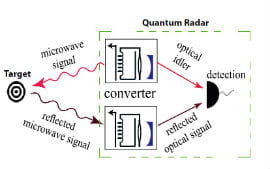 A prototype quantum radar has the potential to detect objects that are invisible to conventional systems. The new breed of radar is a hybrid system that uses quantum correlation between microwave and optical beams to detect objects of low reflectivity, such as cancer cells or aircraft, with a stealth capability. Because the quantum radar operates at much lower energies than conventional systems, it has the long-term potential for a range of applications in biomedicine including non-invasive NMR scans.
A conventional radar antenna emits a microwave to scan a region of space. Any target object would reflect the signal to the source, but objects of low reflectivity immersed in regions with high background noise are difficult to spot using classical radar systems. In contrast, quantum radars operate more effectively and exploit quantum entanglement to enhance their sensitivity to detect small signal reflections from very noisy regions.
The radar could be operated at short distances to detect the presence of defects in biological samples or human tissues in a completely non-invasive fashion, thanks to the use of a low number of quantum-correlated photons.
Source :
More From SAE Media Group
Aerospace & Defense Tech Briefs
Pathfinder Radar ISR and SAR Systems: Tactical Eyes for the Warfighter

Aerospace & Defense Tech Briefs
Detection with Quantum Radar
Tech Briefs
Micro-Mirror Optical Tracking and Ranging System
Tech Briefs
Products of Tomorrow
Aerospace INSIDER
Flexible Skin Traps Radar Waves and Cloaks Objects
Tech Briefs
Sensitive Optical Receivers for Space
Aerospace & Defense Tech Briefs
Photonic Microwave Generation Using On-Chip Optical Frequency Combs
Aerospace & Defense Tech Briefs
Nonlinear Effects in Transformation Optics-Based Metamaterial Shields for Counter Directed Energy Weapon Defense
Robotics & Automation INSIDER
Smallest Walking Robot Makes Microscale Measurements
Photonics & Imaging Technology INSIDER
Researchers 3D Print Metamaterials with Novel Optical Properties

Medical Design Briefs
Self-Cleaning Optical Fiber Can Help in Diagnosing Cancer, Monitoring Environment

Medical Design Briefs
Optimizing Illumination for qPCR Diagnostics — Design Considerations

Medical Design Briefs
Tiny Chip-Based Device Performs Ultrafast Modulation of X-Rays
Tech Briefs
Making Measurements with a Fine-Toothed Comb

Tech Briefs
Product of the Month

Medical Design Briefs
Optical Design Considerations for Additive Manufacturing
Tech Briefs
Multiplexed Optical Antennas
Tech Briefs
How Metasurfaces Can Act as Quantum Upgrades
Electronics & Sensors INSIDER
Manufacturing the World's Tiniest Light-Emitting Diodes
Photonics & Imaging Technology
Need for Larger Space Telescope Inspires Lightweight Flexible Holographic Lens
Photonics & Imaging Technology
Tackling Aircraft Laser Strikes from the Ground
Tech Briefs
Pseudo-Random Coding Technique for 3D Imaging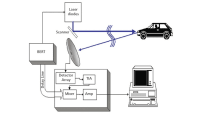
Photonics & Imaging Technology INSIDER
Thin Device Triggers One of Quantum Mechanics’ Strangest Phenomena
Top Stories
INSIDERMaterials
 How Airbus is Using w-DED to 3D Print Larger Titanium Airplane Parts
INSIDERAerospace
 FAA to Replace Aging Network of Ground-Based Radars
NewsUnmanned Systems
 CES 2026: Bosch is Ready to Bring AI to Your (Likely ICE-powered) Vehicle
NewsSoftware
 Rewriting the Engineer’s Playbook: What OEMs Must Do to Spin the AI Flywheel
Road ReadyTransportation
 2026 Toyota RAV4 Review: All Hybrid, All the Time
NewsSoftware

Webcasts
Automotive
 E/E Architecture Redefined: Building Smarter, Safer, and Scalable...
Transportation
 Hydrogen Engines Are Heating Up for Heavy Duty
Automotive
 Advantages of Smart Power Distribution Unit Design for Automotive...
Automotive
 Quiet, Please: NVH Improvement Opportunities in the Early Design...
Power
 A FREE Two-Day Event Dedicated to Connected Mobility
Power
 Powering America’s EV Future: Connect, Collaborate, Innovate