




Foldable Material Can Support Many Times its Weight
Researchers at Drexel University and Dalian University of Technology in China have chemically engineered a new, electrically conductive nanomaterial that is flexible enough to fold, but strong enough to support many times its own weight. They believe it can be used to improve electrical energy storage, water filtration, and radio frequency shielding in technology from portable electronics to coaxial cables.
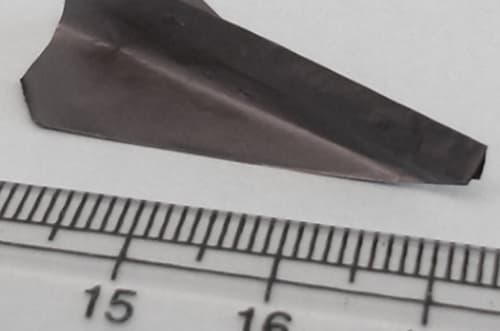
This flexible new material, which is a conductive polymer nanocomposite, is one of a family of composite two-dimensional materials called MXenes. Since inventing the layered carbide material in 2011, the engineers are finding ways to take advantage of its chemical and physical makeup to create conductive materials with a variety of other useful properties.
Because the material is extremely flexible, it can be rolled into a tube, which early tests have indicated only serves to increase its mechanical strength. These characteristics enable applications from flexible armor to aerospace components.
Source :
More From SAE Media Group
Tech Briefs
Foldable Solar Cells

Power Electronics INSIDER
Carbon Nanotubes Store Energy
Electronics & Sensors INSIDER
Powerful Family of Two-Dimensional Materials
Electronics & Sensors INSIDER
Researchers Demonstrate a High-Speed Electrical Readout Method for Graphene Nanodevices
Power Management INSIDER
Nanomaterial Could Speed Up Electric Vehicle Charging


Power Management INSIDER
Inexpensive Tin Packs a Big Punch for the Future of Supercapacitors
Power Electronics INSIDER
Scalable Supercapacitor Technology Made from Graphene
Medical Design Briefs
3D Printable Polymer Nanocomposite Ink
Battery Technology
Tough, Solid Electrolyte Battery Component
Tech Briefs
Woven Nanotube Fibers Turn Heat into Power

Battery Technology
Stretchable Micro-Supercapacitors Self-Power Wearable Devices
Power Electronics INSIDER
Wearable Device Makes Memories and Powers Up with The Flex of a Finger


Tech Briefs
How MXenes Can Improve Air Filtration




Tech Briefs
Technique Creates Adaptive Materials
Power Management INSIDER
Faster, More Efficient Energy Storage From Layered Materials
Battery & Electrification Technology
High-Performance MXene Electrodes for Next-Generation Battery
Tech Briefs
Products of Tomorrow

Top Stories
INSIDERManufacturing & Prototyping
 How Airbus is Using w-DED to 3D Print Larger Titanium Airplane Parts
INSIDERManned Systems
 FAA to Replace Aging Network of Ground-Based Radars
NewsTransportation
 CES 2026: Bosch is Ready to Bring AI to Your (Likely ICE-powered) Vehicle
NewsSoftware
 Accelerating Down the Road to Autonomy
EditorialDesign
 DarkSky One Wants to Make the World a Darker Place
INSIDERMaterials
 Can This Self-Healing Composite Make Airplane and Spacecraft Components Last...
Webcasts
Defense
 How Sift's Unified Observability Platform Accelerates Drone Innovation
Automotive
 E/E Architecture Redefined: Building Smarter, Safer, and Scalable...
Power
 Hydrogen Engines Are Heating Up for Heavy Duty
Electronics & Computers
 Advantages of Smart Power Distribution Unit Design for Automotive...
Unmanned Systems
 Quiet, Please: NVH Improvement Opportunities in the Early Design...
