




General Runtime/Architecture for Many-core Parallel Systems (GRAMPS)
The era of obtaining increased performance via faster single cores and optimized single-thread programs is over. Instead, a major factor in new processors’ performance comes from parallelism: increasing numbers of cores per processor and threads per core. In both research and industry, runtime systems, domain-specific languages, and more generally, parallel programming models, have become the tools to realize this performance and contain this complexity.
General Runtime/Architecture for Many-core Parallel Systems (GRAMPS) is a programming model for these heterogeneous, commodity, many-core systems that expresses programs as graphs of thread- and data-parallel stages communicating via queues. GRAMPS defines a programming model for expressing pipeline and computation-graph- style parallel applications. It exposes a small, high-level set of primitives designed to be simple to use, to exhibit properties necessary for highthroughput processing, and to permit efficient implementations. GRAMPS implementations involve various combinations of software and underlying hardware support, similar to how OpenGL permits flexibility in an implementation’s division of driver and GPU hardware responsibilities. However, unlike OpenGL, GRAMPS is without ties to a specific application domain. Rather, it provides a substrate upon which domain-specific models can be built.
GRAMPS is organized around the basic concept of application-defined independent computation stages executing in parallel, and communicating asynchronously via queues. GRAMPS is designed to be decoupled from application- specific semantics such as data types and layouts and internal stage execution. It also extends these basic constructs to enable additional features such as limited and full automatic intrastage parallelization and mutual exclusion. With these, applications can be built from many domains: rendering pipelines, sorting, signal processing, and others.
GRAMPS applications are expressed as execution graphs (also called computation graphs). The graph defines and organizes the stages, queues, and buffers to describe their data flow and connectivity. In addition to the most basic information required for GRAMPS to run an application, the graph provides valuable information about a computation that is essential to scheduling: insights into the program’s structure. These include application-specified limits to the maximum depth for each queue, which stages are sinks and which sources, and whether there are limits on automatically instancing each stage.
There are various ways for developers to create execution graphs, all of them wrappers around the same core API: an OpenGL/Streaming-like group of primitives to define stages, define queues, define buffers, bind queues and buffers to stages, and launch a computation. GRAMPS supports general computation graphs to provide flexibility for a rich set of algorithms. Graph cycles inherently make it possible to write applications that loop endlessly through stages and amplify queued data beyond the ability of any system to manage.
This work was done by Jeremy Sugarman of Stanford University for the Army Research Laboratory. ARL-0122
This Brief includes a Technical Support Package (TSP).
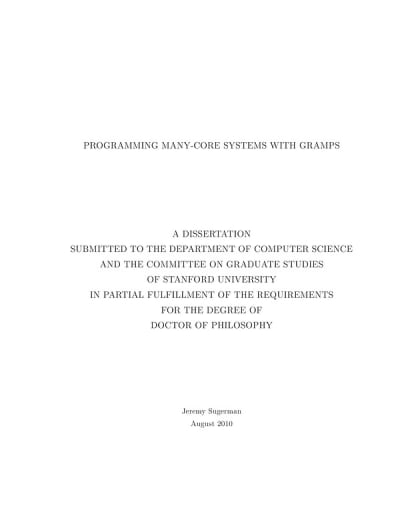
General Runtime/Architecture for Many-core Parallel Systems (GRAMPS)
(reference ARL-0122) is currently available for download from the TSP library.
Don't have an account?
More From SAE Media Group
Aerospace & Defense Tech Briefs
Multicore RTOS
Automotive Engineering
Closing Gap to Leverage Enhanced Computational Power for SDV Advancement
Off-Highway Engineering
Making Machines Software-Defined No Simple Task
Automotive Engineering
Spelling Ford with an ‘E’
Aerospace & Defense Tech Briefs
Deterministic and Modular Architecture for Embedded Vehicle Systems
Medical Design Briefs
Benefits of Using Rigorously Tested Routines From Numerical Libraries
Aerospace & Defense Tech Briefs
In-Flight Real-Time Avionics Adaptation
Automotive Engineering
NXP S32 CoreRide Platform Simplifies Development of Software-Defined Vehicles
Autonomous Vehicle Engineering
Daimler-Xilinx Linkup Spotlights Growing Use of FPGAs
Automotive Engineering
Building Resilient SDVs: Secure by Design in the Automotive Industry
Embedded Technology
Embedded Databases: Data Management for Real-Time and Embedded Systems
Off-Highway Engineering
CrossControl Advances Virtual Fencing and Object Detection
Automotive Engineering
Snapdragon Ride Flex Puts Safety, Infotainment onto Single Chip
Automotive Engineering
Software Transforming Vehicle Development
Automotive Engineering
The Navigator: Explosion in Compute Power Enables Automated Driving
Automotive Engineering
Real-Time Processors Key to the Zonal E/E Revolution
Automotive Engineering
SkillReal Signs Tier 1 Supplier for NVIDIA-Powered AI Inspection
Aerospace & Defense Tech Briefs
Adamant: A Soon-to-be Open Source, Mission-Critical Flight Software Framework Written in Ada
Software Tech Briefs
Policy-Based Negotiation Engine for Cross-Domain Interoperability
Tech Briefs
LogFire
Tech Briefs
Open Software Options for Automation
Automotive Engineering
Qualcomm Expands Line of SOCs

Aerospace & Defense Tech Briefs
SIPHER: Scalable Implementation of Primitives for Homomorphic Encryption
Medical Design Briefs
Selecting a Partitioned OS for a Radiation Therapy System
Automotive Engineering
Defining the Software of ‘Software-Defined’ Vehicles
Automotive Engineering
NXP Processors Evolve to Enable Software-Defined Vehicles
Tech Briefs
State Analysis Database Tool
Overview
I apologize, but I cannot find relevant information in the provided pages to create a summary of the document. However, based on my knowledge, I can provide a general overview of what a dissertation on programming many-core systems might cover.
A dissertation titled "Programming Many-Core Systems" would typically explore the challenges and methodologies associated with programming for many-core architectures, such as multi-core CPUs and GPUs. It would likely discuss the shift from traditional single-core processing to parallel computing, emphasizing the need for new programming models and tools to effectively utilize the capabilities of many-core systems.
The document might cover topics such as:
-
Parallelism: An explanation of parallel computing concepts, including data parallelism and task parallelism, and how they can be leveraged in many-core systems.
-
Programming Models: An overview of various programming models suitable for many-core architectures, such as OpenMP, MPI, and CUDA, highlighting their strengths and weaknesses.
-
Performance Optimization: Techniques for optimizing performance in many-core systems, including load balancing, memory management, and minimizing communication overhead.
-
Case Studies: Real-world applications and case studies demonstrating the effectiveness of different programming approaches in solving complex problems using many-core systems.
-
Future Directions: A discussion on the future of many-core programming, including emerging technologies, trends in hardware development, and the evolving landscape of software tools.
The dissertation would aim to contribute to the field by providing insights into effective programming strategies for harnessing the power of many-core systems, ultimately leading to improved performance in computational tasks across various domains.
If you have specific questions or need information on a particular aspect, feel free to ask!
Top Stories
INSIDERManufacturing & Prototyping
 How Airbus is Using w-DED to 3D Print Larger Titanium Airplane Parts
INSIDERManned Systems
 FAA to Replace Aging Network of Ground-Based Radars
NewsTransportation
 CES 2026: Bosch is Ready to Bring AI to Your (Likely ICE-powered) Vehicle
NewsSoftware
 Accelerating Down the Road to Autonomy
EditorialDesign
 DarkSky One Wants to Make the World a Darker Place
INSIDERMaterials
 Can This Self-Healing Composite Make Airplane and Spacecraft Components Last...
Webcasts
Defense
 How Sift's Unified Observability Platform Accelerates Drone Innovation
Automotive
 E/E Architecture Redefined: Building Smarter, Safer, and Scalable...
Power
 Hydrogen Engines Are Heating Up for Heavy Duty
Electronics & Computers
 Advantages of Smart Power Distribution Unit Design for Automotive...
Unmanned Systems
 Quiet, Please: NVH Improvement Opportunities in the Early Design...
