




Software Design for CFD Rotary-Wing Aeromechanics Modeling
Helios software solves many of the multidisciplinary physics problems associated with helicopter flight.
Helicopter flight involves many multidisciplinary physics problems that are difficult to predict with today’s engineering modeling and simulation tools. Rotor aerodynamic systems involve complex interactions among the rotor blades, rotor wakes, and fuselage, and they create challenges such as simultaneous modeling of rotating and nonrotating components; retreating-blade, low-speed dynamic stall; advancing-blade transonic flow; rotor “trim” requirements to balance aerodynamic and dynamic forces for particular control settings; and strong coupling between rotor-blade aerodynamics and rotor blade dynamics (both rigid and elastic blade motion).
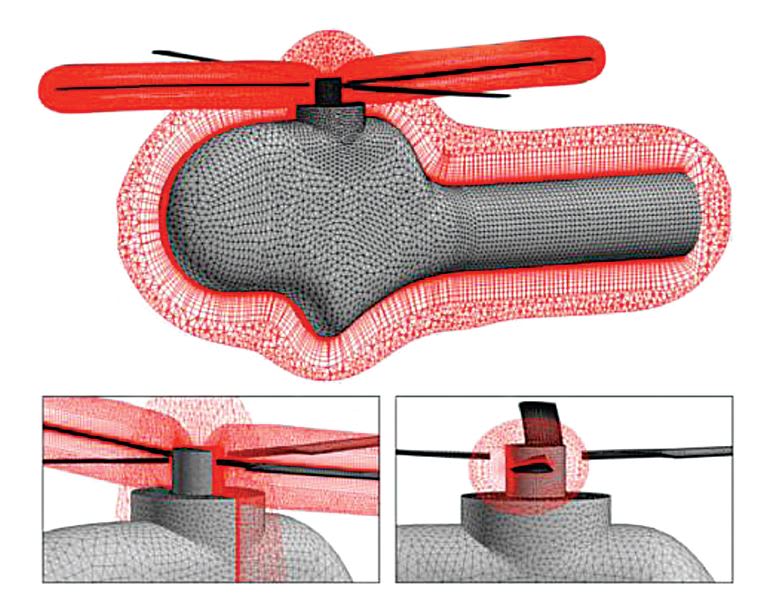
A software product called Helios has been developed for multi-disciplinary rotary-wing aeromechanics modeling. The Helios infrastructure links both new and existing software modules with little need for extensive code modifications. Data exchanges between software modules occur through a Python-based integration framework. This Python software framework is both object-oriented and scalable on large parallel computer systems.
A desirable alternative to traditional monolithic software development consists of a lightweight computational infrastructure that links together independent multidisciplinary software modules. This concept is not new, and a number of such infrastructures currently exist. They can generally be classified into two categories; high-level execution managers that coordinate the execution of standalone legacy codes, and low-level frameworks that provide a common data format and communication protocol from which the higher-level executable may be built.
Helios uses an intermediate-level software infrastructure that uses characteristics from both approaches. Like the highlevel execution managers, it links existing software modules with little need for extensive code modifications. However, instead of using file transfers for data exchanges between modules, data exchanges take place through a top-layer Python-language integration framework that is both object-oriented and scalable. The Python top layer facilitates data exchanges between individual multidisciplinary component software modules, and these data exchanges occur through direct memory access rather than file input and output (I/O). As such, the Helios Python framework provides simple data transfers among software component modules with sufficient granularity to ensure that groups of programmers can work independently on each of many multidisciplinary software component modules and then easily use Python to tie them together in order to create the final software product.
The Helios modeling approach solves the Reynolds-averaged Navier- Stokes (RANS) equations to discretize the aerodynamic flow field around a rotorcraft. These equations capture both the fluid dynamic forces on the vehicle plus the vortical rotor wake behavior beneath the rotor system. Helios uses two types of grid systems to capture these rotarywing aerodynamic effects. The “near-body” grids use body-fitted, triangular surface meshes to represent the solid surfaces on the rotor and fuselage. Such unstructured triangular grid systems are typically generated directly from digital computeraided design (CAD) models that represent the vehicle component surfaces.
Rotor structural dynamics and trim modeling is handled by the Rotorcraft Comprehensive Analysis System (RCAS). The Python-based software integration framework sends the rotor motions to the CFD solvers and then brings the corresponding rotor aerodynamics forces back to the computational structural dynamics model. At the end of a trimmed rotor computation, the aerodynamic forces on the rotor are consistent with the rotor dynamic motions and also with the pilot control inputs.
The success of the Helios software development effort is heavily dependent on the use of its lightweight Python infrastructure that connects individual component software modules using welldefined interfaces for each component software module.
This work was done by Roger C. Strawn of the Army Aeroflightdynamics Directorate. ARL-0151
This Brief includes a Technical Support Package (TSP).
Software Design for CFD Rotary-Wing Aeromechanics Modeling
(reference ARL-0151) is currently available for download from the TSP library.
Don't have an account?
More From SAE Media Group
Tech Briefs
Executive Roundtable: Cloud Software
Tech Briefs
Hacker-Resistant Cloud Software System
Motion Design
OPC UA Standard for Industrial Automation

Autonomous Vehicle Engineering
Foretellix Building Precise Software Language for Validating Self-Driving Scenarios
Tech Briefs
Product of the Month
Medical Design Briefs
New Products & Services
Tech Briefs
Data Transfer Service

Tech Briefs
Industry Update: Analysis & Simulation Software

Off-Highway Engineering
TE Connectivity Enhances Digital Platform with CT Data Analysis
Tech Briefs
Executive Forum: Machine Learning & AI
Aerospace & Defense Tech Briefs
In-Flight Real-Time Avionics Adaptation
Automotive Engineering
Software Transforming Vehicle Development
Sensor Technology
The Industrial Nervous System: IIoT and PLCs


Aerospace & Defense Tech Briefs
Data-Centric Distributed Application Architecture for Shipboard Systems
Aerospace INSIDER
The Future of Avionics: Machine-Learned and Certified
Motion Design INSIDER
Physics-Aware Neural Networks Improve Camera-Based Machines

Tech Briefs
Using AI to Track Professional Hockey Players
Tech Briefs
WiFi RSSI Sensor Tracker for the ISS
Electronics & Sensors INSIDER
New Transmitter Could Make Wireless Devices More Energy-Efficient
Robotics & Automation INSIDER
New Imaging Technique Reconstructs the Shapes of Hidden Objects

Overview
The document presents insights from the Seventh International Conference on Computational Fluid Dynamics (ICCFD7), focusing on the software design strategies employed in the US Army's Helios software, which addresses the complexities of rotary-wing aeromechanics. The paper highlights the challenges of creating accurate, efficient, and maintainable modeling and simulation software in this multidisciplinary field.
Helios is designed with a lightweight Python-language integration framework that facilitates the connection of various software components. This design strategy allows for the easy incorporation of alternative software components and the rapid introduction of new computational fluid dynamics (CFD) technologies. The framework promotes efficient data exchanges between modules through direct memory access rather than traditional file input/output methods, enhancing performance and scalability.
The document contrasts high-level and low-level software coupling approaches. High-level approaches require minimal changes to existing legacy codes but often suffer from inefficiencies and limited scalability due to file-based data exchanges. In contrast, low-level approaches allow for more integrated functionality but necessitate significant rewrites of software modules, which can complicate coordination among developers. Helios adopts an intermediate-level approach, combining the benefits of both strategies while minimizing the need for extensive code modifications.
The paper also discusses the importance of maintaining granularity in software components, enabling independent work by programming teams. This independence is crucial for managing the complexity of multidisciplinary simulations, as it allows for parallel development and integration of various software modules.
Additionally, the document provides examples of Helios simulations that demonstrate its capabilities in solving rotor dynamics and aerodynamics, as well as achieving high-resolution modeling of rotor wake systems. These simulations illustrate the practical applications of the software in real-world scenarios, showcasing its effectiveness in addressing the intricate challenges of rotary-wing aeromechanics.
Overall, the document emphasizes the innovative design strategies of Helios, which leverage modern programming practices to enhance the development and performance of multidisciplinary CFD software. By integrating various components seamlessly and allowing for rapid advancements in technology, Helios represents a significant step forward in the field of computational fluid dynamics.
Top Stories
INSIDERManufacturing & Prototyping
 How Airbus is Using w-DED to 3D Print Larger Titanium Airplane Parts
INSIDERManned Systems
 FAA to Replace Aging Network of Ground-Based Radars
NewsTransportation
 CES 2026: Bosch is Ready to Bring AI to Your (Likely ICE-powered) Vehicle
NewsSoftware
 Accelerating Down the Road to Autonomy
EditorialDesign
 DarkSky One Wants to Make the World a Darker Place
INSIDERMaterials
 Can This Self-Healing Composite Make Airplane and Spacecraft Components Last...
Webcasts
Defense
 How Sift's Unified Observability Platform Accelerates Drone Innovation
Automotive
 E/E Architecture Redefined: Building Smarter, Safer, and Scalable...
Power
 Hydrogen Engines Are Heating Up for Heavy Duty
Electronics & Computers
 Advantages of Smart Power Distribution Unit Design for Automotive...
Unmanned Systems
 Quiet, Please: NVH Improvement Opportunities in the Early Design...
