




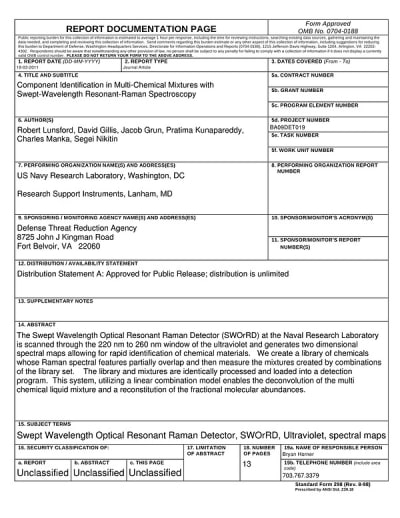
Component Identification in Multi-Chemical Mixtures with Swept-Wavelength Resonant-Raman Spectroscopy
Resonance Raman spectroscopy is used to detect and identify chemical, biological, and nuclear hazards.
The utilization of ultraviolet resonance Raman spectroscopy for the detection and identification of chemical, biological, and nuclear hazards is of great interest due to the sensitivity and specificity afforded by this technique. Detection by means of optical probing is a fast, non-contact method that requires little to no sample preparation and can be performed remotely by an operator. In addition, this method is also well suited for use by an automated monitor or a mobile autonomous system, such as an in-situ environmental detector or a sensorequipped unmanned vehicle. In addition, this technique offers the ability for a single detector to identify multiple species of targets. However, for Raman detection to become practicable as a forensic tool, the method must demonstrate the ability to distinguish the target elements while operating in a complex environment.
By employing a variable frequency laser source to illuminate the anylate, one can interrogate the molecules at a number of distinct wavelengths. The compilation of these single-wavelength illuminations generates a two-dimensional contour map of the functional form I = f(x,y) where x and y are the excitation wavelength and the Stokes Raman frequency shift, respectively.
In addition to the Raman peaks present in the single spectrum that provide information about the target compound’s molecular structure, the twodimensional signature also contains a record of the changes in the molecular resonance cross-sections as the sample responds to variations in the illuminating laser wavelength. This additional dimensionality should create a signal that is much more robust and therefore harder to confuse, resulting in better specificity. This is particularly important when utilizing the device in realistic environments containing multiple target materials and contaminants.
The Swept Wavelength Optical Resonant Raman Detector (SWOrRD) at the Naval Research Laboratory is a stimulated spectroscopy system capable of rapidly acquiring the spectral signatures of both solid and liquid samples over a large range of laser wavelengths. The uniqueness of the SWOrRD system is its ability to both scan over a large range of wavelengths as well as to selectively tune to wavelengths that overlap with the resonant energy bands of the target molecules. As it is impossible to completely determine a priori which wavelengths will be the most effective when attempting to detect a particular signal within a complex and rapidly changing environment, the operation of a system that is flexible in this regard holds distinct advantages over fixed wavelength systems.
In the work presented here, the twodimensional Raman signatures of selected chemicals are measured and then utilized to form a detection basis. These chemicals are then combined in various permutations so as to create unknown mixtures that are then likewise measured. Upon completion of the full experimental run, the raw spectra are Fourier-filtered to remove both high-frequency noise and baseline instrument contributions, and then recalibrated to compensate for power variation, sample absorption, wavelength drifts, system transmission, and detector responses. They are then assembled to obtain a single, multi-run spectrum that is treated as a single unit.
Utilizing a LabVIEW-based detection program, the components of the mixture are rapidly determined through an examination of the signal correlation between the unknown signature and those signatures stored in the chemical library. Once the mixture components have been identified, an estimation of the relative abundances of the tagged chemicals is undertaken by comparison of the functional distance between the unknown signal and a weighted linear superposition of the library elements.
Utilizing a fully contained mixture set, both the components and the possible mixture combinations of those components were measured in the ultraviolet range from 220-260 nm utilizing the SWOrRD spectroscopy system. Reliable identification of mixture components is possible, and a reasonable reconstruction of the fractional abundance of the constituent chemicals is possible while utilizing a linear mixture model.
This work was done by Robert Lunsford, David Gillis, and Jacob Grun of the Naval Research Laboratory; and Pratima Kunapareddy, Charles Manka, and Sergei Nikitin of Research Support Instruments. NRL-0051
This Brief includes a Technical Support Package (TSP).
Component Identification in Multi-Chemical Mixtures with Swept-Wavelength Resonant-Raman Spectroscopy
(reference NRL-0051) is currently available for download from the TSP library.
Don't have an account?
More From SAE Media Group
Aerospace & Defense Tech Briefs
Next-Generation Spectrometers for Rapid Analysis of Complex Mixtures
Photonics Tech Briefs
Low-Resolution Raman-Spectroscopy Combustion Thermometry

Aerospace & Defense Tech Briefs
Detecting Trace Levels of Explosives Using Vibrational Sum Frequency Spectroscopy
Photonics Tech Briefs
White-Light Whispering-Gallery-Mode Optical Resonators
Tech Briefs
Compact Microwave Fourier Spectrum Analyzer

Aerospace & Defense Tech Briefs
Detecting Explosives by Use of LIBS
Photonics & Imaging Technology
Ultra-Narrowband Optical Filters Pushing Boundaries from the UV to the LWIR


Tech Briefs
Broadband External-Cavity Diode Laser

Medical Design Briefs
Tunable Lasers Expand for Time-Resolved Spectroscopy


Tech Briefs
Surface-Enhanced X-Ray Fluorescence

Electronics Tech Briefs
Exploiting Ion/Atom Cold Collisions in Atomic Clocks
Photonics Tech Briefs
All-Reflective Computed-Tomography Imaging Spectrometers
Tech Briefs
Tunable, Narrow Linewidth, Chip-Scale Lasers
Photonics Tech Briefs
Hot Dielectrics as Light Sources for TPV Devices and Lasers

Tech Briefs
Improved Array of X-Ray Microcalorimeters
Photonics & Imaging Technology
New Frequency Comb Can Identify Molecules in 20-Nanosecond Snapshots
Photonics Tech Briefs
Instruments for Imaging From Far to Near

Photonics Tech Briefs
Integrated Miniature Arrays of Optical Biomolecule Detectors
Overview
The document presents research on the Swept Wavelength Optical Resonant Raman Detector (SWOrRD) developed at the Naval Research Laboratory. This advanced system is designed for the rapid identification of chemical materials by generating two-dimensional spectral maps in the ultraviolet range, specifically between 220 nm and 260 nm. The SWOrRD system utilizes a tunable laser and a coupled dual-stage spectrometer, allowing for the collection of Raman signatures from various chemicals.
The research involves creating a library of chemicals with overlapping Raman spectral features. These chemicals are then combined in various permutations to form unknown mixtures, which are subsequently measured using the SWOrRD system. The raw spectral data collected undergoes Fourier filtering to eliminate high-frequency noise and baseline instrument contributions. The data is then recalibrated to account for variations in power, sample absorption, wavelength drifts, and system responses, ultimately assembling a single multi-run spectrum for analysis.
A LabVIEW-based detection program is employed to determine the components of the mixtures by examining the correlation between the unknown signatures and those stored in the chemical library. This program also estimates the relative abundances of the chemicals in the mixtures by comparing the unknown signal to a weighted linear superposition of the library elements.
The document concludes that the SWOrRD system successfully identifies mixture components and reconstructs the fractional abundances of the constituent chemicals using a linear mixture model. The research highlights the potential for reliable identification of chemical mixtures, which is crucial for applications in defense and safety, particularly in addressing threats related to weapons of mass destruction (WMD).
The work is sponsored by the Defense Threat Reduction Agency (DTRA), which aims to safeguard the U.S. and its allies from WMD threats. The findings underscore the effectiveness of the SWOrRD system in chemical detection and the importance of continued research in this area to enhance capabilities in threat mitigation and response. Overall, the document illustrates significant advancements in spectroscopy and chemical analysis, contributing to improved safety and security measures.
Top Stories
INSIDERManufacturing & Prototyping
 How Airbus is Using w-DED to 3D Print Larger Titanium Airplane Parts
INSIDERManned Systems
 FAA to Replace Aging Network of Ground-Based Radars
NewsTransportation
 CES 2026: Bosch is Ready to Bring AI to Your (Likely ICE-powered) Vehicle
NewsSoftware
 Accelerating Down the Road to Autonomy
EditorialDesign
 DarkSky One Wants to Make the World a Darker Place
INSIDERMaterials
 Can This Self-Healing Composite Make Airplane and Spacecraft Components Last...
Webcasts
Defense
 How Sift's Unified Observability Platform Accelerates Drone Innovation
Automotive
 E/E Architecture Redefined: Building Smarter, Safer, and Scalable...
Power
 Hydrogen Engines Are Heating Up for Heavy Duty
Electronics & Computers
 Advantages of Smart Power Distribution Unit Design for Automotive...
Unmanned Systems
 Quiet, Please: NVH Improvement Opportunities in the Early Design...
