




Operation and On-Chip Integration of Cavity-QED-Based Detectors for Single Atoms and Molecules
This method helps in understanding quantum-limited measurements of the motion of a macroscopic mechanical object.
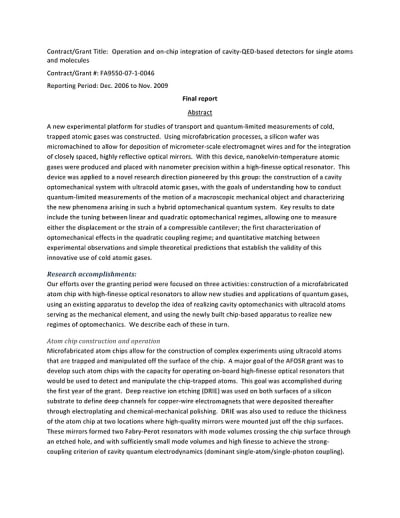
A new experimental platform for studies of transport and quantumlimited measurements of cold, trapped atomic gases was constructed. Using microfabrication processes, a silicon wafer was micromachined to allow for deposition of micrometer-scale electromagnet wires, and for the integration of closely spaced, highly reflective optical mirrors. With this device, nanokelvintemperature atomic gases were produced and placed with nanometer precision within a high-finesse optical resonator. This device was applied to the construction of a cavity optomechanical system with ultracold atomic gases, with the goals of understanding how to conduct quantum-limited measurements of the motion of a macroscopic mechanical object, and characterizing the new phenomena arising in such a hybrid optomechanical quantum system.
Key results include the tuning between linear and quadratic optomechanical regimes, allowing one to measure either the displacement or the strain of a compressible cantilever; the first characterization of optomechanical effects in the quadratic coupling regime; and quantitative matching between experimental observations and simple theoretical predictions that establish the validity of this use of cold atomic gases.
Work was focused on three activities: construction of a microfabricated atom chip with high-finesse optical resonators to allow new studies and applications of quantum gases; using an existing apparatus to develop the idea of realizing cavity optomechanics with ultracold atoms serving as the mechanical element; and using the newly built chip-based apparatus to realize new regimes of optomechanics.
Microfabricated atom chips allow for the construction of complex experiments using ultracold atoms that are trapped and manipulated off the surface of the chip. A major goal was to develop such atom chips with the capacity for operating onboard high-finesse optical resonators that would be used to detect and manipulate the chip-trapped atoms. Deep reactive ion etching (DRIE) was used on both surfaces of a silicon substrate to define deep channels for copper- wire electromagnets that were deposited thereafter through electroplating and chemical-mechanical polishing. DRIE was also used to reduce the thickness of the atom chip at two locations where high-quality mirrors were mounted just off the chip surfaces.
These mirrors formed two Fabry-Perot resonators with mode volumes crossing the chip surface through an etched hole, and with sufficiently small mode volumes and high finesse to achieve the strong coupling criterion of cavity quantum electrodynamics (dominant singleatom/ single-photon coupling).
The atom chip was mounted on a special vibration-isolated holder within an ultra-high-vacuum chamber. Extensive infrastructure was developed to enable experiments using ultracold atoms trapped on the chip; such infrastructure includes arrays of externally controlled current sources, a laser-optical system for laser cooling atoms within the chamber, a sophisticated laser system for stabilizing and probing the on-chip optical resonator, and imaging and data analysis systems. These subsystems were integrated to allow for cold atoms to be loaded onto the atom chip, transported from the loading region into the volume of the on-chip optical resonator, and delivered into an all-optical trap supported by the Fabry-Perot cavity.
During the construction of the atom chip apparatus, a second existing apparatus was used to develop the notion of using cold atoms for studies of cavity optomechanics. Cavity optomechanical systems are being developed on scales ranging from nanofabricated cantilevers and resonators to kilogramscale mirrors and kilometers-long interferometers used to search for gravity waves (LIGO). In such systems, the goal of achieving ever-better sensitivity to the motion of a macroscopic mechanical object has necessitated the understanding and control of quantum effects that ensue from the cavity and mechanical object forming a coupled quantum system.
Under several regimes of atomic confinement, the collective, spatially dependent coupling between resonant cavity photons and an atomic ensemble isolates a single mechanical degree of freedom of the ensemble to which the cavity is sensitive, and upon which the back-action forces of cavity photons act. The atomic ensemble thereby acts as a gas-phase analogue of the typically solidphase cantilevers used in cavity optomechanics experiments. The gas-based approach has the advantages of entering immediately into the quantum regime of mechanical motion, owing to the extremely low temperatures of the atomic gases, of being described ab initio from simple theories of quantum optics and atomic physics, and of allowing for a newly identified granular strong-coupling regime of cavity optomechanics for which the theory is poorly developed.
The atom chip developed in this work offers distinct advantages to the study of cavity optomechanics with ultracold atoms. The tight magnetic confinement provided by the atom chip wires allows atoms to be confined to micron-length scales, and to be positioned precisely within the volume of a Fabry-Perot optical resonator. Transferring these magnetically positioned atoms into a standing-wave optical trap supported by the Fabry-Perot cavity itself, one may place the atomic ensemble selectively between the nodes and antinodes of the cavity probe field. The consequence of such precise control for optomechanics is the ability to tune the optomechanical coupling parameters. At the nodes and antinodes of the probe field, the coupling between the atomic ensemble and the cavity field is such that the cavity response to atomic displacement is quadratic at lowest order; in contrast, between these locations, the response is dominantly linear.
This work was done by Dan M. Stamper-Kurn of the University of California, Berkeley, for the Air Force Office of Scientific Research. AFRL-0182
This Brief includes a Technical Support Package (TSP).
Operation and On-Chip Integration of Cavity-QED-Based Detectors for Single Atoms and Molecules
(reference AFRL-0182) is currently available for download from the TSP library.
Don't have an account?
More From SAE Media Group
Electronics Tech Briefs
Using Light To Fabricate Photonic Devices
Photonics & Imaging Technology
Optical Coatings Technology
Photonics & Imaging Technology INSIDER
Unique Nanodisk Holds Major Potential for Future of Photonic Research
Photonics & Imaging Technology
Continuous and Stable Lasing Achieved From Low-Cost Perovskites at Room Temperature
Tech Briefs
Building Quantum Computers of the Future
Photonics & Imaging Technology
Nanoscale Machines Convert Light into Work

Photonics & Imaging Technology
Overcoming Pitfalls When Measuring Thin, Parallel Optics
Photonics & Imaging Technology
Ultrafast Laser Micromachining
Aerospace & Defense Tech Briefs
3D Meta-Optics for High-Energy Lasers
Medical Design Briefs
Optical Design Considerations for Additive Manufacturing
Tech Briefs
Chip Measures Quantities with Quantum Precision

Tech Briefs
Technique Enables 3D Printing of Microstructures
Photonics & Imaging Technology
Shortwave Infrared Cameras for High-Temperature Manufacturing and R&D Processes


Photonics & Imaging Technology
Manufacturing Large Mirrors
Aerospace & Defense Tech Briefs
Silicon Microsphere Fabrication
Tech Briefs
Wavy Surfaces for Better Light Control
Photonics & Imaging Technology
Industrial Blue Lasers
Photonics & Imaging Technology
SPIE Photonics West 2022 Preview
Photonics & Imaging Technology
SPIE Photonics West 2023 Preview
Photonics & Imaging Technology
LLNL Finds Reason Behind Defects in 3D Printing
Photonics & Imaging Technology
Additive Manufacturing of Precision Optics at Micro and Nanoscale
Motion Design INSIDER
Microdrones With Light-Driven Nanomotors


Overview
The document presents the final report on a research project titled "Operation and on-chip integration of cavity-QED-based detectors for single atoms and molecules," conducted from December 2006 to November 2009. The primary focus of the project was to develop a novel experimental platform for studying transport and quantum-limited measurements of cold, trapped atomic gases.
The research team successfully constructed a microfabricated atom chip using advanced microfabrication processes, including deep reactive ion etching (DRIE). This chip was designed to integrate micrometer-scale electromagnet wires and closely spaced, highly reflective optical mirrors, allowing for the creation of high-finesse optical resonators. These resonators enabled the production of nanokelvin-temperature atomic gases, which could be precisely positioned within the resonator with nanometer accuracy.
A significant goal of the project was to establish a cavity optomechanical system utilizing ultracold atomic gases. This system aimed to enhance the understanding of quantum-limited measurements of macroscopic mechanical objects and to characterize new phenomena arising in hybrid optomechanical quantum systems. Key achievements included the ability to tune between linear and quadratic optomechanical regimes, facilitating measurements of either displacement or strain in a compressible cantilever. The project also marked the first characterization of optomechanical effects in the quadratic coupling regime, with experimental observations aligning closely with theoretical predictions, thereby validating the innovative application of cold atomic gases in this context.
Throughout the granting period, the research focus shifted slightly from measuring single chip-trapped atoms to exploring the collective properties of atomic ensembles. This change allowed for a broader understanding of the quantum behaviors exhibited by these systems.
The project was managed by the Air Force Office of Scientific Research (AFOSR), initially under Dr. Anne Matsuura and later by Dr. Tatjana Curcic. No extensions were granted, and no significant milestones were missed during the project timeline. The report concludes with an acknowledgment of the advancements made in the field of quantum metrology, force sensors, and cavity optomechanics, highlighting the potential applications of the developed technologies in future research and practical implementations.
Overall, the document encapsulates a significant step forward in the integration of quantum technologies, emphasizing the innovative use of ultracold atomic gases in advancing our understanding of quantum mechanics and optomechanical systems.
Top Stories
INSIDERAerospace
 How Airbus is Using w-DED to 3D Print Larger Titanium Airplane Parts
NewsUnmanned Systems
 Microvision Aquires Luminar, Plans Relationship Restoration, Multi-industry Push
INSIDERWearables
 A Next Generation Helmet System for Navy Pilots
ArticlesUnmanned Systems
 Accelerating Down the Road to Autonomy
INSIDERWeapons Systems
 New Raytheon and Lockheed Martin Agreements Expand Missile Defense Production
ArticlesDesign
 CES 2026: Bosch is Ready to Bring AI to Your (Likely ICE-powered) Vehicle
Webcasts
Electronics & Computers
 Advantages of Smart Power Distribution Unit Design for Automotive...
Unmanned Systems
 Quiet, Please: NVH Improvement Opportunities in the Early Design...
Electronics & Computers
 Cooling a New Generation of Aerospace and Defense Embedded...
Energy
 Battery Abuse Testing: Pushing to Failure
Transportation
 A FREE Two-Day Event Dedicated to Connected Mobility
