




Software System for Microbial Genome Sequence Annotation
The annotation of genomes from next-generation sequencing platforms needs to be rapid, high-throughput, and fully integrated and automated. Although a few Web-based annotation services have recently become available, they may not be the best solution for researchers that need to annotate a large number of genomes, possibly including proprietary data, and store them locally for further analysis.
A standalone software application, the Annotation of microbial Genome Sequences (AGeS) system, incorporates publicly available and in-house-developed bioinformatics tools and databases, many of which are parallelized for high-throughput performance. AGeS was designed to support three main capabilities. The first is the storage of input contig sequences in FASTA format and the resulting annotation data in a central, customized database, where the data manipulation and visualization steps are performed through easy-to-use graphical user interfaces (GUIs). The second is the annotation of microbial genomes using an integrated software pipeline, which analyzes sequence contigs and locates genomic regions that code for proteins, RNAs, and other genomic elements through the Do-It-Yourself Annotation (DIYA) framework. The identified protein-coding regions are then annotated using an in-house-developed, high-throughput pipeline, the Pipeline for Protein Annotation (PIPA). The third capability is the visualization of annotated sequences using the opensource genome browser GBrowse. Full genome and protein annotation, storage, and visualization for bacterial genomes have been implemented.
The AGeS system was designed and implemented to provide a standalone, integrated solution that users can install on their computers. AGeS can be installed on either a standalone Linux computer or a Linux cluster. When run on a multicore Linux computer or a Linux cluster, AGeS supports OpenMPI for parallel execution and PBS for batch submission. The AGeS system has been designed for easy integration with future sequence analysis modules. Its Web applications use technologies based on open standards, including Java, JavaScript, and XML.
This work was done by Kamal Kumar, Valmik Desai, Li Cheng, Maxim Khitrov, Deepak Grover, Ravi Vijaya Satya, Chenggang Yu, Nela Zavaljevski, and Jaques Reifman of the Army Medical Research and Materiel Command. ARL-0129
This Brief includes a Technical Support Package (TSP).
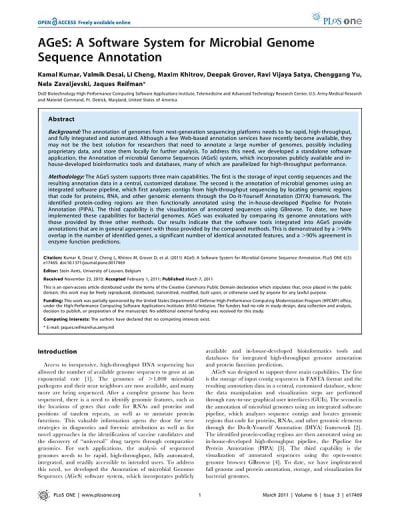
AGeS: A Software System for Microbial Genome Sequence Annotation
(reference ARL-0129) is currently available for download from the TSP library.
Don't have an account?
More From SAE Media Group
Motion Design
Modern HMI Software Propels Industry 4.0
Automotive Engineering
SkillReal Signs Tier 1 Supplier for NVIDIA-Powered AI Inspection
Tech Briefs
From Cockpit Controls to Dashboard Data
Medical Design Briefs
Instantly Capture, Edit, and Store Medical Images via Online Applications
Autonomous Vehicle Engineering
What M&E Can Teach the AV Industry About Data
Off-Highway Engineering
CrossControl Advances Virtual Fencing and Object Detection
Off-Highway Engineering
Deere’s Ingredients for Innovation
Automotive Engineering
Software Transforming Vehicle Development
Automotive Engineering
CES 2024: VW, Cerence Integrate ChatGPT in IDA Voice Assistant

Aerospace & Defense Tech Briefs
Localization and Mapping of Unknown Locations with Unmanned Ground Vehicles
Motion Design
Build IIoT Networks with Smart Control and HMI Software
Aerospace & Defense Tech Briefs
Digital Twins: How The Digital Replica Concept Is Used By Robotic Systems
Tech Briefs
A New, Simple Method to Speed Cache Sifting
Automotive Engineering
SkillReal Says Inexpensive Camera and AI Add up to Faster, Better Inspections
Off-Highway Engineering
Not Quite Your Father’s Cab
Tech Briefs
Propellant Loading Visualization Software
Software Tech Briefs
Space Images for NASA JPL Android Version

Aerospace & Defense Tech Briefs
Adamant: A Soon-to-be Open Source, Mission-Critical Flight Software Framework Written in Ada
Autonomous Vehicle Engineering
A Legal Profile of Facial Recognition
Tech Briefs
AI Advances Heart Research
Automotive Engineering
Alitheon’s Vision Is Easy Digital Traceability
Tech Briefs
Open Software Options for Automation
Off-Highway Engineering
Making Machines Software-Defined No Simple Task
NASA Spinoff
NASA-Born Software Keeps Cloud Traffic Moving

Tech Briefs
Fused Analytic Desktop Environment (FADE)
Tech Briefs
Software Verifies Identity by DNA in Minutes
Overview
The document presents the Annotation of microbial Genome Sequences (AGeS) software system, developed to address the growing need for rapid, high-throughput, and fully automated genome annotation following the exponential increase in available genome sequences due to advancements in DNA sequencing technologies. AGeS is designed specifically for annotating microbial genomes, incorporating both publicly available and in-house-developed bioinformatics tools and databases.
AGeS supports three main capabilities:
-
Data Storage: It allows for the storage of input contig sequences in FASTA format and the resulting annotation data in a centralized, customized database. This facilitates easy data manipulation and visualization through user-friendly graphical user interfaces (GUIs).
-
Genome Annotation: The software employs an integrated pipeline that analyzes sequence contigs to identify genomic regions coding for proteins, RNAs, and other elements. This is achieved through the Do-It-Yourself Annotation (DIYA) framework, which locates these regions, followed by functional annotation of the identified protein-coding regions using the Pipeline for Protein Annotation (PIPA).
-
Visualization: AGeS includes capabilities for visualizing annotated sequences using the open-source genome browser GBrowse, enhancing the accessibility and interpretability of the data.
The document highlights the evaluation of AGeS by comparing its genome annotations with those from three other methods. The results indicate a high level of agreement, with over 94% overlap in the number of identified genes and more than 90% agreement in enzyme function predictions. This demonstrates the reliability and effectiveness of the tools integrated within AGeS.
The authors express gratitude to the developers of various open-source bioinformatics tools that contributed to the AGeS pipeline, emphasizing the collaborative nature of bioinformatics research. The document concludes with acknowledgments and a note on the authors' affiliations, ensuring that the opinions expressed are their own and do not reflect official views of the U.S. Army or the Department of Defense.
Overall, AGeS represents a significant advancement in microbial genome annotation, providing researchers with a comprehensive, efficient, and user-friendly tool for genomic analysis, which is crucial for applications in diagnostics, vaccine development, and comparative genomics.
Top Stories
INSIDERManufacturing & Prototyping
 How Airbus is Using w-DED to 3D Print Larger Titanium Airplane Parts
INSIDERManned Systems
 FAA to Replace Aging Network of Ground-Based Radars
NewsTransportation
 CES 2026: Bosch is Ready to Bring AI to Your (Likely ICE-powered) Vehicle
NewsSoftware
 Accelerating Down the Road to Autonomy
EditorialDesign
 DarkSky One Wants to Make the World a Darker Place
INSIDERMaterials
 Can This Self-Healing Composite Make Airplane and Spacecraft Components Last...
Webcasts
Defense
 How Sift's Unified Observability Platform Accelerates Drone Innovation
Automotive
 E/E Architecture Redefined: Building Smarter, Safer, and Scalable...
Power
 Hydrogen Engines Are Heating Up for Heavy Duty
Electronics & Computers
 Advantages of Smart Power Distribution Unit Design for Automotive...
Unmanned Systems
 Quiet, Please: NVH Improvement Opportunities in the Early Design...
