




Laser System Offers Data Transmission Boost to Telecom and TV Broadcasters
A free-space optical laser communications technology that can compensate for atmospheric distortions in real time might soon break the bandwidth bottleneck for cellular telephony networks and high-definition broadcast television transmissions.
AOptix Technologies (Campbell, CA) has developed a laser communications system that uses deformable mirrors to send and receive signals transmitted through free space. The Missile Defense Agency (MDA) funded AOptix through a 2004 Small Business Innovation Research (SBIR) Phase II contract to develop an adaptive optics system capable of reducing the transmission challenges caused by the effects of atmospheric turbulence — the mixing of warm and cold air in the atmosphere.
How it Works
Known as curvature adaptive optics, this technological approach relies on adjustable mirrors to compensate for the atmospheric interference that occurs as laser beams travel from point to point through the air. This wireless optical alternative helps to reduce network congestion bottlenecks caused by the spectral limitations common in radio-frequency (RF)-based systems.
The AOptix free-space laser communications system focuses on controlling the optical paths used to transmit data through the atmosphere. When such data are transmitted in orbit, there is little problem because there is no atmosphere. But when the data are transmitted from Earth to a satellite or from a satellite to the Earth, the atmosphere does become an issue. The atmospheric disturbances distort the laser beam, resulting in wavefront errors. These errors cause the beam itself to disperse, minimizing the light energy at the receiving location.
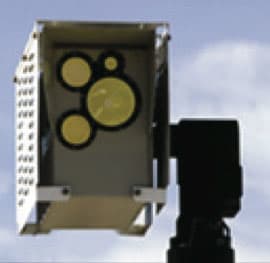
The process also works in reverse, pre-correcting the transmission beam for atmospheric disturbances it will encounter on its outgoing journey. Once corrected, the signals are sent via optical fibers to a ground-based network node, from which devices capable of receiving the data can be reached. Such devices include computers, televisions, or a cellular telephony infrastructure.
The main advantages of the AOptix laser communications system over traditional RF-based systems are the technology’s ability to deploy ultra-high bandwidths through reduced size, weight, power, and the fact that the optical spectrum does not require International Telecommunications Union allocation or licensing.
AOptix’s technology uses a very small-diameter laser beam capable of traveling tens of kilometers for line-of-sight transmissions. Such a system can reduce the chance of malicious eavesdropping or jamming of signals — a serious concern with military communications. RF transmissions do not have the same emission pattern, making communications security an ever-present concern.
Where it Stands
Company tests show the adaptive optics technology is energy-efficient, operating on as little as 30 Watts of power. Most RF technologies require several hundred Watts to operate. AOptix’s system is also faster, according to the company. Adaptive optics enable data transmission rates of more than 40 gigabytes per second, compared with the 274 megabytes common to comparable RF technologies.
The company, primarily funded by venture capital, is looking to further market its adaptive optics technology to a wide array of potential users, including telecommunications companies, television broadcasters, intelligence agencies, law-enforcement agencies, or any organization needing long-distance, ultra-fast data transmission. Beyond the commercial world, AOptix now is teamed with Northrop Grumman, L3 Communications, and Johns Hopkins University to develop a fully functional Optical RF Communications Adjunct-networked communications system.
More Information
For more information on the AOptix laser communications system, visit http://info.hotims.com/28060-518 . (Source: Joe Singleton/ NTTC; MDA TechUpdate, Missile Defense Agency, National Technology Transfer Center Washington Operations)
Top Stories
INSIDERManufacturing & Prototyping
 How Airbus is Using w-DED to 3D Print Larger Titanium Airplane Parts
INSIDERManned Systems
 FAA to Replace Aging Network of Ground-Based Radars
NewsTransportation
 CES 2026: Bosch is Ready to Bring AI to Your (Likely ICE-powered) Vehicle
NewsSoftware
 Accelerating Down the Road to Autonomy
EditorialDesign
 DarkSky One Wants to Make the World a Darker Place
INSIDERMaterials
 Can This Self-Healing Composite Make Airplane and Spacecraft Components Last...
Webcasts
Defense
 How Sift's Unified Observability Platform Accelerates Drone Innovation
Automotive
 E/E Architecture Redefined: Building Smarter, Safer, and Scalable...
Power
 Hydrogen Engines Are Heating Up for Heavy Duty
Electronics & Computers
 Advantages of Smart Power Distribution Unit Design for Automotive...
Unmanned Systems
 Quiet, Please: NVH Improvement Opportunities in the Early Design...
