




Processing System Detects and Monitors Human Behavior in Crowds
A new surveillance technology soon might allow police, transportation officials, and private security firms to quickly and efficiently scan crowds to guard against terrorists or to spot would-be criminals.
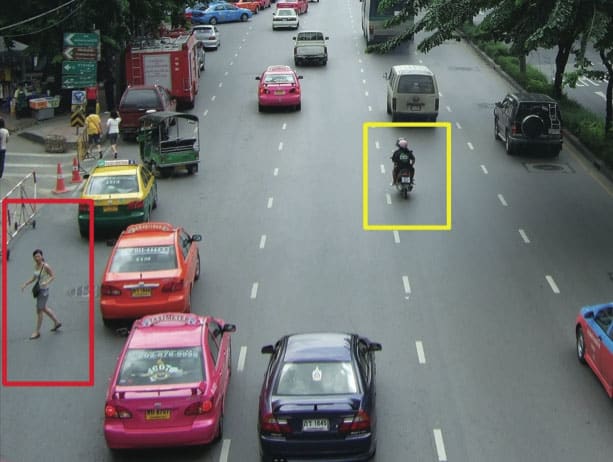
The Missile Defense Agency (MDA) first funded Eutecus through a 2004 Small Business Innovation Research (SBIR) Phase II contract to develop a microprocessor architecture capable of performing multitarget discrimination and tracking on missile defense systems.
Company engineers decided to move beyond the defense realm after the MDA contract ended. Using the same basic microprocessing architecture and programming concepts developed for MDA, Eutecus devised algorithms that can be tailored to perform a number of simultaneous tasks, including monitoring human behavior. For instance, if the technology is placed in an Internet Protocol (IP) security camera, a police officer could use it to track up to 12 behavioral patterns at once, such as loitering and a person dropping off a bag. While this technology could offer significant help to law enforcement, it also offers a competitive edge: other IP security cameras can track at most only a few behavioral patterns at a time.
How it Works
The company’s algorithms can run on a microprocessing architecture built two different ways, either as an application-specific integrated circuit (ASIC) that is directly integrated with sensors, or as a field-programmable gate array (FPGA)-based module placed in close proximity to the sensors or a focal plane array. The latter format is the company’s premiere configuration; it already has been endorsed by Xilinx, the world’s largest FPGA manufacturer, for enhanced video processing applications, and is being introduced to potential customers. Further, the technology scales to an improved format (high definition) and has higher frame rates (greater than 30 frames per second) than competitive solutions.
Eutecus plans to commercialize the technology by licensing the hardware and software to camera manufacturers, programming cameras as they are being manufactured, or at delivery.
Depending on algorithmic complexity, current prototype chips created by the company can analyze images at rates of more than 1,000 frames per second. This significantly exceeds the 30 frames-per-second rate common on commercial surveillance cameras. Company officials said it recently developed a prototype chip with a sensing rate that exceeds 100,000 frames per second.
The company designed its ASIC microprocessing architecture with efficiency in mind. Separate sensor and processor chip sets - typical in most competitive military architectures - are not necessary on the Eutecus device, because they are integrated into one package. Combining the sensors and processors means that this product uses about half the power that a typical competing product would use. The Eutecus offering can use less than 100 milliwatts. The size of the package also is reduced by half.
Where it Stands
Eutecus projects its technology will save money once mass production commences. Current IP cameras for security can range in price between $1,000 and $2,000 per unit, depending on specifications. Adding an analytical package for use on a server arrangement (not in the camera) can add at least a few hundred per camera. Eutecus officials believe their systems could be offered much more inexpensively — possibly $100 per camera, in volume. The company wants to license its technology to camera manufacturers and establish partnerships with systems integrators.
More Information
For more information on Eutecus’ microprocessing architecture, visit http://info.hotims.com/28058-517 . (Source: Joe Singleton/NTTC; MDA TechUpdate, Missile Defense Agency, National Technology Transfer Center Washington Operations)
Top Stories
INSIDERManufacturing & Prototyping
 How Airbus is Using w-DED to 3D Print Larger Titanium Airplane Parts
INSIDERManned Systems
 FAA to Replace Aging Network of Ground-Based Radars
NewsTransportation
 CES 2026: Bosch is Ready to Bring AI to Your (Likely ICE-powered) Vehicle
NewsSoftware
 Accelerating Down the Road to Autonomy
EditorialDesign
 DarkSky One Wants to Make the World a Darker Place
INSIDERMaterials
 Can This Self-Healing Composite Make Airplane and Spacecraft Components Last...
Webcasts
Defense
 How Sift's Unified Observability Platform Accelerates Drone Innovation
Automotive
 E/E Architecture Redefined: Building Smarter, Safer, and Scalable...
Power
 Hydrogen Engines Are Heating Up for Heavy Duty
Electronics & Computers
 Advantages of Smart Power Distribution Unit Design for Automotive...
Unmanned Systems
 Quiet, Please: NVH Improvement Opportunities in the Early Design...
