




Data-Driven Prognostics Software Predicts Deformation and Failure
Air- and space-borne systems require the storage, transport, and dispensing of large amounts of cryogenic fluids. In addition, these systems must be as lightweight as possible. Advanced composite materials have the potential to provide significant mass reduction due to their high specific strength and stiffness compared to metals, but they have relatively low damage tolerance and are susceptible to cracking. Thus, development of robust linerless composite tanks for storage and handling of liquid hydrogen and other cryogenic fluids is a critical enabling technology. One important hurdle to development of composite tanks is achieving accurate analysis and simulation of their performance.
How it Works
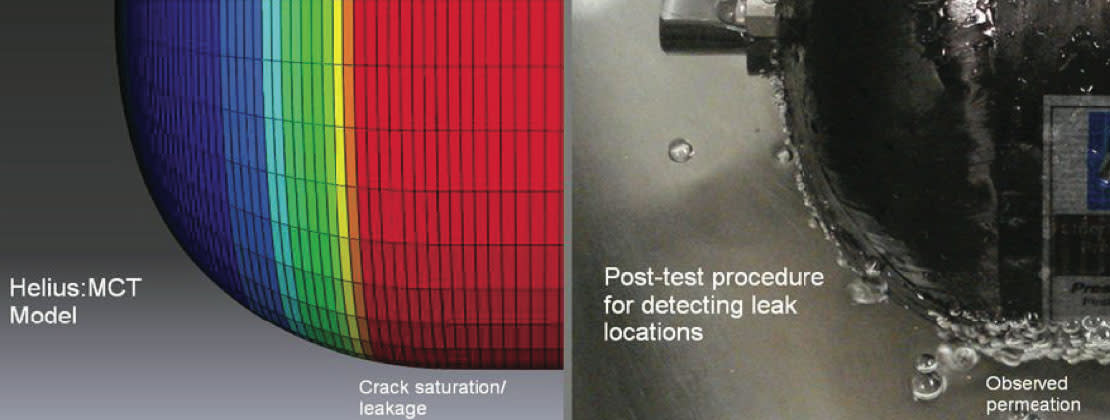
Firehole Technologies developed a product that was derived from an Air Force Small Business Innovation Research (SBIR) project. The product is a software analysis tool designed specifically for composites called Helius: MCT™. It is based on Multi-Continuum Technology (MCT), which allows composite material simulations to accurately and efficiently include material behavior at the fiber and matrix level. The inclusion of this multi-scale information enables Helius: MCT to correctly identify failure of individual material constituents and degrade the composite material accordingly.
Using Helius: MCT to enhance structural analysis software, it is possible to predict the evolution of localized matrix cracking and, with acute accuracy, the point of failure. The developed technology will enable the advantageous design of unlined composite tanks for storage of cryogenic fluids. These unlined composite tanks are typically used in spacecraft applications, where proper design to minimize weight is essential. The key problem in such tanks is cracking in the matrix material, which is well addressed in the analysis. With accurate simulation capabilities, the Firehole Technologies analysis procedure allows an optimal design to be developed while avoiding a costly empirical (“make and break”) approach.
Where it Stands
According to Jerad Stack, CEO of Firehole Technologies, “The products developed as part of this effort are a key part of our composite analysis tool suite as we take our software to market. In addition, the good agreement of our predictive tools with experiential results obtained in this project will speak volumes to our potential customers and will help grow sales.”
More Information
For more information on Firehole Technologies’ analysis software, visit http://info.hotims.com/28058-518 .
Top Stories
INSIDERManufacturing & Prototyping
 How Airbus is Using w-DED to 3D Print Larger Titanium Airplane Parts
INSIDERManned Systems
 FAA to Replace Aging Network of Ground-Based Radars
NewsTransportation
 CES 2026: Bosch is Ready to Bring AI to Your (Likely ICE-powered) Vehicle
NewsSoftware
 Accelerating Down the Road to Autonomy
EditorialDesign
 DarkSky One Wants to Make the World a Darker Place
INSIDERMaterials
 Can This Self-Healing Composite Make Airplane and Spacecraft Components Last...
Webcasts
Defense
 How Sift's Unified Observability Platform Accelerates Drone Innovation
Automotive
 E/E Architecture Redefined: Building Smarter, Safer, and Scalable...
Power
 Hydrogen Engines Are Heating Up for Heavy Duty
Electronics & Computers
 Advantages of Smart Power Distribution Unit Design for Automotive...
Unmanned Systems
 Quiet, Please: NVH Improvement Opportunities in the Early Design...
