




Portable, Rapid-Test Fuel Tank Leak Detection System
This portable system is used in tanks of 50,000 gallons or less, and helps avoid cleanup costs for undetected fuel leaks.
In 1988, the EPA issued Underground Storage Tank (UST) regulations for fuel storage in order to implement monthly monitoring and annual tightness testing. Monthly monitoring requires that the leak detection system be certified for a leak rate of 0.2 gallons per hour (GPH), and annual tightness testing requires a certified leak rate of 0.1 GPH, both with a probability of detection of at least 95%, and a probability of false alarm of no more than 5%. The DoD owns and operates hundreds of underground storage tanks that are less than 100,000 gallons. These tanks, commonly operating at base fuel farms, must comply with EPA, state, and local regulations, and require that either an annual tightness test with monthly inventory reconciliation or monthly monitoring tests be conducted in accordance with published performance standards. Existing technologies either cannot meet performance standards for the large 50-K to 100-K gallon USTs or do not provide a cost-effective solution. The Portable Rapid Test (PRT) is designed and recommended for testing tanks containing lower-volatile, heavier-type fuels such as diesel, JP-5, JP-8, etc.
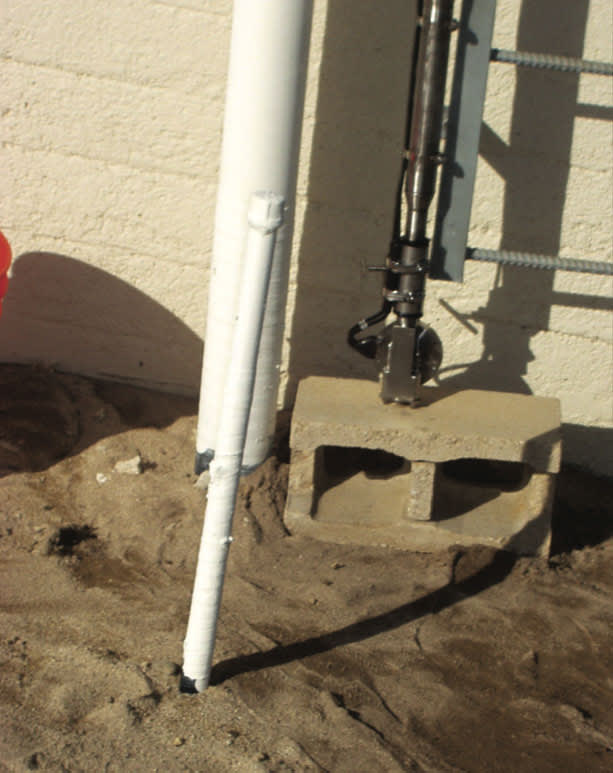
A differential pressure transducer is attached to the side of the bottom section of the reference tube and is adjacent to the sliding seal. The pressure transducer measures the pressure difference between the height/mass of the fluid in the reference tube and the height/mass of the fluid in the test tank. To minimize fluid cavity areas that can potentially trap or contain vapor bubbles, the pressure transducer is mounted directly to the reference without the use of external tubing. To provide quick thermal stabilization, the pressure transducer body is also of a type that can be directly immersed in the test tank fuel without use of a containment vessel. The bottom section of the reference tube, the sliding seal, and the differential pressure transducer comprise a modular unit that can be attached to any length of upper reference tube so that the modular unit can be adapted to any tank configuration.
The electrical conductors are hermetically sealed to the differential pressure transducer and are contained in a fuel-resistant jacket. The conductors/ jacket are attached to the outside of the reference tube, run along the full length of the reference tube, and have approximately 20 to 30 feet of additional cable length available for routing to the electronics package outside the test tank. The electronics package consists of a signal conditioner, power supply, terminal block, and PCMCIA A/D card. The signal conditioner maintains an intrinsically safe 4- to 20-milliamp (ma) supply current to the differential pressure transducer. The pressure transducer modifies the magnitude of the supply current (i.e., the analog test signal) in relation to actual pressure differentials developed between the reference tube and the test tank. The analog test signal is then output from the signal conditioner and fed to a laptop computer for analog-to-digital conversion. Saved test data can also be easily downloaded into to a spreadsheet.
The system allows testing at EPA standard leak rates of 0.10 gal/hr and 0.20 gal/hr. This provides a significant improvement over current methods technologically, operationally, and in short- and long-term cost benefits.
This work was done by William Major and Leslie Karr of the Naval Facilities Engineering Command. For more information, download the Technical Support Package (free white paper) at www.defensetechbriefs.com/tsp under the Physical Sciences category. NRL-0044
This Brief includes a Technical Support Package (TSP).
Portable, Rapid-Test Fuel Tank Leak Detection System
(reference NRL-0044) is currently available for download from the TSP library.
Don't have an account?
More From SAE Media Group


Battery & Electrification Technology
New Products
Motion Design
Reducing Plasma Cutting Cycle Time with a Cobot Cutter
Electronics & Sensors INSIDER
Self-Powered Sensor Automatically Harvests Magnetic Energy

Aerospace & Defense Tech Briefs
Making a Material Difference in Aerospace & Defense Electronics
Power Electronics INSIDER
The Battery Powering a Truly Green Revolution in Personal Electronics
Power Electronics INSIDER
Highly Conductive Aluminum Can Equal Copper
Electronics & Sensors INSIDER
Careful Heating Unlocks Unprecedented Sensitivity to Pressure in Semiconductor Materials

NASA Spinoff
Toxin-Eating Plants
Tech Briefs
First Transformable Nanoscale Electronic Devices


Motion Design INSIDER
Are Shapeshifting “Soft Machines” In Our Future?

Photonics Tech Briefs
Curved Piezoelectric Actuators for Stretching Optical Fibers
Power Electronics INSIDER
New Material To Make Next Generation of High-Power Electronics Faster and More Efficient
Electronics & Sensors INSIDER
MIT Engineers Grow “High-Rise” 3D Chips
Electronics & Sensors INSIDER
Novel Approach to Advanced Electronics and Data Storage with Ferroelectricity
Electronics & Sensors INSIDER
Researchers Demonstrate a High-Speed Electrical Readout Method for Graphene Nanodevices
Electronics & Sensors INSIDER
The World’s First Wood Transistor
Power Electronics INSIDER
Carbon Nanotubes Store Energy
Tech Briefs
Rotationally Vibrating Electric-Field Mill
Electronics & Sensors INSIDER
Researchers Create First Functional Semiconductor Made from Graphene
Electronics & Sensors INSIDER
Tiny But Mighty: Next-Gen Transistors Hold Great Promise
Electronics & Sensors INSIDER
A New Magnetic Transistor for More Energy-Efficient Electronics
Motion Design
Flexible Conductive Skin Gives Robots the Human Touch
Overview
The document is a Technical Memorandum (TM-2412-ENV) detailing the Portable Rapid Test (PRT) Fuel Tank Leak Detection System, developed to enhance leak detection in fuel storage tanks, particularly for the U.S. Navy. The report, dated April 2010, outlines the system's design, evaluation procedures, and performance results.
The introduction provides background on the need for effective leak detection technologies in underground storage tanks (USTs) to comply with environmental regulations and prevent fuel contamination. The project objective is to develop a portable, efficient, and reliable leak detection system that can be easily deployed in various tank configurations.
The document describes the test facility and the specific equipment used for leak simulation, which is crucial for evaluating the PRT system's performance. The evaluation procedures are detailed, outlining how the system was tested under controlled conditions to ensure accurate results.
Key findings from the tests indicate that the PRT system can detect leaks at a rate of 0.067 gallons per hour, with a high probability of detection. This performance is significant for maintaining compliance with environmental standards and ensuring the integrity of fuel storage systems. The results demonstrate that the PRT system is capable of identifying leaks quickly and effectively, making it a valuable tool for environmental protection and operational efficiency.
The summary of the PRT Bulk Tank Leak Detector's performance highlights its advantages over prior technologies, emphasizing its portability and ease of use. The document concludes with an attachment containing report forms for the PRT Tank Leak Detection System, which can be utilized for documentation and compliance purposes.
Overall, the TM-2412-ENV serves as a comprehensive resource for understanding the development and capabilities of the PRT Fuel Tank Leak Detection System, showcasing its potential to improve leak detection practices in military and civilian applications. The findings underscore the importance of innovative technologies in safeguarding the environment and ensuring the safe management of fuel resources.
Top Stories
INSIDERManufacturing & Prototyping
 How Airbus is Using w-DED to 3D Print Larger Titanium Airplane Parts
INSIDERManned Systems
 FAA to Replace Aging Network of Ground-Based Radars
NewsTransportation
 CES 2026: Bosch is Ready to Bring AI to Your (Likely ICE-powered) Vehicle
NewsSoftware
 Accelerating Down the Road to Autonomy
EditorialDesign
 DarkSky One Wants to Make the World a Darker Place
INSIDERMaterials
 Can This Self-Healing Composite Make Airplane and Spacecraft Components Last...
Webcasts
Defense
 How Sift's Unified Observability Platform Accelerates Drone Innovation
Automotive
 E/E Architecture Redefined: Building Smarter, Safer, and Scalable...
Power
 Hydrogen Engines Are Heating Up for Heavy Duty
Electronics & Computers
 Advantages of Smart Power Distribution Unit Design for Automotive...
Unmanned Systems
 Quiet, Please: NVH Improvement Opportunities in the Early Design...
