




Large-Area Hydride Vapor Phase Epitaxy of Gallium Nitride
The Missile Defense Agency (MDA) has awarded Kyma Technologies (Raliegh, NC) numerous Small Business Innovation Research (SBIR) contracts in the area of bulk growth of gallium nitride (GaN) crystals for high-power radio-frequency applications. The latest SBIR was a 2006 Phase I, (awarded in 2007) to develop a means of achieving seeded bulk GaN crystal growth for the production of large-area, high-quality, semi-insulating GaN
substrates for radio frequency (RF) applications. These substrates are expected to improve the performance and reliability of GaN-based power amplifiers for X-band radar applications in missile defense.
The company has demonstrated the ability to increase the size and manufacturability of bulk GaN, and has worked with Department of Defense (DoD) laboratories and academic partners to demonstrate their product in several advanced semiconductor device types of both military and commercial interest.
Bulk GaN is emerging as a viable replacement for silicon carbide and sapphire, which are used to make blue and white LEDs, with many other applications possible in hybrid electric vehicles, sensors, laser diodes, terahertz imaging, and optoelectronic displays.
How it Works
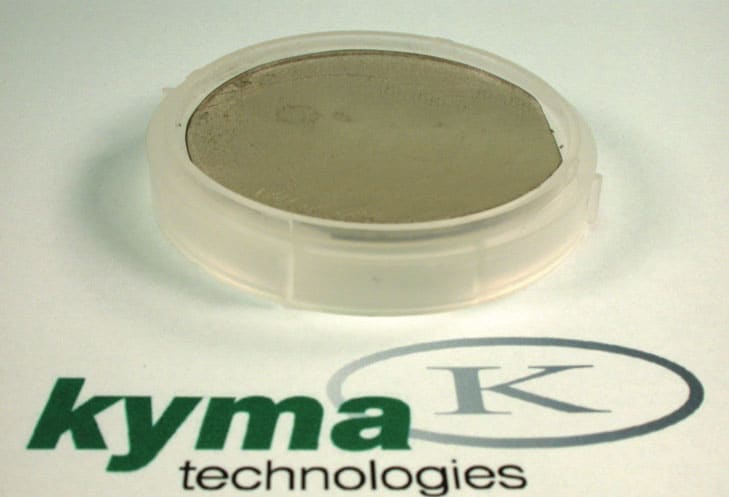
Kyma’s mission is to create a high-volume supply of high-quality native GaN substrates. Kyma has made great strides in advancing the capabilities of its proprietary hydride vapor phase epitaxy (HVPE)-based methods of growing “native” GaN, enabling the production of very-low-defect substrates that are getting bigger and better over time.
Kyma’s HVPE process enhancements address the problems of lattice-matching and thermal expansion matching that complicate the crystal growth process and present challenges to increasing the size of “native” GaN. Starting with a GaN seed, the company currently grows crystals that are up to 1 cm thick and up to 3" in diameter. Continuous reduction in post-growth cracking has enabled Kyma to deliver very-high-quality 30-mm-round substrates to the DoD, and full 2" and 3" substrates are in sight. The 1-cm-thick wafer can then be sliced into a dozen or so 500-μm-thick substrates. Kyma expects to grow a 4"-diameter wafer.
Applications for GaN substrates include solid-state lighting (white LEDs), which also opens the possibility of exploiting these LEDs simultaneously for their broadband characteristics, such as transmitting Internet signals. In addition, blue laser diodes are a major target for replacement with GaN. The materials have been demonstrated in high-performance LEDs, laser diodes, UV detectors, RF FETs, and Schottky diode electronic switches.
Other applications are in chemical and biological sensing, solar blind UV light detection, electric drives for transportation, distribution transformers for the power grid, fault-current limiting devices, variable-speed controls for motors, high-voltage DC converter stations, interfaces with storage devices, high-power RF devices (signal jamming), UV LEDs for water purification, terahertz devices for imaging without ionizing radiation (luggage/cargo screening), high-definition TV and video projectors, and avionics/automotive displays.
Where it Stands
Kyma is busily supplying research and development laboratories with wafers. In a five- to ten-year timeframe, the industry expects that silicon carbide will give way to GaN. The combined nitride semiconductor market is expected to exceed $9B this year, with GaN and AlN making up about $500M of that market. Kyma is well positioned to respond to the market as it grows. The company projects that the first shipments of 4"-circular native GaN will be this year.
More Information
For more information on Kyma’s GaN wafers, visit http://info.hotims.com/28054-519 . (Source: Joan Zimmermann/NTTC; MDA TechUpdate, Missile Defense Agency, National Technology Transfer Center Washington Operations)
Top Stories
INSIDERManufacturing & Prototyping
 How Airbus is Using w-DED to 3D Print Larger Titanium Airplane Parts
INSIDERManned Systems
 FAA to Replace Aging Network of Ground-Based Radars
NewsTransportation
 CES 2026: Bosch is Ready to Bring AI to Your (Likely ICE-powered) Vehicle
NewsSoftware
 Accelerating Down the Road to Autonomy
EditorialDesign
 DarkSky One Wants to Make the World a Darker Place
INSIDERMaterials
 Can This Self-Healing Composite Make Airplane and Spacecraft Components Last...
Webcasts
Defense
 How Sift's Unified Observability Platform Accelerates Drone Innovation
Automotive
 E/E Architecture Redefined: Building Smarter, Safer, and Scalable...
Power
 Hydrogen Engines Are Heating Up for Heavy Duty
Electronics & Computers
 Advantages of Smart Power Distribution Unit Design for Automotive...
Unmanned Systems
 Quiet, Please: NVH Improvement Opportunities in the Early Design...
