




Polymer Coating Material Limits Computer Damage Caused by Vibrations
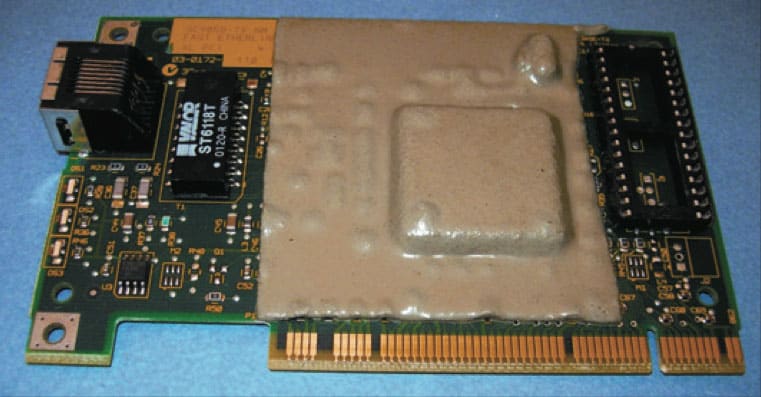
Cornerstone Research Group (Dayton, OH) has developed an organic, polymer-based material that can be directly applied to any circuit board — as well as other metal- and plastic-based objects — to protect against vibrations.
The protective hard-coating technology, originally developed for the Air Force Research Laboratory (AFRL), is now being funded by a Missile Defense Agency (MDA) Small Business Innovation Research (SBIR) Phase II contract to determine whether it can protect information system technologies used in current and proposed space-based ballistic missile defense platforms.
How it Works
The hard-coating material protects circuit boards and other electronic components in a way that other compounds cannot. Many of the options to mitigate vibration damage, such as coating with commercial off-the-shelf plastic compounds, do not have the same coefficient of thermal expansion as the components they protect. When such compounds undergo heating or cooling, they expand or contract at different rates than the components to which they are attached — a situation that can lead to cracking or breaking. Cornerstone’s durable, hard-coating technology, however, is engineered to allow the material to shrink and expand at a rate close to that of circuit board assemblies, so no damage is done to the board components.
Since the hard coating’s successful high-endurance tests with the AFRL, Cornerstone researchers have been actively trying to find its niche in the commercial market. Businesses needing their electronics protected against vibrations and harsh conditions — such as mining, transportation, and the chemical, oil, and gas industries — should welcome this new technology’s usefulness. The technology is also expected to be useful in mitigating vibrations in the electronics of the burgeoning off-road vehicle market.
And considering the protective hard coating would be used in a variety of electronics and environments in both heavy industry and the home electronics markets, the product has to be adaptable. Cornerstone starts off manufacturing the material in three distinct formats: a paste that allows a user to apply and coat a piece of equipment as thick as deemed necessary; thin sheets that use direct-applied adhesion, similar to contact paper; and machine-molded coatings fitted to a customer’s specifications. Since the hard-coating material can be used on virtually any electronic device to protect against vibration, it is more versatile and compatible than competitive coatings on the market, which tend to be specialized toward use on specific applications.
Where it Stands
While Cornerstone plans to continue manufacturing its protective coatings, the company hopes to partner with electronics companies to supply the material for coating components. The coatings can be integrated into standard manufacturing processes with little to no impact on production.
More Information
For more information on Cornerstone’s circuit-board coating technology, visit http://info.hotims.com/28054-518 . (Source: Joe Singleton/NTTC; MDA TechUpdate, Missile Defense Agency, National Technology Transfer Center Washington Operations)
Top Stories
INSIDERManufacturing & Prototyping
 How Airbus is Using w-DED to 3D Print Larger Titanium Airplane Parts
INSIDERManned Systems
 FAA to Replace Aging Network of Ground-Based Radars
NewsTransportation
 CES 2026: Bosch is Ready to Bring AI to Your (Likely ICE-powered) Vehicle
NewsSoftware
 Accelerating Down the Road to Autonomy
EditorialDesign
 DarkSky One Wants to Make the World a Darker Place
INSIDERMaterials
 Can This Self-Healing Composite Make Airplane and Spacecraft Components Last...
Webcasts
Defense
 How Sift's Unified Observability Platform Accelerates Drone Innovation
Automotive
 E/E Architecture Redefined: Building Smarter, Safer, and Scalable...
Power
 Hydrogen Engines Are Heating Up for Heavy Duty
Electronics & Computers
 Advantages of Smart Power Distribution Unit Design for Automotive...
Unmanned Systems
 Quiet, Please: NVH Improvement Opportunities in the Early Design...
