




Miniaturized Rad-Hard System Shrinks Propulsion Electronics
Developed by Space Micro (San Diego, CA), a new technology involves the miniaturization and radiation hardening of electronics through a novel means of stacking commercial-off-the-shelf semiconductor materials. The Missile Defense Agency (MDA) funded Space Micro through a 2007 Small Business Innovation Research (SBIR) Phase II contract to develop an electronics module for interceptor divert attitude and control systems (DACS) that meet radiation-hardness requirements.
Space Micro’s technology focuses on the electronic circuitry used in a DACS module to control thrusters to propel a missile or satellite into position to acquire a target. In either a missile or satellite, minimal space is available for placement of electronics, making miniaturization of such components essential.
How it Works
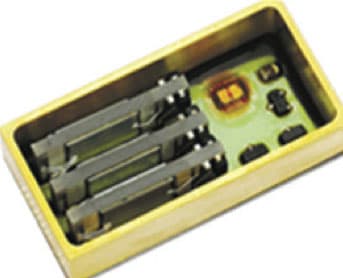
While other companies occasionally design products that use stacking to conserve space, Space Micro’s product is designed for space-borne computer applications; namely, memory chips used on high-power space platforms or technologies. One particular DACS module chip, known as a power MOSFET — a metal oxide semiconductor field-effect transistor used to handle large amounts of power — produces about 8 amperes of power for controlling the thrusters of a missile or satellite.
Cost savings are another advantage. The biggest savings is through the use of commercial off-the-shelf processes and materials. Generally, these materials are less expensive than custom solutions, which means end users ultimately can enjoy a lower price. For example, a power MOSFET costs around $450 from major suppliers, if radiation hardened. But a non-rad-hard power MOSFET can be procured for around $10. As six power MOSFETs are needed for a DACS module, the company pays $60 and packages it with a proprietary blend of high-density, radiation-shielding materials. By doing the work in-house, Space Micro’s overall cost can be significantly reduced for its customers.
Where it Stands
While the technology is designed primarily for military satellites and missiles, Space Micro’s DACS modules could be used on commercial satellites. The closest commercial application on the ground may involve opening valves at nuclear power plants, which the company considers to be a stretch since miniaturization is not critical.
Space Micro intends to continue developing this technology in the near term — which stands at Technical Readiness Level 5 — while growing the company. Partnering, and possibly merging, with larger companies that can use Space Micro’s technology is being pursued.
More Information
For more information on Space Micro’s chip-stacking technology, visit http://info.hotims.com/28054-517 . (Source: Joe Singleton/NTTC; MDA TechUpdate, Missile Defense Agency, National Technology Transfer Center Washington Operations)
Top Stories
INSIDERManufacturing & Prototyping
 How Airbus is Using w-DED to 3D Print Larger Titanium Airplane Parts
INSIDERManned Systems
 FAA to Replace Aging Network of Ground-Based Radars
NewsTransportation
 CES 2026: Bosch is Ready to Bring AI to Your (Likely ICE-powered) Vehicle
NewsSoftware
 Accelerating Down the Road to Autonomy
EditorialDesign
 DarkSky One Wants to Make the World a Darker Place
INSIDERMaterials
 Can This Self-Healing Composite Make Airplane and Spacecraft Components Last...
Webcasts
Defense
 How Sift's Unified Observability Platform Accelerates Drone Innovation
Automotive
 E/E Architecture Redefined: Building Smarter, Safer, and Scalable...
Power
 Hydrogen Engines Are Heating Up for Heavy Duty
Electronics & Computers
 Advantages of Smart Power Distribution Unit Design for Automotive...
Unmanned Systems
 Quiet, Please: NVH Improvement Opportunities in the Early Design...
