




Nanodomain Model of Polymer-Derived Ceramics
Areport discusses a model developed to explain the unusual properties of polymer- derived ceramics (PDCs), which are so named because they are made by controlled pyrolysis of cross-linked polymers. PDCs are metastable ceramics that have potential to be further developed into high-temperature materials that can be tailored to have properties needed to perform specific functions. The PDCs studied thus far have comprised silicon, carbon, nitrogen, and oxygen. The unusual properties of PDCs are the following: They bear similarity to both polymers and metallic glasses, even though the pyrolysis temperatures used in producing them are with experimental data.
This work was done by Rishi Raj of the University of Colorado at Boulder for the Air Force Research Laboratory. For more information, download the Technical Support Package (free white paper) at www.defensetechbriefs.com/tsp under the Materials category. AFRL-0074
This Brief includes a Technical Support Package (TSP).
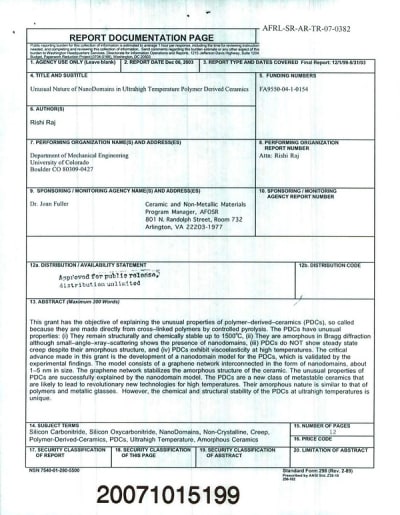
Nanodomain Model of Polymer-Derived Ceramics
(reference AFRL-0074) is currently available for download from the TSP library.
Don't have an account?
More From SAE Media Group
Medical Design Briefs
Transforming Plastic Parts into High-Value Products


Tech Briefs
Method Recovers Metals from Electronic Waste
Tech Briefs
Glue Activated by Magnetic Field
Medical Design Briefs
The Use of Parylene-Coated Mandrels in the Balloon Catheter Manufacturing Process
Tech Briefs
Durable Polyimide Aerogels
Air Force Research Laboratory Technology Horizons
Geopolymers
Medical Design Briefs
Plasma Treatment: Transforming Plastic Parts into High-Value Products
Tech Briefs
Fast-Acting Molecular Probe

Air Force Research Laboratory Technology Horizons
Automated Material Deposition Chamber
Tech Briefs
New Process Breaks Down Polystyrene
Tech Briefs
Copolyimide Surface-Modifying Coating
Tech Briefs
Reducing Wear and Friction of CVD Diamond Films


Medical Design Briefs
Hybrid Material Enables Next-Gen E-Skin
Tech Briefs
Refractory Ceramic Foams for Novel Applications

Tech Briefs
Self-Healing, Highly Adhesive Elastomers

Medical Design Briefs
Adhesive Bonding of Plastics in Medical Devices, Part 2: Material Properties of Plastics

Aerospace Manufacturing and Machining
Scaling Low-Cost Carbon Fiber Production with Oxidation Technology
Aerospace & Defense Tech Briefs
How to Select the Right Silicone for Space Applications
Overview
The document is a final performance report titled "Unusual Nature of NanoDomains in Ultrahigh Temperature Polymer Derived Ceramics," submitted by Rishi Raj, the Principal Investigator from the Department of Mechanical Engineering at the University of Colorado, Boulder. The report is addressed to Dr. Joan Fuller, the Program Manager for Ceramic and Non-Metallic Materials at the Air Force Office of Scientific Research (AFOSR).
The primary objective of the research is to elucidate the unique properties of polymer-derived ceramics (PDCs), which are synthesized directly from cross-linked polymers through controlled pyrolysis. This process results in materials that exhibit exceptional thermal stability and mechanical properties, making them suitable for high-temperature applications.
The report is structured into two main sections. The first section provides a scientific foundation for a nanodomain model, which is a conceptual framework developed to understand the behavior of these ceramics at the nanoscale. It details the experiments and spectroscopic observations that led to the formulation of this model. The second section quantitatively develops the model to predict the thickness of the domain wall in micrometers and the size of the nanodomains in nanometers.
The research highlights the significance of understanding the nanostructure of PDCs, as it directly influences their macroscopic properties. The findings suggest that the arrangement and size of nanodomains play a crucial role in determining the mechanical and thermal performance of the ceramics. This understanding could lead to the design of advanced materials with tailored properties for specific applications, particularly in aerospace and defense sectors where high-performance materials are essential.
The report also includes acknowledgments of the personnel involved in the research, including post-doctoral researchers and graduate students from the University of Colorado, Boulder. Their contributions were vital in conducting the experiments and analyzing the results.
In summary, this document presents a comprehensive overview of the research conducted on polymer-derived ceramics, focusing on the innovative nanodomain model that enhances the understanding of their unique properties. The insights gained from this study are expected to contribute significantly to the development of advanced ceramic materials with applications in extreme environments.
Top Stories
INSIDERManufacturing & Prototyping
 How Airbus is Using w-DED to 3D Print Larger Titanium Airplane Parts
INSIDERManned Systems
 FAA to Replace Aging Network of Ground-Based Radars
NewsTransportation
 CES 2026: Bosch is Ready to Bring AI to Your (Likely ICE-powered) Vehicle
NewsSoftware
 Accelerating Down the Road to Autonomy
EditorialDesign
 DarkSky One Wants to Make the World a Darker Place
INSIDERMaterials
 Can This Self-Healing Composite Make Airplane and Spacecraft Components Last...
Webcasts
Defense
 How Sift's Unified Observability Platform Accelerates Drone Innovation
Automotive
 E/E Architecture Redefined: Building Smarter, Safer, and Scalable...
Power
 Hydrogen Engines Are Heating Up for Heavy Duty
Electronics & Computers
 Advantages of Smart Power Distribution Unit Design for Automotive...
Unmanned Systems
 Quiet, Please: NVH Improvement Opportunities in the Early Design...
