




Power for Micro Autonomous Systems
Basic power requirements for mobile microsystems, such as autonomous robots, are examined.
The Micro Autonomous Systems and Technology (MAST) Collaborative Technology Alliance (CTA) has been initiated to spur basic research in small autonomous robots, particularly in four main areas: Microsystem Mechanics, Autonomous Processing, Micro electronics, and Integration. In order to focus its efforts, the Army proposed multiple scenario missions of increasing difficulty to work towards: small unit building search (flat, straight walls, no wind, etc.), a small unit cave search (potential for wind gusts, no regular surfaces to use as reference points), and perimeter defense (longer required mission time, and range and potentially harsh environments). The size ranges considered were defined as “palm-size” and below, where no lower limit was specified.

The basic scenario is assumed to be a small building unit search, particularly emblematic of Operation Iraqi Freedom. By sending in a robotic platform, fundamental information about the current state of the building can be ascertained before soldiers are placed in harm’s way. The soldiers’ concept of how best to use such systems would likely include separate and distinct periods of locomotion and surveillance/ data sensing. For example, the robot would initially fly/crawl to a corner of a room, then stop and sense the surrounding environment. Upon sensing an “interesting” event, or after being given a command, the robot would stop sensing and locomote to a new position for a different view of the situation. Therefore, the hypothetical mission posed here is assumed to last about 21 minutes, divided among three perch locations of five minutes each, with about two minutes of ambulation/flying between perch locations. This leads to a minimum MAST system requirement of six minutes of crawling/flying, with an additional 15 minutes of sensing duties. Soldiers did indicate a desire for mission durations up to and exceeding 24 hours, the majority of which would be in the sensing/perched mode where the power draw is widely variable depending on the sensors being used.
While this 24-hour goal is not addressed in this report, techniques such as low sampling rates, reduced communications, and sleep modes should enable longer missions with little impact on the overall energy requirement.
This work was done by Brian Morgan and Sarah Bedair of the Army Research Laboratory. For more information, download the Technical Support Package (free white paper) at www.defensetechbriefs.com/tsp under the Physical Sciences category. ARL-0085
This Brief includes a Technical Support Package (TSP).
Power for Micro Autonomous Systems
(reference ARL-0085) is currently available for download from the TSP library.
Don't have an account?
More From SAE Media Group
Aerospace & Defense Tech Briefs
Robust Quantum Sensors Program
Tech Briefs
When Mushrooms Control Robots
Motion Design INSIDER
Programming Robots with Rubber Bands
Tech Briefs
An Octopus-Inspired Smart Robot
Aerospace & Defense Tech Briefs
Distributed, Collaborative Human- Robotic Networks for Search, Identify, and Track
Motion Design
Flexible Conductive Skin Gives Robots the Human Touch
Tech Briefs
A Robot with the ‘Brains’ to Morph Mid-Air
Motion Design INSIDER
RoboBee Comes in for a Landing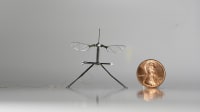
NASA Spinoff
Toxin-Eating Plants

Tech Briefs
Videos of the Month
Motion Design INSIDER
Jumping Robot Leaps to Record Heights
Tech Briefs
Hopping Robots to Traverse Challenging Terrain

Aerospace & Defense Tech Briefs
Gesture-Directed Sensor-Information Fusion Gloves

Electronics & Sensors INSIDER
Self-Powered Sensor Automatically Harvests Magnetic Energy
Motion Design INSIDER
Are Shapeshifting “Soft Machines” In Our Future?
Robotics & Automation INSIDER
Researchers Explore the Phenomenon of Holonomy

Tech Briefs
Products of Tomorrow
Aerospace & Defense Tech Briefs
New Drone Will Mimic Albatross Flight
Motion Design INSIDER
Tiny Fans on the Feet of Water Bugs Could Lead to Energy Efficient Mini Robots
Motion Design INSIDER
Engineering a Robot That Can Jump 10 Feet High — Without Legs
NASA Spinoff
Using AI to Predict the Sky
Electronics & Sensors INSIDER
Careful Heating Unlocks Unprecedented Sensitivity to Pressure in Semiconductor Materials
Electronics & Sensors INSIDER
World's First Petahertz-Speed Phototransistor in Ambient Conditions

Overview
The "Power for Microsystems Strategic Technology Initiative Report on MAST Mission Power Requirements" is a comprehensive analysis authored by Brian Morgan and Sarah Bedair, published by the U.S. Army Research Laboratory in July 2009. The report addresses the critical power requirements for Micro Autonomous Systems (MAS) within the context of military applications, particularly focusing on the challenges and solutions related to energy efficiency and power sourcing for these advanced technologies.
The document begins with an introduction that outlines the mission definition and the significance of power in the development of micro autonomous systems. It highlights the increasing complexity of these systems, which necessitates a greater demand for energy as they incorporate more functions and capabilities. The report emphasizes that efficient power management is essential for the successful operation of these microsystems, especially in military scenarios where performance and reliability are paramount.
Subsequent sections delve into various aspects of the report. The authors discuss locomotion options for meso- to millimeter-scale devices, exploring different modalities that can be employed for movement. This section is crucial as it sets the stage for understanding how power requirements vary with different locomotion strategies.
The report also reviews potential electronic and sensor payloads that can be integrated into these microsystems. This analysis is vital for assessing the overall energy consumption of the systems and determining the feasibility of various power sources.
A significant portion of the report is dedicated to examining available power options and their limitations. The authors compare existing and emerging power sources, evaluating their suitability for powering mobile microsystems in military missions. This section provides insights into the trade-offs between power capacity, weight, and efficiency, which are critical for the design and deployment of these technologies.
Finally, the report outlines future directions and areas for further research, emphasizing the need for innovative solutions to overcome the identified power challenges. The findings aim to guide the development of more efficient and capable micro autonomous systems, ultimately enhancing the operational effectiveness of military missions.
In summary, this report serves as a foundational document for understanding the power dynamics of micro autonomous systems, offering valuable insights into their design, functionality, and potential applications in military contexts.
Top Stories
INSIDERManufacturing & Prototyping
 How Airbus is Using w-DED to 3D Print Larger Titanium Airplane Parts
INSIDERManned Systems
 FAA to Replace Aging Network of Ground-Based Radars
NewsTransportation
 CES 2026: Bosch is Ready to Bring AI to Your (Likely ICE-powered) Vehicle
NewsSoftware
 Accelerating Down the Road to Autonomy
EditorialDesign
 DarkSky One Wants to Make the World a Darker Place
INSIDERMaterials
 Can This Self-Healing Composite Make Airplane and Spacecraft Components Last...
Webcasts
Defense
 How Sift's Unified Observability Platform Accelerates Drone Innovation
Automotive
 E/E Architecture Redefined: Building Smarter, Safer, and Scalable...
Power
 Hydrogen Engines Are Heating Up for Heavy Duty
Electronics & Computers
 Advantages of Smart Power Distribution Unit Design for Automotive...
Unmanned Systems
 Quiet, Please: NVH Improvement Opportunities in the Early Design...
