




High-Resolution Anatomic and Elastographic Transrectal Ultrasound for Improved Diagnosis of Prostate Cancer
Improved imaging can detect prostate cancer earlier and more reliably.
Prostate cancer screening generally uses the Pro state Spe cific Antigen (PSA) blood test, free-PSA testing, and Digital Rectal Exam ination (DRE). When the PSA is used, there exists a significant gray area in which cancers may be missed. Addition ally, DRE is practically limited to the detection of shallow (subcapsular) palpable abnormalities. Even systematic multi-core biopsy fails to detect clinically detectable cancers in up to 34% of men. Thus, there is compelling clinical interest in finding improved detection methods.
- Research, design, development, and prototype testing of a new transrectal ultrasound transducer, syringe pump, and ultrasound instrumentation to facilitate a Synthetic Digital Rectal Examination (SDRE). A high-frequency (8-14 MHz) transducer array was designed. This specialized ultrasound transducer has two tracking arrays, each with 32 elements, a central imaging array with 192 elements, and the elements are spaced on a 0.2 mm pitch. This transducer is operable at up to 14 MHz, whereas the previously available transducer was only operable up to 8 MHz.
- Research, development, and prototype testing of techniques to enable quantitative (dimensionally accurate) 3D reconstructions of the prostate. An apparatus was assembled based on strain imaging. Using internally made phantoms, the design was iterated efficiently, and the replacement phantoms were fabricated quickly.
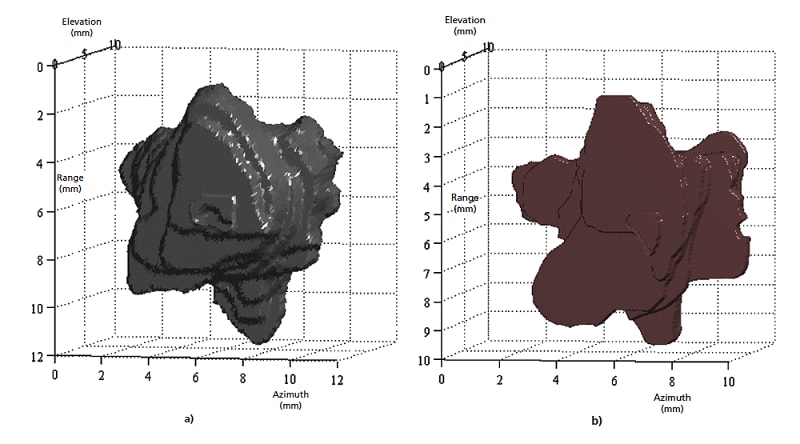
- Research, development, and test of techniques to improve ultrasound image quality and to facilitate automated (or semi-automated) border detection of lesions. An accurate 3D surface rendering was developed from 2D slices by implementing a 3D gradient vector flow (GVF) snake algorithm. The method is a stochastically driven compression filter called the “squeeze box filter” (SBF).
After the 3D surface of the prostate is segmented, the volume is determined by applying a novel blobbing technique, called the multi-directional connected component analysis (MDCCA). The volume in units of voxels of the object enclosed by the 3D surface is attained by summing the binary 3D data of MDCCA of non-intersecting slices. The volume is converted to units of cubic centimeter (or millimeter or other units) by multiplying with the voxel resolution. Since volumes can be measured directly, rather than extrapolating volume from a length dimension or cross-sectional area, the image contributions are well-matched and complement contributions in 3D and elastographic imaging.
This work was done by Dr. John A. Hossack of the University of Virginia for the U.S. Army Medical Research and Materiel Command. ARL-0065
This Brief includes a Technical Support Package (TSP).

High Res Anatomic & Elastographic Transrectal Ultrasound for Improved Diagnosis of Prostate Cancer
(reference ARL-0065) is currently available for download from the TSP library.
Don't have an account?
More From SAE Media Group
Medical Design Briefs
NASA-Developed Software Improves Diagnostic Imaging
Medical Design Briefs
Miniature Robot Could Check Colons for Early Signs of Disease
Medical Design Briefs
Oxford Software Spin-out Improving Ultrasound Diagnostics
Medical Design Briefs
Compact Device Can Detect Rheumatoid Arthritis

Medical Design Briefs
Simulations Address Delays in MRI Breast Imaging
Medical Design Briefs
Spatially-Invariant Vector Quantization for Image Analysis

Photonics & Imaging Technology
Laser-based System Achieves Noncontact Medical Ultrasound Imaging

Medical Design Briefs
New, More Accurate Tool Helps Surgeons Find Liver Tumors
Medical Design Briefs
Device Combines Ultrasound and Photoacoustics to Improve Imaging
Medical Design Briefs
Paper-Based Technology Advances Earlier Cancer Detection
Medical Design Briefs
High-Visibility Biopsy Needles

Photonics & Imaging Technology
Developing a Laser System to Decrease the Rate of Neurodevelopment Issues
Medical Design Briefs
Improved 3D Printing for Patient-Specific Medical Diagnosis
Medical Design Briefs
AI Enables Low-Dose CT Scans
Medical Design Briefs
Microchip Detects Prostate Cancer Markers
Medical Design Briefs
Noninvasive Test Detects Cancer Cells
Medical Design Briefs
AI Platform for Mammography Aids Decision-Making
Photonics & Imaging Technology
Hybrid Microscope Streamlines Imaging for Research and Medicine
Medical Design Briefs
AI Spots Lung Cancer Before Radiologists
Medical Design Briefs
Metamaterial-Enhanced MRI Technology Provides Higher-Quality, More Detailed Images
Medical Design Briefs
Rapid Imaging of Functions in Living Brain
Medical Design Briefs
Microfluidics Device Helps Diagnose Sepsis
Medical Design Briefs
The Promise of Mobile Photoacoustic Imaging
Medical Design Briefs
New Tech Takes Radiation Out of Cancer Screening
Medical Design Briefs
Optical Device Offers Improved Thyroid Cancer Screening
Medical Design Briefs
Device Creates 3D Images of Skin
Overview
The document is an annual report detailing the progress of a research project titled "High Resolution Anatomic and Elastographic Transrectal Ultrasound for Improved Diagnosis of Prostate Cancer," led by Dr. John A. Hossack at the University of Virginia. Funded by the U.S. Army Medical Research and Materiel Command, the project aims to enhance prostate cancer diagnosis through advanced ultrasound imaging techniques.
The report outlines the project's key objectives, referred to as "Aims." The first aim focuses on the design and development of a high-resolution transducer optimized for imaging elastic inhomogeneities. A specialized ultrasound transducer capable of operating at frequencies up to 14 MHz was designed and manufactured, significantly improving image resolution compared to previous models that operated at a maximum of 8 MHz. This transducer features a central imaging array with 192 elements and two tracking arrays, providing high-quality raw ultrasound data essential for subsequent analyses.
The second aim involves the development and testing of a tissue elasticity imaging system. The team assembled the necessary apparatus for transrectal ultrasound-based strain imaging and created custom prostate phantoms for testing. These phantoms allowed for efficient design iterations and low-cost replacements. The tissue elasticity system was tested using both the older and newer transducers, demonstrating the potential for migration to other ultrasound systems.
The third aim focuses on improving algorithms for 3D elastography and image processing. Significant progress was made in developing techniques for dimensionally accurate 3D reconstructions of the prostate, enhancing the quality of ultrasound images and facilitating automated detection of lesions.
The report also highlights preliminary results, including the successful assembly of ultrasound test instrumentation and the production of dimensionally accurate 3D prostate phantom images. The project has made substantial progress in achieving its goals, with ongoing work planned for further refinement and clinical testing.
Overall, the report emphasizes the innovative approaches being taken to improve prostate cancer diagnosis through advanced ultrasound technology, showcasing the potential impact of these developments on clinical practices. The research is positioned as a significant advancement over conventional diagnostic methods, such as Digital Rectal Examination (DRE) and PSA blood tests.
Top Stories
INSIDERManufacturing & Prototyping
 How Airbus is Using w-DED to 3D Print Larger Titanium Airplane Parts
INSIDERManned Systems
 FAA to Replace Aging Network of Ground-Based Radars
NewsTransportation
 CES 2026: Bosch is Ready to Bring AI to Your (Likely ICE-powered) Vehicle
NewsSoftware
 Accelerating Down the Road to Autonomy
EditorialDesign
 DarkSky One Wants to Make the World a Darker Place
INSIDERMaterials
 Can This Self-Healing Composite Make Airplane and Spacecraft Components Last...
Webcasts
Defense
 How Sift's Unified Observability Platform Accelerates Drone Innovation
Automotive
 E/E Architecture Redefined: Building Smarter, Safer, and Scalable...
Power
 Hydrogen Engines Are Heating Up for Heavy Duty
Electronics & Computers
 Advantages of Smart Power Distribution Unit Design for Automotive...
Unmanned Systems
 Quiet, Please: NVH Improvement Opportunities in the Early Design...
