




Heavy-Payload Conveyance Paves the Way for Next-Generation Battery Manufacturing
As battery applications diversify, the ability to adapt production systems quickly will separate leaders from laggards.

Battery technology is at the center of global innovation. From electric vehicles and off-highway machinery to consumer electronics and grid storage, demand for high-performing, reliable batteries has never been higher. This acceleration creates pressure on manufacturers to scale production while safeguarding quality and throughput.
The challenges are significant. Modern battery lines must balance high-volume output with unparalleled precision, often operating within fractions of millimeters to ensure product consistency. At the same time, battery packs are becoming larger and heavier, particularly in applications such as electric trucks, aviation and renewable energy storage. As payload requirements increase, manufacturers are turning to advanced automation and material handling systems to keep pace.
The Push for Productivity
Heavy-payload conveyance is emerging as a defining capability in this transition. By integrating transport systems capable of moving modules weighing hundreds or even thousands of kilograms with accuracy and repeatability, battery producers can accelerate speed to market without sacrificing quality.
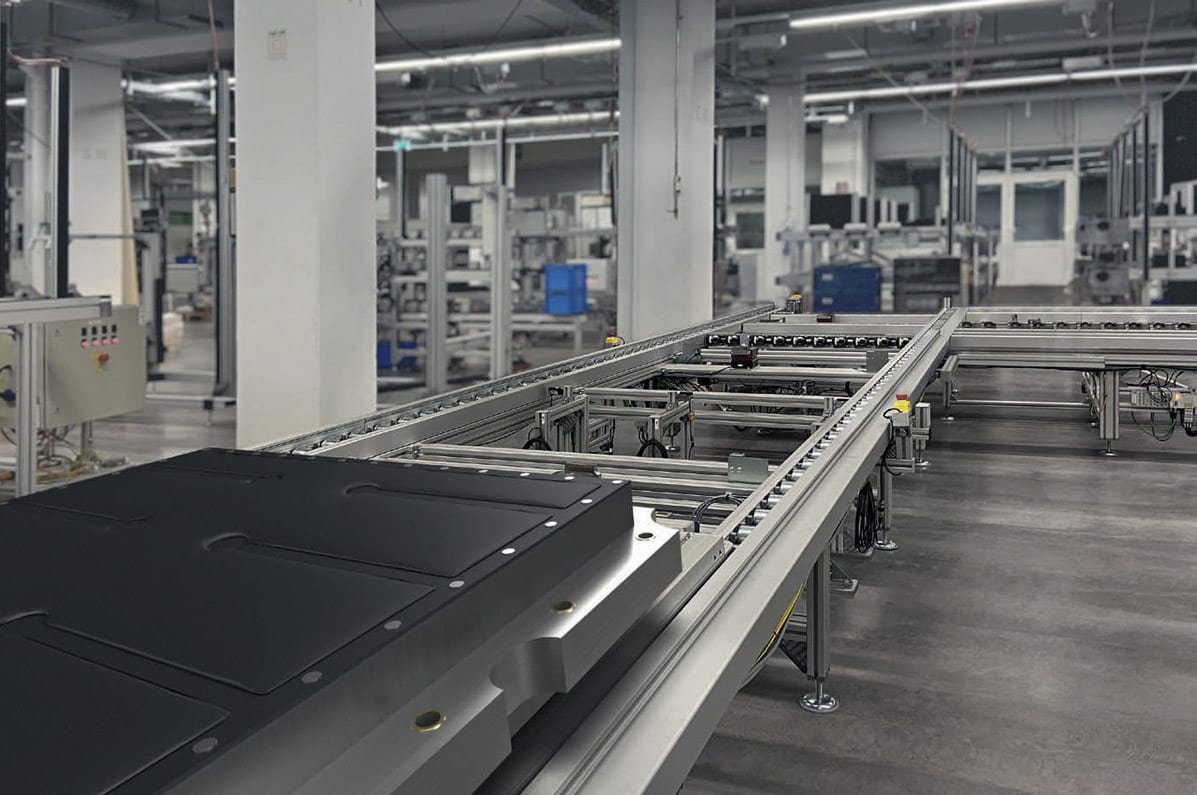
Whether in cylindrical, pouch or prismatic form, each battery cell must be produced, stacked, assembled, and tested in highly automated environments. A single production line may need to stack electrode layers every 200 milliseconds, with endpoint accuracy within 200 microns. Any deviation introduces costly scrap or rework.
Automation technology suppliers have supported industries facing similar challenges for decades. With batteries, however, the breadth of operational complexities and needs is unique. Lines must not only handle vast volumes but also move progressively heavier and more complex modules. As manufacturers push for larger-scale production output, traditional conveyor systems are no longer sufficient.
Conveyance for Heavy Payloads
Among the most significant advances in battery line design is the adoption of linear motor–driven transport systems. Unlike conventional conveyors, these systems use magnetically propelled movers that can carry payloads from a few kilograms up to more than 1,000 kilograms — all at speeds of up to five meters per second.
This capability has proven to be critical in production because battery packs for electric trucks or grid storage can weigh well over half a ton. Moving such payloads with precision — within 0.02 millimeters — ensures each pack can be assembled, tested and validated in-line without compromising throughput.
Linear motor-driven transport systems also allow for more engineering flexibility. Individual carriers can be programmed to move asynchronously or in unison, allowing manufacturers to synchronize critical process steps or reroute products dynamically. In practice, this means heavy modules can bypass certain stations, return for rework or move directly into end-of-line testing without disrupting flow.
For plant designers, the ability to integrate heavy-payload conveyance into compact footprints is equally important. With pallet sizes up to 1.5 meters by 2.8 meters, these systems can accommodate large-format modules while still supporting high-density layouts that conserve floor space.
Automation Across the Line
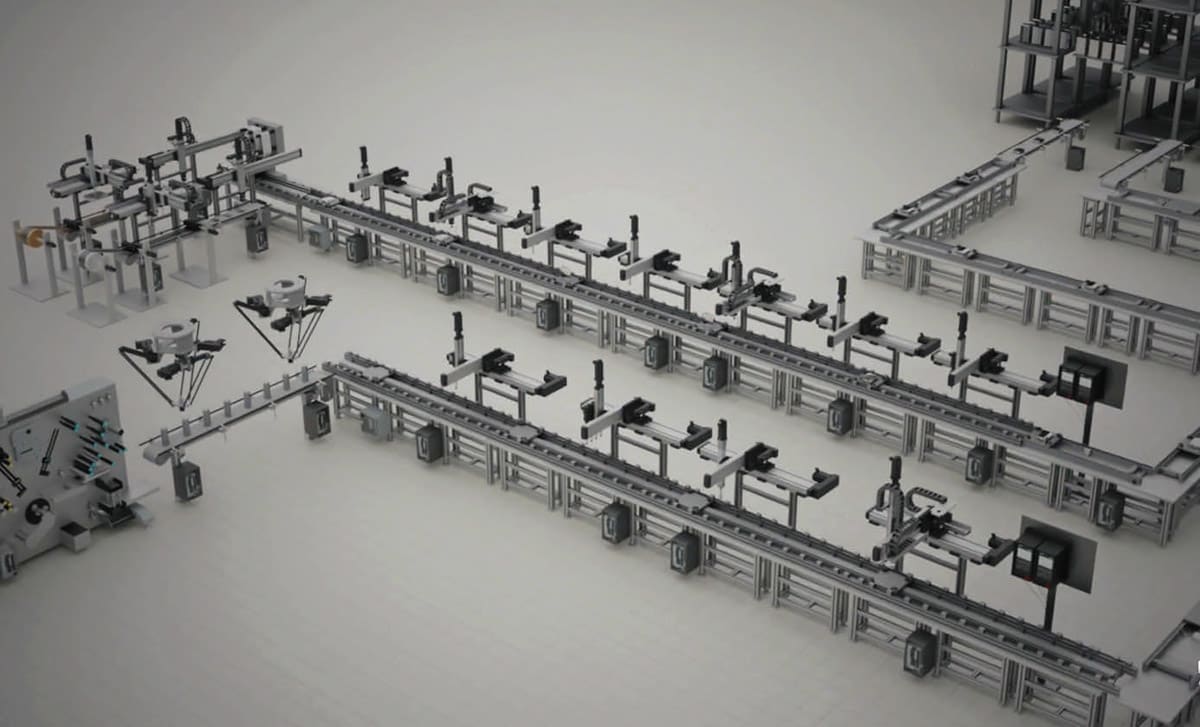
Heavy-payload conveyance is only one element of the equation, as battery manufacturing requires precision automation at every stage.
Electrode production: Quality control begins with mixing and coating raw materials into anodes and cathodes. Multi-axis synchronization and tension control ensure foils are applied consistently, reducing the risk of web breakage. Advanced electromechanical cylinders and servo-driven actuators help maintain accuracy even at high speeds. Maintaining synchronization across dozens of axes is essential to avoid variations in coating thickness or pressure during electrode production. Even small inconsistencies can reduce energy density or shorten cycle life, making precise control a priority in high-volume environments.
Cell production: Once electrodes are prepared, cells must be stacked, wound or filled depending on format. Here, high-speed transport systems deliver components with both velocity and precision. Conveyor technologies provide modular, adaptable solutions for lighter loads, while heavier-duty systems handle larger payloads.
Module assembly: Bringing cells together into modules requires robotics, pressing systems and precise dispensing. Plug-and-produce mechatronics kits simplify commissioning and enable fast integration of robotic handling systems. Intelligent handheld tools support hybrid assembly approaches, offering torque control and traceability for critical fastening steps. While robotic systems manage the bulk of repetitive steps, certain module designs still benefit from skilled manual intervention. Smart handheld tools that integrate control and analytics allow operators to perform these tasks efficiently while maintaining traceability and quality assurance.
End-of-line testing: Testing is non-negotiable. EV battery lines may require testing a new pack every 72 seconds to match vehicle assembly rates. Scalable drive and power conversion platforms provide constant voltage and current control, enabling precise cycling that validates battery performance before shipment.
Together, these systems create a cohesive automation strategy that allows battery manufacturers to scale battery production safely.
Expanding Global Demand
The push for electrification is global, and so is the race to increase battery production capacity. Battery production capacity is increasing worldwide, raising expectations for both speed and reliability in manufacturing. Heavy-payload conveyance plays an essential role in meeting these demands by ensuring large and complex modules can be moved safely and efficiently through each stage of assembly.
Meeting Diverse Applications
Battery manufacturing is not limited to developing on-highway passenger EVs. Heavy-duty vehicles, aviation prototypes and marine transport all rely on increasingly powerful batteries, and the demand continues to grow. Stationary storage for wind and solar installations requires modules that can weigh several thousand kilograms. Conveyance systems must therefore handle a wide range of sizes and formats, from compact cylindrical cells to massive multi-module packs.
Designing flexible systems that can adapt to different applications reduces the need for costly retooling. It also enables manufacturers to serve multiple markets from a single facility, an increasingly common strategy as electrification expands.
Future-Proofing for New Chemistries
As research accelerates, new battery chemistries such as solid-state and sodium-ion are moving closer to commercialization. Each chemistry introduces its own production challenges, from different material handling requirements to alternative assembly techniques. Conveyance and automation platforms that are modular and adaptable will help manufacturers pivot more easily when these technologies scale.
The ability to future-proof investments is crucial. A plant designed around today’s lithium-ion modules may need to support a new format in only a few years. Flexible transport, robotic handling and testing systems give manufacturers the foundation to adjust quickly without major disruptions.
Meeting the Speed-to-Market Imperative
Electrification markets evolve quickly. Automakers are committing to aggressive rollout schedules. Energy providers are investing heavily in stationary storage. Consumer demand for electronics continues to climb. In each case, speed to market is a competitive advantage.
But moving faster carries risks. If manufacturers prioritize output without considering the integration of conveyance, robotics, testing and controls, they risk quality lapses that can erode customer trust. Recalls or field failures in batteries can have catastrophic financial and reputational consequences.
The more viable path is to adopt a system-level approach, where each step from electrode to end-of-line is designed to scale together. Heavy-payload conveyance plays a pivotal role in that system, ensuring even the largest modules move efficiently through the line.
Leveraging Expertise and Partnerships
No manufacturer can tackle these challenges in isolation. The complexity of modern battery lines requires collaboration between automation suppliers, machine builders and integrators. By applying concurrent engineering, overlapping system design, programming and component sourcing, production systems can be deployed more rapidly while minimizing downtime.
Suppliers with experience in both automotive and industrial automation bring valuable crossover knowledge. The same principles that govern precision in automotive assembly or packaging apply to batteries, with the added challenges of heavier payloads and tighter tolerances. Drawing from these industries accelerates learning curves and reduces risk.
Looking Ahead
The growth trajectory of electrification shows no sign of slowing. As battery applications diversify, the ability to adapt production systems quickly will separate leaders from laggards. Investments in flexible conveyance and automation platforms today can help manufacturers accommodate new formats, scale output efficiently, and remain competitive in a rapidly evolving industry.
Heavy-payload conveyance, once considered a niche capability, is becoming central to this vision. By combining it with robust robotics, flexible automation platforms and reliable testing systems, manufacturers can position themselves to deliver the next generation of batteries quickly, safely, and profitably.
This article was written by Bill LeAnna, Sales Product Manager, TS Conveyors, Bosch Rexroth (Charlotte, NC). For more information, visit here .
More From SAE Media Group

Automotive Engineering
BMW Plans Move to Structural Battery Packs and ‘46120’ Cells
Automotive Engineering
EMBATT Technology Could Double the Driving Range of EVs
Tech Briefs
Videos of the Month
Tech Briefs
How to Detect Battery Failures Quicker
Battery & Electrification Technology
Recyclable ‘Water Batteries’ That Won’t Catch Fire
Battery & Electrification Technology
The Rechargeable Renaissance
Battery & Electrification Technology
New Products
Battery & Electrification Technology
Improving Battery Performance with More Efficient Electrodes
Battery & Electrification Technology
New Products

Tech Briefs
Dry Manufacturing Process for EV Batteries
Power Electronics INSIDER
World’s Strongest Battery Paves Way for Light, Energy-Efficient Vehicles
Aerospace & Defense Tech Briefs
Improving Battery Design for eVTOL Aircraft With Simulation
Battery & Electrification Technology
Battery Innovation Key for Commercial and Off-Highway EVs

Automotive Engineering
Launching Aerospace Battery Tech for EVs
Automotive Engineering
All (Robot) Hands on Deck
Automotive Engineering
Q&A: Panasonic Races to Keep Pace with EV Battery Demand

Battery & Electrification Technology
New Products
Tech Briefs
Q&A: A Circulatory System for Robots
Battery & Electrification Technology
Developing High-Energy, Stable All-Solid-State Lithium Batteries Using Aluminum-Based Anodes and High-Nickel Cathodes
Battery Technology
Advancing Battery Technology: THE 2021 BATTERY SHOW Preview
Battery & Electrification Technology
Product Showcase
Tech Briefs
Factorial’s Solid-State B-Samples Send a Message
Battery & Electrification Technology
Volvo Trucks’ Battery Chemistry of Choice: NCA
Battery & Electrification Technology
How Intelligent Battery Management Drives EV Buyer Confidence
Top Stories
INSIDERManufacturing & Prototyping
 How Airbus is Using w-DED to 3D Print Larger Titanium Airplane Parts
INSIDERManned Systems
 FAA to Replace Aging Network of Ground-Based Radars
NewsTransportation
 CES 2026: Bosch is Ready to Bring AI to Your (Likely ICE-powered) Vehicle
NewsSoftware
 Accelerating Down the Road to Autonomy
EditorialDesign
 DarkSky One Wants to Make the World a Darker Place
INSIDERMaterials
 Can This Self-Healing Composite Make Airplane and Spacecraft Components Last...
Webcasts
Defense
 How Sift's Unified Observability Platform Accelerates Drone Innovation
Automotive
 E/E Architecture Redefined: Building Smarter, Safer, and Scalable...
Power
 Hydrogen Engines Are Heating Up for Heavy Duty
Electronics & Computers
 Advantages of Smart Power Distribution Unit Design for Automotive...
Unmanned Systems
 Quiet, Please: NVH Improvement Opportunities in the Early Design...
