




Breaking the Rules to Build a Better Battery
Fast charging a battery is supposed to be risky — a shortcut that leads to battery breakdown. But for a research team studying zinc-ion batteries, fast charging led to a breakthrough: It made the battery stronger.

By flipping a foundational belief in battery design, Hailong Chen, an Associate Professor in the George W. Woodruff School of Mechanical Engineering, and his team, found that charging zinc-ion batteries at higher currents can make them last longer. This surprising result, recently published in Nature Communications, challenges core assumptions and offers a path toward safer, more affordable alternatives to lithium-ion technology.
Zinc-ion batteries have several key advantages over lithium-ion batteries, the most commonly used rechargeable battery technology:
Zinc is one of the most abundant metals on Earth, and it’s mined in many countries.
Zinc is significantly cheaper than lithium and doesn’t rely on scarce materials.
Unlike lithium, zinc batteries won’t catch fire — a critical safety benefit.
Zinc is less toxic and easier to recycle than lithium-based materials.
However, until Chen’s discovery, zinc-ion batteries had one major drawback. The growth of dendrites, the sharp metal deposits that form during charging, can eventually short-circuit the battery. “We found that using faster charging actually suppressed dendrite formation instead of accelerating it,” Chen said. “It’s a very different behavior than what we see in lithium-ion batteries.”
With this approach, the zinc doesn’t build up into dendrites. Instead, it settles into smooth, compact layers — more like neatly stacked books than splintered shards — a structure that not only avoids short circuits but also helps the battery last longer.
“It goes against the conventional thinking that fast charging shortens battery life,” Chen said. “What we found expands people’s understanding of fast charging and could rewrite how we think about battery design and where they can be used.”
However, even breakthroughs have certain limits. Chen was quick to point out that while his discovery solves a major issue, it only fixes one half of the battery. A battery has two main ends, the anode and the cathode. Chen’s team made the anode last much longer. Now, the cathode must catch up. He is working to improve the cathode so the whole battery performs reliably over time. His team is also experimenting with mixing zinc with other materials to make zinc-ion batteries even more durable.
Chen’s team didn’t just stumble on these results. They built a novel tool that allowed them to watch how zinc behaved under different charging rates in real time, studying many samples simultaneously. That real-time, side-by-side view was important. Traditional battery experiments usually test one variable at a time. But this novel approach allowed researchers to test hundreds of conditions at the same time, speeding up discovery and revealing patterns that would have been easy to miss.
“We weren’t just seeing whether the battery worked or not; we were watching the structure of the material evolve as it charged,” Chen noted. Using their new tool, he and his team uncovered for the first time why fast charging makes zinc settle into smooth, tightly packed layers instead of dangerous, needle-like spikes. No one had ever experimentally mapped out this process before.
Chen’s team didn’t reinvent the battery. They challenged the status quo — and the data took them somewhere no one imagined. That unexpected result could redefine battery science. “You can imagine these zinc-ion batteries being used to store solar energy in homes, or for grid stabilization,” Chen said. “Anywhere you need reliable, affordable backup power.”
With growing demand for clean energy, unstable lithium supply chains, and safety concerns over flammable batteries, the need for alternatives has never been more urgent. If all goes well, Chen hopes zinc-ion batteries could be ready for everyday use in about five years.
For more information, contact Hailong Chen at
More From SAE Media Group
Power Electronics INSIDER
World’s Strongest Battery Paves Way for Light, Energy-Efficient Vehicles
Battery & Electrification Technology
Recyclable ‘Water Batteries’ That Won’t Catch Fire

Battery & Electrification Technology
Enhancing the Performance of All-Solid-State Batteries

Battery & Electrification Technology
Developing High-Energy, Stable All-Solid-State Lithium Batteries Using Aluminum-Based Anodes and High-Nickel Cathodes
Tech Briefs
A Better-Performing Sodium-Ion Cathode

Battery & Electrification Technology
Sodium Battery Is Capable of Rapid Charging in Just a Few Seconds
Tech Briefs
Metal-Free Battery Degrades on Demand
Battery & Electrification Technology
New Battery Cathode Material Could Revolutionize EV Market and Energy Storage
Battery & Electrification Technology
Smoothing Over Rough Edges in Batteries
Tech Briefs
Behold: The Oxygen-Ion Battery
Tech Briefs
A New Design for Lithium-Sulfur Batteries
Battery & Electrification Technology
New Cathode Material for Sodium-Ion Batteries
Tech Briefs
First-Ever 3D-Printed Battery
Battery & Electrification Technology
Researchers Discover a Surprising Way to Jump-Start Battery Performance



Battery Technology
Semi-Liquid Metal Anode
Battery & Electrification Technology
Designing Sodium-Ion Batteries with Extended Longevity
Tech Briefs
Test Your Knowledge About Batteries
Power Management INSIDER
A Fluid Solution to Dendrite Growth in Batteries
Medical Design Briefs
Flexible High-Energy Textile Lithium Battery Designed for Wearables
Battery & Electrification Technology
Advancing High-Energy-Density Devices
Battery & Electrification Technology
A Sodium-Aluminum Battery Aims to Integrate Renewables for Grid Resiliency
Photonics & Imaging Technology INSIDER
Invention Merges Solar With Liquid Battery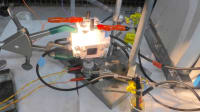
Top Stories
INSIDERManufacturing & Prototyping
 How Airbus is Using w-DED to 3D Print Larger Titanium Airplane Parts
INSIDERManned Systems
 FAA to Replace Aging Network of Ground-Based Radars
NewsTransportation
 CES 2026: Bosch is Ready to Bring AI to Your (Likely ICE-powered) Vehicle
NewsSoftware
 Accelerating Down the Road to Autonomy
EditorialDesign
 DarkSky One Wants to Make the World a Darker Place
INSIDERMaterials
 Can This Self-Healing Composite Make Airplane and Spacecraft Components Last...
Webcasts
Defense
 How Sift's Unified Observability Platform Accelerates Drone Innovation
Automotive
 E/E Architecture Redefined: Building Smarter, Safer, and Scalable...
Power
 Hydrogen Engines Are Heating Up for Heavy Duty
Electronics & Computers
 Advantages of Smart Power Distribution Unit Design for Automotive...
Unmanned Systems
 Quiet, Please: NVH Improvement Opportunities in the Early Design...
