




Heterogeneous System-on-a-Chip for Self-Powered Wireless Sensor Networks
Hundreds to thousands of ultralight sensor nodes can perform remote sensing in a distributed fashion.
A new dimension of system architecture design is emerging where hundreds to thousands of ultralight (<10g) sensor nodes will collectively perform a spectrum of wireless sensor network missions in a distributed fashion. To support this architecture, the development of a technique is underway to design and fabricate self-powered wireless sensor nodes monolithically as a system-on-a-chip (SoC) with commercially available complementary metal-on-silicon (CMOS) technology. The goal is to realize a novel system-on-a-chip (SoC) component integration on a single silicon die.
Two essential technologies specifically targeted at non-benign environments are proposed: integrated solar cells in CMOS, and radiation hardening by design of asynchronous logic. Two prototype designs have been designed, fabricated, and tested. The average efficiency of the first prototype is 2.4%, compared to an estimated, but unverified, 1% from previous work. The actual efficiency of the junction is 8.3%, without considering the metallization overhead. An improved design demonstrates 3.44% efficiency, a 40% improvement. The junction efficiency alone is 11.3%. However, power from these first two prototypes cannot be harnessed properly in the current implementation.
This novel development has potential widespread application to a rapidly growing number of solar self-powered SoC designs of any type. The application of radiation hardening by design (RHBD) to asynchronous logic is suggested as a unique approach for bare-die SoC implementations in hostile environments. Starting with a common synchronous microcontroller design implemented with commercial logic gates, the application of RHBD results in an expected 200% core area increase and requires 160% more energy. The most significant result is that the application of asynchronous design reduced the energy penalty to 85% (from 160%) for a 6% area increase with no performance impact. Additionally, electromagnetic interference is greatly reduced.
This approach provides environmental tolerance to radiation and temperature extremes. A suggested next step would be the monolithic integration of the developed solar cells and microcontroller with a single-chip radio design and simple sensor. The focus of this work would be to minimize or eliminate the traditional external components and establish self-powered wireless interconnectivity.
The monolithic SoC approach has been challenged by various packaging alternatives, including traditional printed circuit board (PCB), multichip module (MCM), system-in-package (SiP), and now system-on-package (SOP); however, SoC’s attraction is its low cost and mass producibility. Related prototyping design activities have been undertaken, targeting a system mass less than one kilogram, leading to a 70-g satellite-on-a-PCB prototype.
This work was done by Dr. Tanya Vladimirova and Dr. David Barnhart of the University of Surrey, UK, for the Air Force Office of Scientific Research. AFRL-0126
This Brief includes a Technical Support Package (TSP).
Heterogeneous System-on-a-Chip for Self-Powered Wireless Sensor Networks
(reference AFRL-0126) is currently available for download from the TSP library.
Don't have an account?
More From SAE Media Group
Tech Briefs
Rad-Hard CMOS Crystal Oscillator



Defense INSIDER
Defense Leaders Receive First Intel SHIP Multi-Chip Prototype

Electronics & Sensors INSIDER
Self-Powered Sensor Automatically Harvests Magnetic Energy
Tech Briefs
Graphene “Nano-Origami” Creates Tiny Microchips
Tech Briefs
Printable IoT Sensor Development Platform
Tech Briefs
Single Event Upset Suppression System (SEUSS)
Tech Briefs
How Much Do You Know About Integrated Circuits?
Tech Briefs
Radiation-Tolerant Dual Data Bus

Electronics & Sensors INSIDER
Opening Up the Potential of Thin-Film Electronics for Flexible Chip Design

Photonics & Imaging Technology INSIDER
STARLight Project Launches European Value Chain for Silicon Photonics Production
Tech Briefs
Thin-Film Electronics for Flexible Chip Design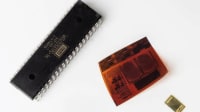
Aerospace & Defense Tech Briefs
Radiation-Tolerant FPGAs Solve Spacecraft Design Challenges
Aerospace & Defense Tech Briefs
SHIP Prototype Computer Chip
Tech Briefs
Magnetic Random-Access Memories
Tech Briefs
Products of Tomorrow
Tech Briefs
A Two-in-One Storage and Computing Device
Aerospace Manufacturing and Machining INSIDER
Army Launches CMOSS Prototyping Competition for Computer Chassis and Cards
Tech Briefs
Hyper-Distributed RFID Antenna (HYDRA) System
Aerospace & Defense Tech Briefs
New Products
Tech Briefs
Minimal Power Latch for Single-Slope ADCs
Aerospace & Defense Tech Briefs
FPGAs and HPC

Tech Briefs
Enhanced Material Stable Enough for Solar Cells
Tech Briefs
Executive Forum: Electronics Design
Overview
The document titled "Heterogeneous System-on-a-Chip Design for Self-Powered Wireless Sensor Networks in Non-Benign Environments" is a final report for the EOARD Grant FA8655-06-1-3053, authored by Dr. David Barnhart and Dr. Tanya Vladimirova from the University of Surrey. It presents a comprehensive study on the design and implementation of advanced sensor networks capable of functioning in harsh environmental conditions.
The report begins with an introduction outlining the scope and objectives of the project, emphasizing the need for robust wireless sensor networks (WSNs) that can operate in non-benign environments, such as those found in military or space applications. The authors discuss the concept of a "Satellite on-a-Chip," which integrates various functionalities into a single chip to enhance performance and reduce size.
A significant portion of the report is dedicated to the design of radiation-hardened asynchronous logic, which is crucial for ensuring the reliability of electronic components in environments with high radiation levels. The authors provide a background on radiation hardening techniques and present a case study demonstrating the synergy between radiation hardening by design (RHBD) and asynchronous logic. This section highlights the development of environmentally tolerant logic designs that can withstand extreme conditions.
The report also details the design and testing of SiGe BiCMOS solar cells, which are integral to the self-powered aspect of the sensor networks. The authors explain the basic theory of solar cell operation, the design process, and the results of testing these integrated solar cells, showcasing their effectiveness in powering the sensor nodes.
In addition to the technical aspects, the report outlines the mission needs for the sensor networks, including power generation, data handling, and wireless communication capabilities. The authors emphasize the importance of survivability and operability in the design of these systems, ensuring they can function effectively in diverse and challenging environments.
The conclusions section summarizes the results of the research and suggests future research directions, indicating the potential for further advancements in the field of self-powered wireless sensor networks. Overall, the document serves as a valuable resource for understanding the complexities and innovations involved in designing resilient sensor networks for critical applications.
Top Stories
INSIDERManufacturing & Prototyping
 How Airbus is Using w-DED to 3D Print Larger Titanium Airplane Parts
INSIDERManned Systems
 FAA to Replace Aging Network of Ground-Based Radars
NewsTransportation
 CES 2026: Bosch is Ready to Bring AI to Your (Likely ICE-powered) Vehicle
NewsSoftware
 Accelerating Down the Road to Autonomy
EditorialDesign
 DarkSky One Wants to Make the World a Darker Place
INSIDERMaterials
 Can This Self-Healing Composite Make Airplane and Spacecraft Components Last...
Webcasts
Defense
 How Sift's Unified Observability Platform Accelerates Drone Innovation
Automotive
 E/E Architecture Redefined: Building Smarter, Safer, and Scalable...
Power
 Hydrogen Engines Are Heating Up for Heavy Duty
Electronics & Computers
 Advantages of Smart Power Distribution Unit Design for Automotive...
Unmanned Systems
 Quiet, Please: NVH Improvement Opportunities in the Early Design...
