




Making Better EV Batteries — From the Bottom Up
BASF aims to become the world’s leading system supplier of functional materials for high-performance batteries. It has built a powerful R&D portfolio with which to challenge Japan’s incumbent giants in this booming field.

After chemist Marina Safont sealed the door to the ultra-dry room in BASF’s Battery Material Lab, the air inside the cramped antechamber gradually grew arid, almost as if a desert Sirocco wind had somehow swept through the German winter into the company’s city-size chemical plant and headquarters in Ludwigshafen, across the Rhine from Mannheim.
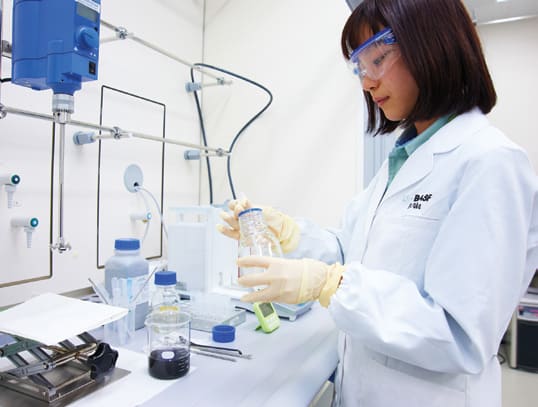
“Lithium is a fire hazard in the presence of water,” she told a small group of visitors including Automotive Engineering as the small space dehydrated further, parching lips and faces. Then with a slight pressure change the inner door opened out onto a large, well-lit clean room arrayed with argon-filled glove box stations for assembling sample cells, testing chambers, and analytical instruments.
In an adjacent room Safont pointed to labeled shelves of small batteries running silently behind glass doors. “In that one, we do accelerated testing of sample lithium-iron-phosphate cells and that one holds experimental lithium-sulfur cells.” BASF established the Battery Materials Lab in 2013, she said.

In fact, much of the big chemical company’s efforts in the $6 billion global EV battery market are relatively new, noted Andreas Fischer, Vice President of Battery Research and Electrochemistry. “Starting five or ten years ago we looked at the possibility of entering the battery materials market, but the suppliers of consumer-electronics battery technology were already too well established in Asia for us to catch up and contribute,” he recalled.
But despite its relatively late start, BASF set a long-term objective to become the world’s leading system supplier of functional materials for high-performance batteries. It aims to challenge Japan’s incumbents — Mitsubishi Chemical Holdings Corp., Sumitomo Chemical Co., and Ube Industries Ltd. — which currently dominate the global battery-materials business. BASF forecasts that by 2020 the global EV market for cathodes will reach $23 billion and the electrolyte market $6 billion, by which time it expects its own share to grow to about $570 million.
Building an R&D powerhouse
Fischer explained that when the electromobility issue emerged, “it became clear that new solutions in cathode and electrolyte technology were required to drive electric vehicles toward practicality.” BASF’s expertise in catalysts received a significant boost in 2006 with the purchase of Engelhard, at which point the company “knew that we could make a contribution to what would become an increasingly attractive market,” he said. Similarly, BASF’s traditional know-how in organic chemistry was expected to lead to improved electrolytes.
BASF’s entry strategy was to leverage a few existing cathode R&D activities and a series of specialist lab and IP acquisitions to rapidly give the company a uniquely diverse technology portfolio.
“Even a large chemical company can’t do everything on its own, so we started to look at R&D acquisition targets,” Fischer noted. BASF bought several companies and purchased licenses to create an impressive portfolio that includes the NiMH (nickel-metal-hydride) activities of Evonik Industries of Essen, Germany; the electrolyte expertise of Darmstadt-based Merck Germany; and Novolyte Technologies, an electrolyte maker in Baton Rouge, LA, and Suzhou, China.
It also licensed nickel-cobalt-manganese (NCM) cathode technology from Argonne National Laboratory, which Fischer explained offers good energy density, high temperature stability, and good efficiency by enabling more discharge/charge cycles for batteries. Meanwhile, from LiFePO4+C Licensing, it purchased the rights to make lithium-iron-phosphate (LFP) cells, which combine good energy and power density, safety, and lower total unit costs.

In 2012 BASF opened an NCM manufacturing plant in Elyria, OH, and the next year spent $25 million to expand its R&D facility in Beachwood, OH, where it conducts catalyst and battery materials research. Space was made for a cathode materials research team and a team of chemical and process engineers. At BASF’s facility in Amagasaki, Japan, electrolyte research is the focus, and its Suzhou, China, facility conducts electrolyte application development work.
Recently, Fischer added, BASF announced a joint venture with Tokyo-based materials manufacturer Toda Kogyo Corp. that will focus on R&D, production, marketing, and sales of a broad range of cathode materials including nickel cobalt aluminum oxide (NCA), lithium manganese oxide (LMO), and NCM in Japan.
Since 2010 BASF has worked with Sion Power, of Tucson, AZ, to develop lithium-sulfur (Li-S) batteries and in 2012 made a $50-million equity investment in it.

“Sulfur electrochemistry gives you almost double the energy density,” Fischer said. “Sulfur is a really cheap and abundant material compared to cobalt, manganese, and nickel. Plus, if you can deliver more energy, the cost will go down.”
Using Sion Power’s Li-S batteries at night and solar power during the day, the Zephyr 7 all-electric UAV set a record for drone endurance a few years ago by flying for two weeks straight. Qinetiq, the U.K.-based multinational defense company built the drone and now Airbus Defense and Space is constructing the follow-on, the Zephyr 8 high-altitude pseudo-satellite vehicle, which will provide clients with long-term, uninterrupted communications links and surveillance services.
Tapping a global talent pool

Fischer stressed that a key part of BASF’s strategy in EV batteries is to partner with both the auto industry on battery applications and with the scientific community on basic research. “To make the best materials, we come at the problem from both the application side and the fundamental level,” he explained.
The company has fostered a network of top scientists in electrochemistry and battery materials to promote the open discussion of fundamental research issues in the field. “We’re presently tapping the talent pool in Asian universities, especially in Japan, but also Korea and China,” he noted.
The scientific network includes Takeshi Kondo at the Tokyo University of Science who studies electrochemical surfaces. Hubert A. Gasteiger, chair of Technical Electrochemistry at TUM Munich, is an expert on electrocatalysts, electroactive components, and electrodes. Brett Lucht, an organic chemist at the University of Rhode Island, specializes in electrolytes, while Petr Novák at ETH Zurich researches the electrochemistry of lithium-ion batteries.
Both BASF and Karlsruhe Institute of Technology fund the BELLA Battery and Electrochemistry Laboratory there. Fischer together with Jürgen Janek, solid-state electrochemist and head of the institute of physical chemistry at the Justus-Liebig-University Giessen, jointly lead the BELLA program, which combines fundamental work with application-driven projects on materials and cell components for next-generation batteries.
The network scored an advance in Li-S battery technology recently when a team led by Linda Nazer at the University of Waterloo in Canada developed a way to use manganese dioxide nanotechnology to better retain sulfur in electrodes and avoid the usual self-destruction. Waterloo’s experimental Li-S battery can recharge more than 2000 cycles.
“It’s a major step forward, especially long-term, but it doesn’t solve all the problems with sulfur,” Fischer noted.
Next-gen high-performance technologies
The “pillars” of successful EV battery technology are high energy density, small volume, lower weight, total safety, and low costs, Fischer said. “And since 1990, energy density per kilogram has about doubled, and tripled or quadrupled by volume, while safety has improved and costs have started to fall.”
Materials substitution is one way to cut costs, he said, citing an R&D project that aims to develop nickel-rich NCM-family electrodes that would require less cobalt and manganese, which both cost more.
Better performance is another approach toward better affordability. Fischer highlighted both high-voltage spinel and high-energy NCM batteries as two likely next-generation candidates to provide higher energy densities at roughly equivalent cost.
“High-voltage spinel (LiNiMnO) means higher energy density, but you need an electrolyte that won’t break down,” Fischer said. Lithium-ion runs at 4.3 to 4.4 V, whereas the spinel could run at 5 V.
Meanwhile, researchers such as Doron Aurbach of Bar Ilan University in Tel Aviv are working on high-energy NCM batteries that are based on alternative ion-conducting materials. The most promising cell is based on magnesium ions, which supply double the positive charge than do lithium ions and make more powerful batteries. By using nano-materials, Aurbach believes that the new batteries could be significantly lighter and last as much as twice as long as current ones. In addition, magnesium-ion cells would be cheaper to produce.
But high-energy NCM prototypes so far have had problems with magnesium leaching out of the cathodes and gassing at high voltage, Fischer noted. These issues might be controlled with the right additive or basic solvent. “But first we need to better understand the fundamental mechanism,” he said.
More From SAE Media Group
Power Electronics INSIDER
World’s Strongest Battery Paves Way for Light, Energy-Efficient Vehicles
Battery & Electrification Technology
Manufacturing Advances in Solid-State Batteries
Battery Technology
Cobalt-Free Cathodes for Lithium-Ion Batteries
Battery Technology
Mapping Performance Variations to See How Lithium-Metal Batteries Fail


Battery & Electrification Technology
Developing a Better Way to Recycle Lithium-Ion Batteries
Battery & Electrification Technology
The Rechargeable Renaissance
Battery Technology
Hybrid Membrane Doubles the Lifetime of Rechargeable Batteries
Tech Briefs
Lithium Metal Battery Allows Cold Charging


Battery & Electrification Technology
Thick Electrodes’ Chemistry Matters More Than Structure for Battery Performance
Battery & Electrification Technology
Using Nano-Engineering Techniques to Develop a Safer Battery
Tech Briefs
Long-Life Lithium-Metal Battery
Battery Technology
New Materials Move Li-Ion Batteries Toward the Solid-State Endgame


Battery Technology
Semi-Liquid Metal Anode
Battery & Electrification Technology
Safe and Energy-Efficient Quasi-Solid Battery for Electric Vehicles and Devices
Battery & Electrification Technology
Folded or Cut, This Lithium-Sulfur Battery Keeps Going
Tech Briefs
A New, Low-Cost Aluminum-Sulfur Battery
Battery & Electrification Technology
Iron Could Be Key to Less Expensive, Greener Lithium-Ion Batteries
Battery & Electrification Technology
Developing High-Energy, Stable All-Solid-State Lithium Batteries Using Aluminum-Based Anodes and High-Nickel Cathodes
Battery & Electrification Technology
Increased Storage Capacity in Water-Based Batteries

Tech Briefs
Building Temperature-Resilient Batteries
Battery & Electrification Technology
Niobium: Magic Metal for Battery Anodes?
Top Stories
INSIDERManufacturing & Prototyping
 How Airbus is Using w-DED to 3D Print Larger Titanium Airplane Parts
INSIDERManned Systems
 FAA to Replace Aging Network of Ground-Based Radars
NewsTransportation
 CES 2026: Bosch is Ready to Bring AI to Your (Likely ICE-powered) Vehicle
NewsSoftware
 Accelerating Down the Road to Autonomy
EditorialDesign
 DarkSky One Wants to Make the World a Darker Place
INSIDERMaterials
 Can This Self-Healing Composite Make Airplane and Spacecraft Components Last...
Webcasts
Defense
 How Sift's Unified Observability Platform Accelerates Drone Innovation
Automotive
 E/E Architecture Redefined: Building Smarter, Safer, and Scalable...
Power
 Hydrogen Engines Are Heating Up for Heavy Duty
Electronics & Computers
 Advantages of Smart Power Distribution Unit Design for Automotive...
Unmanned Systems
 Quiet, Please: NVH Improvement Opportunities in the Early Design...
