




Breakthroughs in White LEDs Pave the Way for Changes in the Illumination Industry
In 2007, Cree, Inc. of Durham, NC announced a series of breakthroughs in its ongoing research of white light-emitting diode (LED) technology, including the demonstration of a device that can produce as much light as a standard light bulb or fluorescent tube.
Cree's latest milestone, an - nounced in September 2007, is the 1,000-lumen mark. (A lumen is a measure of brightness as perceived by the human eye.) The company believes reaching this milestone shows that the technology is well on its way to making ordinary incandescent light bulbs obsolete.
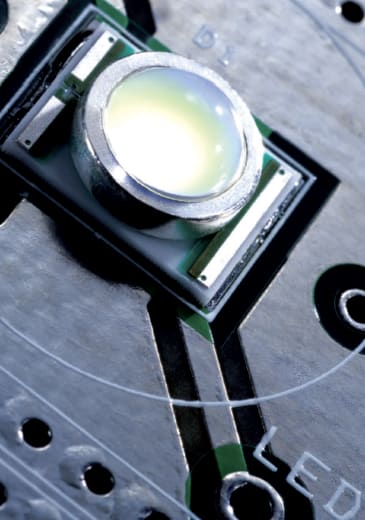
Warm-white LEDs produce an effect similar to the light that comes from incandescent bulbs. White LEDs that operate at lower levels of current can reach even higher efficiency levels.
None of these devices tested last year was made for commercial use. However, Cree will apply what it has learned from the experiments to improve its XLamp® line of LED products. For nearly a decade, Cree has been refining white LED technology in order to offer more efficient, longer-lasting, and cost-effective alternatives to traditional lighting sources.
Already, LED lighting products, including devices that emit colors such as red, green, and blue, last longer than incandescent light bulbs — burning for 10,000 to 50,000 hours, depending on their use. And not only do white LEDs function nearly 10 times as efficiently as ordinary light bulbs, they also outperform halogen bulbs by at least four times, and they outperform some fluorescent bulbs by a factor of 1.5.
How it Works
LEDs, solid-state semiconductors that convert electrical energy into light, have come a long way since they were first used for indicator lamps for consumer electronics and for illuminating small displays on mobile phones and other portable devices. The first LEDs on the market were red, followed by green and yellow. These colors can be created by a variety of semiconductor materials. (The materials regulate the wavelength and, therefore, the color of light emitted.) The key to producing white light depended on the development and efficient exploitation of blue LEDs.
White light could be generated by combining emissions from red, green, and blue LEDs, although this approach is not favored by those making LED systems for the commercial market today, because of the difficulty in maintaining the consistency of three light sources. Rather, most white LED devices are made by covering blue LEDs with a yellow phosphor, which to the human eye gives the appearance of white light. Some companies explored the use of sapphire as a substrate for the blue LEDs, while Cree focused on silicon-carbide (SiC) semiconductor materials because they are electrically conductive and because they are better heat conductors.
Cree uses SiC as a growth substrate, with gallium nitride (GaN) as the active blue-emitting lighting element on top. Much of the success to date in developing white LEDs can be attributed to advances in the performance of blue-light emitters.
Where it Stands
As for applications, these solidstate components can be used for personal and portable lighting, industrial lighting, emergency lighting on police cars and fire trucks, and the illumination of streets and parking areas. Muni - cipalities are particularly interested in white LEDs for street and parking illumination because they save money by employing longer lasting and more energy-efficient lights. Cree's XLamp LED product line also is used in color-changing systems for mood and architectural accent lighting. In fact, Cree's XLamp LEDs provided the artistic lighting for the National Aquatics Center at the 2008 Summer Olympics in Beijing. The building, known as the "Water Cube," employed 444,000 color-changing XLamp LEDs to illuminate the bubble shapes that appear all along its translucent exterior.
Households and businesses can reap the benefits of white LED technology. Not only can these devices save energy, they also are more environmentally friendly than some light sources because they do not contain lead or mercury. Cree sees the efficiency and long life of LED technology, as well as accompanying energy savings, as top selling points. A wide array of customers have turned to LED systems for applications that range from automobile taillights to traffic signals to architectural lighting. Still, the company is focused on producing less-expensive white LEDs that can send the incandescent light bulb to the dustbin of history.
More Information
For more information on Cree's XLamp line of LEDs, click here . (By Keith Costa/NTTC; Source: MDA TechUpdate, Missile Defense Agency, National Technology Transfer Center Washington Operations.)
Top Stories
INSIDERManufacturing & Prototyping
 How Airbus is Using w-DED to 3D Print Larger Titanium Airplane Parts
INSIDERManned Systems
 FAA to Replace Aging Network of Ground-Based Radars
NewsTransportation
 CES 2026: Bosch is Ready to Bring AI to Your (Likely ICE-powered) Vehicle
NewsSoftware
 Accelerating Down the Road to Autonomy
EditorialDesign
 DarkSky One Wants to Make the World a Darker Place
INSIDERMaterials
 Can This Self-Healing Composite Make Airplane and Spacecraft Components Last...
Webcasts
Defense
 How Sift's Unified Observability Platform Accelerates Drone Innovation
Automotive
 E/E Architecture Redefined: Building Smarter, Safer, and Scalable...
Power
 Hydrogen Engines Are Heating Up for Heavy Duty
Electronics & Computers
 Advantages of Smart Power Distribution Unit Design for Automotive...
Unmanned Systems
 Quiet, Please: NVH Improvement Opportunities in the Early Design...
