




Infrared-Sensitive Photorefractive Polymer Composite Devices
Reading and writing can be done at video frame rates.
Polymer composites that are photorefractive at visible and near- infrared wavelengths, and devices that exploit their photorefractivity, have been demonstrated. Potential applications for such devices could include real-time holography, medical imaging, imaging through light-scattering media, and beam cleanup in free-space optical communications. Especially notable products of this development effort include devices that exhibit one-photon photorefractivity with high diffraction efficiency at a wavelength of about 1 μm and devices that exhibit two-photon photorefractivity at a wavelength of about 1.5 μm. The polymer composites used in these devices are the first-demonstrated all-organic photorefractive materials suitable for wavelengths >0.83 μm, and are among the best infrared-sensitive photorefractive materials yet demonstrated under similar experimental conditions.
•Poly(acrylic tetraphenyldiaminobi - phenyl) [PATPD] was formulated as the charge-transport matrix component;
•Two new chromophores C 3-(N,N-di-n-butylaniline-4-yl)-l- dicyanomethylidene-2- cyclohexene (DBDC) and 3-(4-(azepan-I-yl)-phenyl)-l- dicyanomethylidene-2- cyclohexene (APDC) C were formulated to increase conjugation lengths, and hence, dipole moments over those of previously known dicyanostyrene-based chromophores. These increases are expected to lead, in turn, to increases in figures of merit.
•Polymer composite samples containing a single previously known chromophore C 4-homopiperidino benzylidine-malonitrile C were prepared. Usually, loading of a single chromophore in a photorefractive composite must be limited to less than 40 weight percent to prevent crystallization, which is undesired. However, when chromophores are mixed, a greater loading can be achieved before the onset of phase separation. Hence, in addition, samples containing two chromophores were prepared.
•Adopting a poly(vinyl carbazole) composite recipe previously demonstrated to be successful, ethyl carbazole was used as a plasticizer and fullerene (C60) was used as a photosensitizer at a wavelength of 633 nm.
•A new molecule C 2-[2-{5-[4-(di-n-butylamino) phenyl]-2,4-pentadienylidene}-1,1-dioxido-1-benzothien-3(2H)-ylidene] malononitrile (DBM) C was developed as the sensitizer for one-photon photorefractivity at a wavelength of 1 μm and two-photon photorefractivity at a wavelength of 1.5 μm.
Other accomplishments include the following:
- The response times of the devices developed in this effort are of the order of 300°C, short enough for writing and erasing at video frame rates.
- A photorefractive polymer composite for use at the important telecommunication wavelength of 1.55 μm was formulated. The components of this composite were optimized to yield a diffraction efficiency >40 percent.
- It was shown that holograms can be fixed by reducing their temperatures and that, while thus fixed, they can be read nondestructively.
- Devices that exhibit >90 percent internal diffraction efficiency at working voltages as low as 1 kV (lower than those of prior photorefractive polymer devices) were demonstrated.
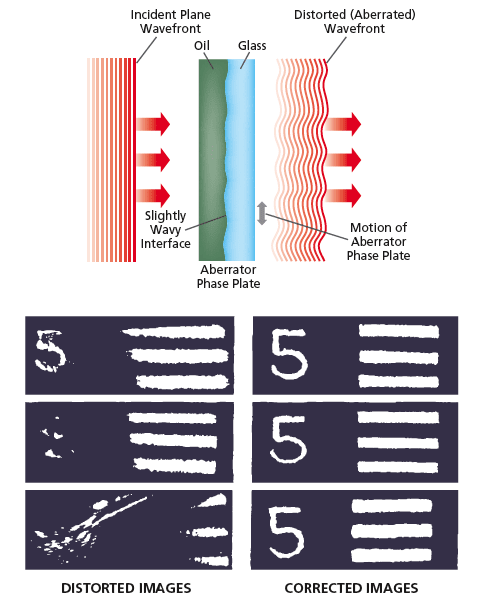
- In an experiment, a photorefractive polymer composite was shown to be capable of high-quality correction of dynamic atmospheric-like wavefront aberrations (see figure) with video-rate response.
- It was shown that photorefractive devices can be used to perform a high-spatial-frequency-pass filter function for edge detection.
- Photorefractive polymer composites were formulated for applications in which insensitivity to vibrations is required. An optimized composite of this type exhibited a diffraction efficiency >50 percent when written by a single 0.532-μm-wavelength laser pulse having an energy density of 4 mJ/cm2 and read by use of a continuous-wave laser beam at a wavelength of 0.633 μm. Insensitivity to vibrations can be achieved because the duration of the writing pulse is of the order of a nanosecond. Moreover, these composites can be written and read at either or both wavelengths and, therefore, can be used for performing two-color holography. Further development may enable the use of these or related composites as dynamic full-color holographic recording media.
This work was done by Nasser N. Peyghambarian of Purdue University for the Air Force Research Laboratory.
AFRL-0033
This Brief includes a Technical Support Package (TSP).

Infrared-Sensitive Photorefractive Polymer Composite Devices
(reference AFRL-0033) is currently available for download from the TSP library.
Don't have an account?
More From SAE Media Group
Photonics & Imaging Technology
Ultra-Narrowband Optical Filters Pushing Boundaries from the UV to the LWIR
Tech Briefs
Products of Tomorrow

Tech Briefs
Chemical Sensors Based on Optical Ring


Photonics Tech Briefs
Hot Dielectrics as Light Sources for TPV Devices and Lasers
Tech Briefs
Tunable, Narrow Linewidth, Chip-Scale Lasers
Photonics & Imaging Technology
New Frequency Comb Can Identify Molecules in 20-Nanosecond Snapshots

Tech Briefs
Levitating Objects with Light

Photonics Tech Briefs
Imaging of γ-Irradiated Regions of a Crystal
Photonics & Imaging Technology
The Latest Advancements in Optics
Motion Design INSIDER
Microdrones With Light-Driven Nanomotors

Tech Briefs
Delamination-Indicating Thermal Barrier Coatings
Photonics Tech Briefs
Holographic Vortex Coronagraph



Electronics & Sensors INSIDER
Two-Dimensional Hybrid Metal Halide Device Allows Control of Terahertz Emissions

Tech Briefs
System for Thermal Imaging of Hot Moving Objects



Overview
The document titled "Infrared-Sensitive Photorefractive Polymer Composite Devices" presents a comprehensive overview of advancements in photorefractive (PR) materials, particularly focusing on polymer composites that are sensitive to infrared wavelengths. The research, conducted by Professor Nasser N. Peyghambarian and his team at Purdue University, spans from March 2004 to December 2006 and outlines significant accomplishments in the field.
The primary goal of the project was to develop high-performing PR polymer composites that operate effectively at wavelengths around 1 µm (1000 nm) and 1.5 µm (1550 nm), which are critical for telecommunications and imaging applications. The report highlights the successful development of devices that demonstrate high diffraction efficiency, near-video-rate response times, and the ability to perform two-color holography. This capability is a step towards creating dynamic full-color holographic recording media.
Key findings include the creation of a photorefractive polymer composite that operates efficiently at the important telecommunication wavelength of 1550 nm, achieving over 40% diffraction efficiency. The document also discusses the potential applications of these materials in real-time holography, medical imaging, and imaging through scattering media. Notably, the research addresses the use of PR materials for beam cleanup in free-space communications, which is essential for improving signal quality in optical communication systems.
The report emphasizes the innovative approach of using one-photon and two-photon photorefractivity to enhance device performance. The team successfully demonstrated the first all-organic photorefractive material that operates beyond 830 nm, marking a significant milestone in the field. Additionally, the document outlines the development of devices sensitive to green (532 nm) and red (633 nm) wavelengths, aimed at all-color display applications.
Overall, the research showcases the potential of photorefractive polymer composites in various high-tech applications, including updateable 3D displays and advanced imaging systems. The findings contribute to the ongoing development of efficient and versatile materials that can meet the demands of modern optical technologies, paving the way for future innovations in the field of optoelectronics.
Top Stories
INSIDERManufacturing & Prototyping
 How Airbus is Using w-DED to 3D Print Larger Titanium Airplane Parts
INSIDERManned Systems
 FAA to Replace Aging Network of Ground-Based Radars
NewsTransportation
 CES 2026: Bosch is Ready to Bring AI to Your (Likely ICE-powered) Vehicle
NewsSoftware
 Accelerating Down the Road to Autonomy
EditorialDesign
 DarkSky One Wants to Make the World a Darker Place
INSIDERMaterials
 Can This Self-Healing Composite Make Airplane and Spacecraft Components Last...
Webcasts
Defense
 How Sift's Unified Observability Platform Accelerates Drone Innovation
Automotive
 E/E Architecture Redefined: Building Smarter, Safer, and Scalable...
Power
 Hydrogen Engines Are Heating Up for Heavy Duty
Electronics & Computers
 Advantages of Smart Power Distribution Unit Design for Automotive...
Unmanned Systems
 Quiet, Please: NVH Improvement Opportunities in the Early Design...
