




Laser Televisions Promise More Vibrant Images
Laser televisions have an image produced by three lasers that are each less than one cubic centimeter in size and that are a million times brighter than current state-of-the-art light-emitting diodes (LEDs). They provide sharper, crisper, more brilliant pictures than you have ever seen. And this new television costs less to produce than the television you own now.
Novalux of Sunnyvale, CA has developed the Novalux extended-cavity surface-emitting laser (NECSEL™) for use in high-definition (HD) rear-projection televisions (RPTVs). Laser RPTVs differ greatly from typical televisions on the market today. They offer many advantages compared with the LED and ultra-high-performance lamp RPTVs. The red, green, and blue lasers and accompanying components, which when combined are smaller than a matchbox, render bulky lamp televisions obsolete, as they eliminate the need for fans, lamps, color wheels, and beam-shaping optics.
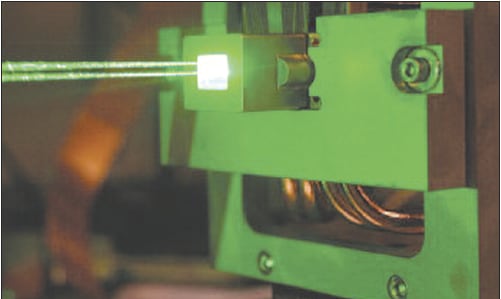
Laser televisions will provide speckle-free images that have more contrast and better color coverage than their unwieldy, expensive counterparts. They also use 60% less power and have a lifespan more than 10 times as long as lamp televisions. And unlike LED televisions, laser televisions have incredible longevity without giving way to distracting color shifts over time.
In 1994, Micracor of Acton, MA developed the technology behind this device, not for use in televisions, but to enable durable, lightweight microlasers for optical communications in space by the Strategic Defense Initiative Organization (SDIO), a predecessor of the Missile Defense Agency (MDA). Dr. Aram Mooradian, founder and principal investigator for Micracor, developed the optically pumped surface-emitting semiconductor laser that was later acquired by Coherent, Inc. After leaving Micracor and founding Novalux, he patented and produced an electrically pumped version that was simpler and more cost-effective.
How it Works
A typical laser consists of a cavity filled with a gain medium. The cavity has a mirror at each end, one of which is partially reflective. An energy source excites the particles in the medium to release light energy, with all the photons having the same phase frequency and direction of travel. The light bounces back and forth between the mirrors before escaping as a laser beam through the partially reflective mirror.
The pinhead-sized NECSEL has a gallium-arsenide semiconductor medium. Novalux modified the traditional structure of the surface-emitting laser by reducing the reflectivity of one of the epitaxial mirrors and adding another partially reflective mirror outside the body of the laser. This extra mirror, separated by a few centimeters from the laser die, leaves sufficient space for intracavity optics. Novalux put a nonlinear optical crystal in that gap. The crystal enables the doubling of the frequency of the light as the beam passes through it, and this shift in frequency makes visible the colors that produce the television's brilliant display.
When Novalux first demonstrated the NECSEL in 1999, the results stunned even the inventor. "When it lased, the brightness was so high it hit the CCD camera and flared it so that on the TV screen it looked like a star pattern, which was exactly the logo for the company that I put down on day one," Mooradian said.
Where it Stands
Since then, Novalux announced a major joint development and license agreement with Seiko Epson Corporation that resulted in the use of NECSEL-based illumination devices in microdisplay-based lasers. It also secured $21.7 million in financing and joined forces with Unaxis Optics, a Switzerlandbased company, with further hopes of using NECSELs in projection displays. In addition, Novalux is pursuing several other deals with major television manufacturers.
Users should see Novalux's lasers in the future, and not just in their televisions. Within the display market, they have potential for use in movie theater projectors, heads-up displays, and car dashboards. Novalux is also planning to market its lasers in cell phone picoprojectors — devices that will allow consumers to project large, sharp, radiant images directly onto walls and screens using portable, hand-held laser displays built into their cell phones.
Beyond displays, NECSELs have a wide range of applications, from medicine to telecommunications to military functions. They may one day serve in the treatment of cancer, and they have potential for use in intricate heart and eye surgeries. They can boost signals sent over optical telephone, computer, or television lines, making telecommunications lightning-fast.
Their potential for use in range finders, target designators, and sensors for detecting chemical and biological agents renders them useful in a wide range of military operations in addition to the space-based applications for which they were funded originally.
More Information
For more information on Novalux's NECSEL technology, click here . (Source: MDA TechUpdate, Missile Defense Agency, National Technology Transfer Center Washington Operations.)
Top Stories
INSIDERManned Systems
 How Airbus is Using w-DED to 3D Print Larger Titanium Airplane Parts
INSIDERAerospace
 FAA to Replace Aging Network of Ground-Based Radars
NewsUnmanned Systems
 Microvision Aquires Luminar, Plans Relationship Restoration, Multi-industry Push
NewsDesign
 CES 2026: Bosch is Ready to Bring AI to Your (Likely ICE-powered) Vehicle
NewsSoftware
 Accelerating Down the Road to Autonomy
INSIDERManned Systems
 Can This Self-Healing Composite Make Airplane and Spacecraft Components Last...
Webcasts
Power
 Hydrogen Engines Are Heating Up for Heavy Duty
Transportation
 Advantages of Smart Power Distribution Unit Design for Automotive...
Automotive
 Quiet, Please: NVH Improvement Opportunities in the Early Design...
Power
 A FREE Two-Day Event Dedicated to Connected Mobility
Connectivity
 E/E Architecture Redefined: Building Smarter, Safer, and Scalable Vehicles
Manufacturing & Prototyping
 How Sift's Unified Observability Platform Accelerates Drone Innovation