




Progress in Design and Synthesis of Nanostructured Materials
These materials may play a role in the development of bio-nanoelectronic circuitry and 3D electronic power structures.
A five-and-a-half-year integrated multidisciplinary research project has been characterized by three themes pertinent to the development of advanced materials having tailorable microstructures and/or nanostructures. These themes are (1) biocompatible nanolithographic methods of patterning and templating of materials to have two- and three-dimensional nanostructures; (2) nucleic-acid-based approaches to preparing (both in solution and from predesigned, nanostructured surface templates) supramolecular structures tailored to perform specific functions; and (3) protein-based or inspired molecular and supramolecular architectures. The contributions of this and other related research projects can be expected to lead to the development of diverse nanostructured organic and inorganic materials and structures, including catalytic peptide tubes, hostguest materials for molecular separations, quantum-dot and magnetic-particle arrays, bio-nanoelectronic circuitry, photonicbandgap and three-dimensional electronic power structures, and novel biowarfare- detection materials.
From one perspective, the objectives of this research project have been the following:
- To establish the basic chemical and physical rules that govern the use of such biomolecules as those of deoxyribonucleic acid (DNA), ribonucleic acid (RNA), peptide nucleic acid (PNA), peptides, and proteins for the assembly of two- and three-dimensional organic and inorganic structures having predictable and useful properties;
- To merge solution-phase strategies for assembly of three-dimensional nanostructures with surface-directed strategies that involve reliance on dip pen nanolithography (DPN); and
- To develop computational means of predicting the structural, optical, electrical, and mechanical properties of novel templated structures synthesized according to the abovementioned concepts.
Progress toward these objectives is manifested in the findings and accomplishments of several different sub-projects into which the research project was divided. Each sub-project emphasizes, and is named for, one aspect of the overall subject matter. The names of the subprojects and their respective efforts, accomplishments, and/or findings are summarized as follows:
Supramolecular Assembly Using Bio-Inspired Approaches
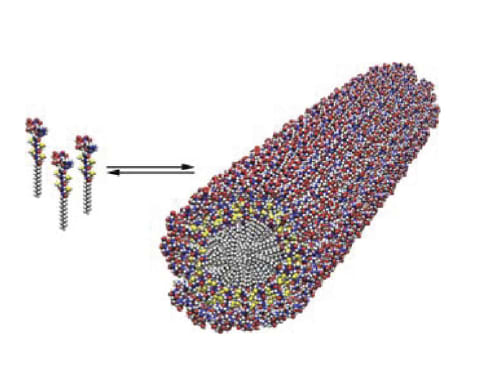
One group of researchers involved in this sub-project focused primarily on exploiting the structural features of selfassembling cyclic D, L-a-peptide nanotubes in the context of self-organizing organic conductors and semiconductors and secondarily on rational design of self-assembling peptide nanotubes carrying different structural and functional features suitable for the fabrication of new biologically active materials. Other groups involved in this sub-project addressed diverse topics, including collagen- like peptides and their threedimensional structures, polymer amphiphiles and formation of micelles, metal organic-based biomolecule nanoarrays, self-assembly of peptide amphiphile nanofibers (see figure), alignment of supramolecular structures based on peptide amphiphiles, a selfassembly system based on peptide lipid hybrid molecules, and synthesis of composite nanorods and assembly thereof into three-dimensional superstructures.
DPN and its Applications
Whittling by means of electrochemical desorption was developed as a means of reducing the sizes of DPNgenerated nanostructures on gold surfaces. Enzymatic polymerization was used in conjunction with DPN patterning of reactive monomers of 4-amin - othiophenol and caffeic acid to synthesize conducting polymers. Protocols for the assembly of nanoarrays composed of functional antibodies for the detection of the p24 protein of the human immunodeficiency virus 1 (HIV-1) were developed. A novel, high-throughput, high-resolution DPN technique called “on-wire lithography” (OWL) was developed for the lithographic processing of metallic nanowires having dents or gaps ranging in size from five to several hundred nanometers. These structures are ideal candidates to be developed into nanoelectronic and molecular electronic devices.
Functional Materials for Data
Storage, Sensing, and Diagnostics DPN-derived templates were used for the assembly of inorganic colloidal structures. It was found that both magnetic and dielectric colloids could be directly assembled or patterned onto the templates. It was found that sol-gels could be used as inks and patterned onto noble-metal and oxide substrates and that through the choice of sol-gel precursors, tailored ceramic materials could be formed. The sol-gel-precursor approach is expected to open new avenues for fabricating nanostructures capable of functioning as sensory, data-storage, and mag - neto/electronic devices. Other accomplishments of this sub-project include development of techniques for fabrication of nanoelectrodes, biosensory devices, and electrically conductive polymer nanostructures; development of a method of multiplexed localized patterning of polymers; and fabrication and determination of electrical properties of gold nanoparticles coated with organic material.
Computational Modeling of Self- Assembly
Computational models of physical and chemical phenomena involved in self-assembly of nanostructures were developed. The models were utilized in computational-simulation studies in which significant progress was made towards understanding, on a theoretical and experimental level, how two types of model molecules — alkyl thiols and peptide amphiphiles — assemble themselves on surfaces. Effects of environmental factors on the shapes and properties of structures formed by such selfassembly were analyzed.
This work was done by Chad A. Mirkin, Vinayak Dravid, Mark Ratner, George Schatz, Sam Stupp, David Kaplan, Reza Ghadiri, and David Ginger of Northwestern University for the Air Force Office of Scientific Research.
This Brief includes a Technical Support Package (TSP).
Progress in Design and Synthesis of Nanostructured Materials
(reference AFRL-0089) is currently available for download from the TSP library.
Don't have an account?
More From SAE Media Group
Tech Briefs
A Lightweight Material Stronger than Steel
Medical Design Briefs
Convergence Nanoparticles for Multi-Modal Biomedical Imaging

Tech Briefs
Advanced Carbon Aerogels for Energy Applications
Tech Briefs
Conductive Carbon Fiber Polymer Composite
Medical Design Briefs
Jetprinting Nanostructures with Self-Assembling Material
Medical Design Briefs
Transforming Plastic Parts into High-Value Products
Medical Design Briefs
3D Printable Polymer Nanocomposite Ink


Medical Design Briefs
Killing Cancer Cells May Be Possible With “Hairy” Nanorods


Photonics & Imaging Technology
New Electron Microscopy Technique Offers First Look at Previously Hidden Processes


Tech Briefs
High Thermally Conductive Polymeric Composites

Medical Design Briefs
Tubing Coated with Light-Powered Catalysts Aids Drug Manufacturing
Medical Design Briefs
Building Better Gas-Phase Biosensors for Fight Against Diseases
Aerospace & Defense Tech Briefs
Carbon Nanotube Thermal Interfaces Enhanced with Sprayed-On Nanoscale Polymer Coatings

Tech Briefs
3D Printing Ultrastrong Materials
Medical Design Briefs
Conductive, Cotton-Based Fiber for Smart Textiles

Tech Briefs
Fiber-Metal Laminate Manufacturing Technique
Overview
The document is a final technical report summarizing the accomplishments of a Multi-University Research Initiative (MURI) project titled "Surface-Templated Bio-Inspired Synthesis and Fabrication of Functional Materials," which took place from May 1, 2000, to December 31, 2005. The project was led by Principal Investigator Chad A. Mirkin at Northwestern University, with contributions from a team of researchers including Vinayak Dravid, Mark Ratner, and others.
The research focused on developing innovative methods for synthesizing and fabricating functional materials using bio-inspired approaches. The project was organized around three thematic areas: biocompatible nanolithography, nucleic acid-based architectures, and protein-based or inspired architectures. Key highlights include advancements in dip-pen nanolithography (DPN), which allowed for the precise patterning of biological molecules and the creation of nanostructured materials.
Significant achievements included the development of new protocols for assembling nanoarrays of functional antibodies for detecting the HIV-1 p24 protein, as well as the introduction of a novel technique called "On-Wire Lithography" (OWL) for fabricating one-dimensional metallic nanowires. This technique enabled the creation of gap structures suitable for nanoelectronic applications.
The report also details the successful application of enzymatic polymerization in conjunction with DPN to synthesize conducting polymers, and the exploration of supramolecular assembly using bio-inspired methods. The research team made strides in understanding the self-assembly of model molecules, such as alkyl thiols and peptide amphiphiles, on surfaces, analyzing how environmental factors influence the properties of these structures.
Throughout the project, the team published over 100 articles in peer-reviewed journals and participated in numerous scientific meetings and workshops, showcasing the productivity and impact of their research. The training of postdoctoral associates and graduate students in critical areas related to the Department of Defense's mission was also emphasized, highlighting the potential long-term benefits of the research.
In summary, the MURI project successfully advanced the field of bio-inspired material synthesis and fabrication, contributing valuable knowledge and techniques that could lead to innovative applications in various domains, including biomedical diagnostics, nanotechnology, and materials science.
Top Stories
INSIDERManufacturing & Prototyping
 How Airbus is Using w-DED to 3D Print Larger Titanium Airplane Parts
INSIDERManned Systems
 FAA to Replace Aging Network of Ground-Based Radars
NewsTransportation
 CES 2026: Bosch is Ready to Bring AI to Your (Likely ICE-powered) Vehicle
NewsSoftware
 Accelerating Down the Road to Autonomy
EditorialDesign
 DarkSky One Wants to Make the World a Darker Place
INSIDERMaterials
 Can This Self-Healing Composite Make Airplane and Spacecraft Components Last...
Webcasts
Defense
 How Sift's Unified Observability Platform Accelerates Drone Innovation
Automotive
 E/E Architecture Redefined: Building Smarter, Safer, and Scalable...
Power
 Hydrogen Engines Are Heating Up for Heavy Duty
Electronics & Computers
 Advantages of Smart Power Distribution Unit Design for Automotive...
Unmanned Systems
 Quiet, Please: NVH Improvement Opportunities in the Early Design...
