




Conjugated Polymers Having High Charge-Carrier Mobilities
Progress has been made toward realization of practical polymer semiconductor devices.
A three-year research project encompassed multiple studies of (1) polymer semiconductors that exhibit relatively high electric-charge- carrier mobilities and (2) applications of these polymers in electronic (including optoelectronic and nanoelectronic) devices. Although these polymers are of broad importance to all polymer semiconductor devices — including light-emitting diodes, photovoltaic cells, photodetectors, and electrophotographic imaging devices — the focus in this project was largely upon the use of these polymers in thin-film transistors, organic light-emitting diodes, and related light-emitting transistors.
The research included studies of synthesis of new polymer and oligomer semiconductors; investigation of novel processing techniques for realizing nanocrystalline, microcrystalline, and single crystalline polymer semiconductor thin films; measurement of charge-carrier mobilities; and design, fabrication, and evaluation of high-performance field effect transistors, organic light-emitting diodes, and light-emitting transistors. The major accomplishments of this research were the following:
- Field-effect electron mobilities as high as 0.1 cm2/(V•s) were observed in thin films of ladder poly(benzobisimidazobenzophenanthroline) [BBL] that had been formed by spin coating. This level of electron mobility is the highest observed to date in a conjugated polymer semiconductor, was found to vary strongly with the intrinsic viscosity (or molecular weight) of the polymer, and was found to be very stable in air and oxygen.
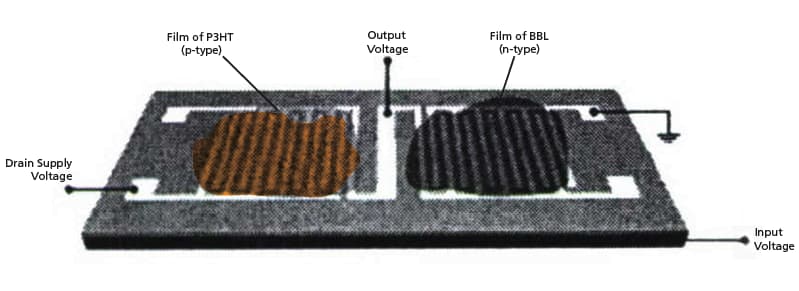
- The first-ever polymer-based complementary inverter was fabricated (see figure) and demonstrated to function substantially as intended. (As used here "complementary" signifies that the device is analogous to a complementary metal oxide/semiconductor inverter).
- A new class of ladder-type bisindoloquinoline semiconductors exhibiting a mobility of 1.0 cm2/(V•s) was synthesized.
- Ambipolar organic field-effect transistors were made from blends of p- and n-type polymers.
- The field-effect mobility of holes in regioregular poly(3 alkylthiophene)s was found to exhibit a non-monotonic dependence on alkyl chain length, showing a maximum mobility with hexyl. Fundamental insights into the structural factors that govern high-mobility charge transport and recombination in polymer semiconductors were also achieved.
This work was done by Samson A. Jenekhe, John D. Wind, Amit Babel, Yan Zhu, Christopher Tonzola, Jessica Hancock, Pei Tzu Wu, and Jessica Lembong of the University of Washington for the Air Force Office of Scientific Research.
AFRL-0082
This Brief includes a Technical Support Package (TSP).
Conjugated Polymers Having High Charge-Carrier Mobilities
(reference AFRL-0082) is currently available for download from the TSP library.
Don't have an account?
More From SAE Media Group
Tech Briefs
Stable Polymeric Ink with High Conductivity

Tech Briefs
Organic Material for Printed Electronics



Tech Briefs
Molecular Highway for Electrons in OLEDs

Tech Briefs
Ultra-Wide-Bandgap Power Electronics
Tech Briefs
A Two-in-One Storage and Computing Device

Tech Briefs
Organic Carbon-Nitride Semiconductor

Tech Briefs
Combined Optical Transmitter and Receiver

Electronics Tech Briefs
Induced-Eddy-Current-Sensor Measurement of Semiconductor Performance
Tech Briefs
New Method to Determine How 2D Materials Expand
Tech Briefs
Enhanced Material Stable Enough for Solar Cells
Electronics & Sensors INSIDER
Tiny But Mighty: Next-Gen Transistors Hold Great Promise
Tech Briefs
Turning Diamond into Metal

Aerospace & Defense Tech Briefs
Silicon Carbide Junction Field-Effect Transistor Devices for Scalable Solid-State Circuit Breakers

Tech Briefs
T-Shaped Emitter Metal Structures for HBTs
Overview
The document is a research report focused on high mobility conjugated polymers, addressing the limitations of current polymer electronic devices, such as organic field-effect transistors (OFETs), photovoltaic cells, and photodetectors, which are primarily hindered by low charge carrier mobilities. The research aims to investigate various polymer semiconductors that exhibit high carrier mobilities and explore their potential applications in electronics, optoelectronics, and nanoelectronics.
The report outlines several key areas of research, including the development of ladder polymer semiconductors, which are noted for their high electron mobility. It discusses the molecular weight dependence of electron mobility, indicating that variations in molecular weight can significantly impact the performance of these materials. Additionally, the report highlights the creation of all-polymer complementary inverters, which integrate p-channel and n-channel organic field-effect transistors (OFETs) to achieve functional electronic circuits. This integration is crucial for advancing low-cost plastic electronics and realizing complementary metal-oxide-semiconductor (CMOS)-like polymer inverters that offer low power dissipation and high performance.
The document also delves into the exploration of ambipolar OFETs, which can operate in both p- and n-channel modes. This characteristic is essential for developing low-power complementary integrated circuits suitable for logic and memory applications. The research investigates polymer blends that combine p-type and n-type components to create ambipolar charge transport properties, which are currently lacking in existing organic and polymer semiconductors.
Figures and diagrams within the report illustrate the chemical structures of the polymers studied, as well as the output characteristics of devices such as P3HT/20 wt% P4HQ nanowire FETs. The findings are positioned as significant contributions to the fields of polymer science and supramolecular chemistry, with implications for the development of advanced electronic materials.
Overall, the report emphasizes the importance of high mobility conjugated polymers in overcoming the limitations of current technologies and advancing the field of organic electronics. It presents a comprehensive overview of the research objectives, methodologies, and accomplishments, showcasing the potential for these materials to enhance the performance of electronic devices and contribute to the future of low-cost, high-performance plastic electronics.
Top Stories
INSIDERManufacturing & Prototyping
 How Airbus is Using w-DED to 3D Print Larger Titanium Airplane Parts
INSIDERManned Systems
 FAA to Replace Aging Network of Ground-Based Radars
NewsTransportation
 CES 2026: Bosch is Ready to Bring AI to Your (Likely ICE-powered) Vehicle
NewsSoftware
 Accelerating Down the Road to Autonomy
EditorialDesign
 DarkSky One Wants to Make the World a Darker Place
INSIDERMaterials
 Can This Self-Healing Composite Make Airplane and Spacecraft Components Last...
Webcasts
Defense
 How Sift's Unified Observability Platform Accelerates Drone Innovation
Automotive
 E/E Architecture Redefined: Building Smarter, Safer, and Scalable...
Power
 Hydrogen Engines Are Heating Up for Heavy Duty
Electronics & Computers
 Advantages of Smart Power Distribution Unit Design for Automotive...
Unmanned Systems
 Quiet, Please: NVH Improvement Opportunities in the Early Design...
