




Measuring Glucose Using pH-Sensitive Hydrogels
Suitably formulated hydrogels exhibit changes in swelling with changes in glucose concentration.
Sensors that exploit pH-sensitive hydrogels for measuring concentrations of glucose in aqueous solutions are undergoing development. Because the underlying chemical and physical principles are also applicable to sensing of biochemicals other than glucose, it is expected to be relatively easy to modify the glucose sensors to enable detection of such biochemicals.

The term "pH-sensitive hydrogels" denotes hydrogels that exhibit structural and hydration properties that change with changing concentrations of H+ ions in aqueous solutions. For the purpose of sensing glucose or another chemical species, a pH-sensitive hydrogel can be modified by the incorporation of active chemical components (e.g., enzymes) for catalyzing chemical reactions that lead to pH changes that increase with the concentration of that species. Then the change in a conveniently measurable physical property (e.g., a change in size as a measure of a change in swelling in response to a change in pH) can be used as an indication of the concentration of the species of interest. pH-sensitive hydrogels that have been modified or formulated to exhibit such changes in response to glucose or other chemical species of interest are sometimes called "smart gels."
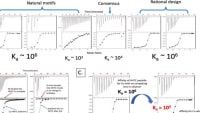
The development work thus far has focused on techniques for stable, efficient immobilization of enzymes and on transduction techniques for measuring small changes in gel size or water content. In one of two transduction techniques that have been investigated, a smart hydrogel is immobilized on one side of a microcantilever, the bending of which is taken as an indication of swelling of the hydrogel. The other transduction technique is based on fluorescence resonance energy transfer: The basic idea is to incorporate, into a hydrogel, fluorescent molecules, the spectral properties of which shift because of energy-transfer changes induced by gel swelling. Efforts to demonstrate sensing of glucose by use of both transduction techniques have been successful (for example, see figure). In addition, this development work has contributed to knowledge of the molecular structures and other properties of hydrogels.
This work was done by Michael J. McShane of Louisiana Tech University for the Army Research Laboratory. For further information, download the free white paper at www.defensetechbriefs.com under the Materials category. ARL-0006
This Brief includes a Technical Support Package (TSP).
Measuring Glucose Using pH-Sensitive Hydrogels
(reference ARL-0006) is currently available for download from the TSP library.
Don't have an account?
More From SAE Media Group

Medical Design Briefs
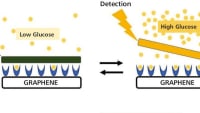
Creating Sensitive Gels for Glucose Testing
Medical Design Briefs
Building Better Gas-Phase Biosensors for Fight Against Diseases

Medical Design Briefs
Hybrid Material Enables Next-Gen E-Skin
Tech Briefs
3D Printing of Shape-Shifting Smart Gel
Medical Design Briefs
Wearable Sensor Measures Lactate Concentration in Real Time


Medical Design Briefs
Tubing Coated with Light-Powered Catalysts Aids Drug Manufacturing

Tech Briefs
Creating 2D All-Organic Perovskites

Medical Design Briefs
New Thermofluidic Improves Lab-On-a-Chip Applications
Sensing Technology
Low-Power Hydrogen Sensor Detects Leaks in an Instant
Tech Briefs
3D Printing Ultrastrong Materials
Sensor Technology
Ultra-Sensitive Lead Detector Could Improve Water Quality Monitoring
Battery & Electrification Technology
Increased Storage Capacity in Water-Based Batteries


Tech Briefs
Wearable, Stretchable Gas Sensor
Tech Briefs
Next-Generation Flow Battery Design
Battery & Electrification Technology
Designing Safer, Higher-Performance Lithium Batteries
Tech Briefs
Fast-Acting Molecular Probe
Overview
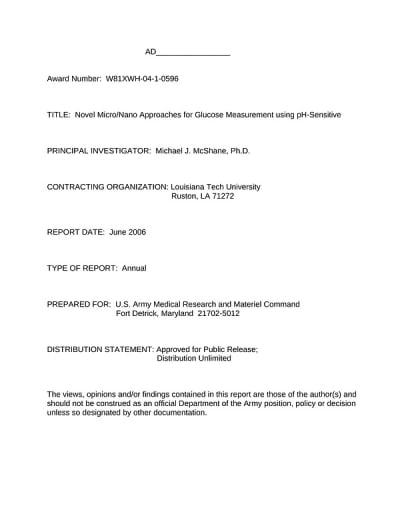
The document is a final report on a research project titled "Novel Micro/Nano Approaches for Glucose Measurement using pH-Sensitive" conducted by Dr. Michael J. McShane at Louisiana Tech University. The project was funded by the U.S. Army Medical Research and Materiel Command and spanned from June 1, 2004, to May 31, 2006. The primary objective of the research was to develop advanced biosensing platforms that utilize environmentally-sensitive hydrogel materials combined with immobilized enzymes to improve glucose monitoring methods, particularly for diabetics.
The report highlights the motivation behind the project, which stems from the need for more effective testing methods for glucose levels, as these levels serve as critical indicators of metabolic status. The research focuses on innovative transduction techniques that can reliably detect small changes in the physical and mechanical properties of hydrogels, specifically through microelectromechanical systems (MEMS) and fluorescence resonance energy transfer (RET) optical systems.
Key accomplishments of the project include successful demonstrations of glucose sensing using the aforementioned techniques. The research has led to significant discoveries regarding the structure and properties of hydrogels, which were uncovered through novel measurement approaches. The project has resulted in the publication of three manuscripts and the presentation of four conference reports, contributing valuable knowledge to the field of biosensing.
The report also includes sections on key research accomplishments, reportable outcomes, and conclusions, summarizing the impact of the findings on glucose monitoring technologies. The research is deemed significant not only for its potential applications in diabetes management but also for its broader implications in metabolic health monitoring.
Overall, the document serves as a comprehensive overview of the research conducted, detailing the methodologies employed, the results obtained, and the implications of the findings. It emphasizes the importance of continued innovation in biosensing technologies to enhance healthcare outcomes for individuals with diabetes and other metabolic disorders. The report is approved for public release, ensuring that the findings can be disseminated widely for further research and application in the field.
Top Stories
INSIDERManufacturing & Prototyping
 How Airbus is Using w-DED to 3D Print Larger Titanium Airplane Parts
INSIDERManned Systems
 FAA to Replace Aging Network of Ground-Based Radars
NewsTransportation
 CES 2026: Bosch is Ready to Bring AI to Your (Likely ICE-powered) Vehicle
NewsSoftware
 Accelerating Down the Road to Autonomy
EditorialDesign
 DarkSky One Wants to Make the World a Darker Place
INSIDERMaterials
 Can This Self-Healing Composite Make Airplane and Spacecraft Components Last...
Webcasts
Defense
 How Sift's Unified Observability Platform Accelerates Drone Innovation
Automotive
 E/E Architecture Redefined: Building Smarter, Safer, and Scalable...
Power
 Hydrogen Engines Are Heating Up for Heavy Duty
Electronics & Computers
 Advantages of Smart Power Distribution Unit Design for Automotive...
Unmanned Systems
 Quiet, Please: NVH Improvement Opportunities in the Early Design...
