




Fast Liquid-Crystal-on-Silicon Spatial Light Modulators
Stressed liquid crystals enable achievement of short response times for infrared light.
Stressed-liquid-crystal (SLC) light-modulating devices suitable for use as liquidcrystal- on-silicon (LCOS) spatial light modulators (SLMs) that could operate in nearand mid-infrared wavelength ranges have been demonstrated. These SLC devices were conceived to exploit the SLC electrooptical effect, which makes it possible to obtain response times shorter than those of prior infrared LCOS SLMs.
An LCOS SLM includes a light-modulating layer of a liquid crystal material placed directly on a complementary metal oxide/semiconductor (CMOS) integrated circuit. A typical LCOS SLM is compact, inexpensive, and easy to use, and contains millions of gray-scale pixels electrically addressable at a rate of thousands of frames per second. LCOS SLMs are used as imagegenerating devices in viewfinders of electronic cameras and rear-projection highdefinition television receivers, but have found only limited use in applications involving infrared light. The principal barrier to widespread acceptance in infrared applications has been long response times.
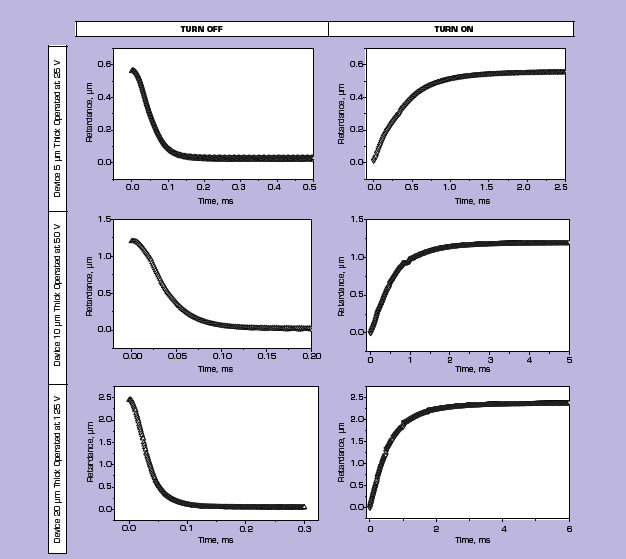
In an SLC device of the present type, the liquid-crystal material is, more specifically, a liquid-crystal/polymer composite aligned by shear stress. The device functions as a variable retarder to modulate light. The device is designed and constructed to exploit the facts that (1) when a sheared liquid- crystal polymer composite is placed between crossed polarizers with its shearing axis aligned at 45° to the polarizer axes, efficient intensity modulation can be obtained; and (2) the response time of an SLC device is shorter than that of a comparable unstressed-liquid-crystal device and is nearly independent of the thickness of the liquid- crystal layer.
The SLC devices that were demonstrated were designed and fabricated for operation in three wavelength bands: a near infrared band (1.8 to 2.5 μm), a midinfrared band (3 to 5.5 μm), and a far infrared band (8 to 14 μm). The devices for these three bands had thicknesses of 5, 10, and 20 μm, respectively. The devices were operated at drive potentials of 25, 50, and 125 V, respectively. As thus designed, built, and operated, the devices imposed half-wave modulation at response times ranging from 1.3 to and 1.6 ms (see figure). Although the drive potentials needed for near- and mid-infrared devices are high relative to potentials used in modern signal- and data-processing semiconductor circuits, they are low enough to enable the design and operation of stressed-liquid-crystal- on-silicon (SLCOS) SLMs into which the needed high-voltage transistors could be incorporated by use of standard CMOS fabrication processes.
This work was done by John R. McNeil, Michael J. O'Callaghan, and Mark A. Handschy of Displaytech, Inc.; Guoqiang Zhang, Anatoliy Glushchenko, and John L. West of Kent State University; and Kerry Lane and Stephen D. Gaalema of Black Forest Engineering for the Air Force Research Laboratory. For further information, download the free white paper at www.defensetechbriefs.com under the Photonics category. AFRL-0008
This Brief includes a Technical Support Package (TSP).
Fast Liquid-Crystal-on-Silicon Spatial Light Modulators
(reference AFRL-0008) is currently available for download from the TSP library.
Don't have an account?
More From SAE Media Group
Photonics & Imaging Technology
Light-Analyzing ‘Lab on A Chip’ Opens Door to Widespread Use of Portable Spectrometers


Tech Briefs
A More Responsive Infrared Photodiode
Photonics Tech Briefs
Arrays of QWIPs With Spatial Separation of Multiple Colors
Photonics & Imaging Technology
A Sharper Look at the Interior of Semiconductors
Air Force Research Laboratory Technology Horizons
Patterned Gallium Arsenide Devices for Infrared Countermeasures
Photonics & Imaging Technology
Optimizing Laser Cutting in Semiconductor Advanced Packaging

Tech Briefs
Light-Based Tech to Navigate the Moon
Photonics & Imaging Technology
Multicolored Light-Emitting Array on a Single Chip
Photonics & Imaging Technology
Moving Precision Communication, Metrology, Quantum Applications from Lab to Chip
Photonics & Imaging Technology
Researchers Create World’s Smallest LED And Holographic Microscope
Aerospace & Defense Tech Briefs
Researchers Demonstrate the First Chip-Based 3D Printer
Aerospace & Defense Tech Briefs
Laser Integration on Silicon Photonic Circuits Through Transfer Printing
Tech Briefs
Programming Light on a Chip
Photonics & Imaging Technology
Using Magnets to Toggle Nanolasers Leads to Better Photonics


Photonics & Imaging Technology
A First-Of-Its-Kind Integrated Optical Isolator
Photonics & Imaging Technology
Changing the Nature of Optics in One Step
Tech Briefs
Silicon Chip Improves LiDAR

Tech Briefs
Platform for All-Optical Computing
Photonics & Imaging Technology
How to Innovate and Overcome the Challenges of Blue Laser Beam Shaping
Overview
The document titled "Fast Multi-Spectral Liquid-Crystal-on Silicon Spatial Light Modulators" (AFRL-ML-WP-TP-2006-466) presents research on the development of stressed liquid-crystal (SLC) devices designed for use as liquid-crystal-on-silicon (LCOS) spatial light modulators (SLMs). The research, conducted by a team from various institutions, focuses on the electro-optic properties of SLCs, which promise rapid response times across multiple infrared (IR) wavelength bands, specifically the near-IR (1.8 to 2.5 μm), mid-IR (3 to 5.5 μm), and far-IR (8 to 14 μm).
The study reports on the fabrication of SLC devices with varying thicknesses (5, 10, and 20 μm) and their performance at different drive voltages (25, 50, and 125 V). These devices achieved half-wave modulation with response speeds ranging from 1.3 to 1.6 milliseconds. Notably, a 20-μm-thick SLC device demonstrated a visible-light contrast ratio of 360:1, which significantly improved to nearly 18,000:1 when a Babinet-Soleil compensator was used to offset residual SLC retardance.
The document emphasizes the potential for integrating these SLC devices into standard CMOS processes, as the drive voltages for near-IR and mid-IR applications are compatible with high-voltage transistor designs. This compatibility allows for the possibility of creating high-resolution SLMs with pixel pitches less than 24 μm, making 1000 × 1000 pixel configurations feasible.
The research highlights the importance of enhancing SLC materials by increasing birefringence (Δn) and dielectric anisotropy (Δε), which could further extend the capabilities of far-IR devices within standard CMOS voltage ranges. The findings suggest that advancements in SLC technology could lead to significant improvements in applications such as infrared scene projection and beam steering, which are critical for defense and security systems.
Overall, this document provides a comprehensive overview of the advancements in SLC technology, showcasing its potential for high-speed, high-contrast applications in various spectral ranges, and outlines the future directions for research and development in this field. The work has been approved for public release, ensuring that the findings contribute to the broader scientific and technical community.
Top Stories
INSIDERManufacturing & Prototyping
 How Airbus is Using w-DED to 3D Print Larger Titanium Airplane Parts
INSIDERManned Systems
 FAA to Replace Aging Network of Ground-Based Radars
NewsTransportation
 CES 2026: Bosch is Ready to Bring AI to Your (Likely ICE-powered) Vehicle
NewsSoftware
 Accelerating Down the Road to Autonomy
EditorialDesign
 DarkSky One Wants to Make the World a Darker Place
INSIDERMaterials
 Can This Self-Healing Composite Make Airplane and Spacecraft Components Last...
Webcasts
Defense
 How Sift's Unified Observability Platform Accelerates Drone Innovation
Automotive
 E/E Architecture Redefined: Building Smarter, Safer, and Scalable...
Power
 Hydrogen Engines Are Heating Up for Heavy Duty
Electronics & Computers
 Advantages of Smart Power Distribution Unit Design for Automotive...
Unmanned Systems
 Quiet, Please: NVH Improvement Opportunities in the Early Design...
