




Thermal Modeling Key to Optimizing EV Range

For potential EV buyers, it's all about the driving range. And for EV engineers tasked with increasing that range, it's all about improving power efficiency through thermal management and electro-thermal modeling.

That's according to Walden (Wally) Rhines, President and CEO of Mentor, who spoke with Automotive Engineering following his keynote at his company's 2017 Integrated Electrical Solutions Forum - Automotive, in Plymouth, MI.
Rhines explained that until recently, thermal analysis "was done by thermal engineering specialists who used very advanced software in order to evaluate the thermal characteristics of a design,” he said. That product development approach meant a particular design could hit a roadblock weeks to months into a program before a potential thermal problem was detected by a thermal engineering specialist.
“If you flunk the ‘thermal gate’ in the design, you go back and re-do the electrical design,” Rhines noted.
Thermal management considerations are now routinely being considered by design engineers, a trend that has evolved rapidly. "You can save an enormous amount of time by having general feedback of where you’re going in terms of thermal-electrical tradeoffs as early as possible,” he observed.
In EV development, the operating state of batteries is vital information, especially from an optimization perspective. A 10º C difference in battery temperature can extend a battery's lifespan by up to three years, Rhines explained. Improving thermal efficiency can improve battery performance by as much as 20%. Thermal simulation is crucial for determining what will happen under a specific condition.
The battery is not only a limiter in terms of driving range—it's also "the real limiter in terms of the overall cost of an electric vehicle because the battery is more expensive than any traditional automotive sub-system,” said Rhines.
Simulation models of an energy storage system are important on a number of fronts.
“It’s about the efficiency of getting the power from the battery to the wheels. If it’s heat being generated instead of usable power, that’s a battery output loss,” Rhines, said, noting there are also reliability issues associated with higher battery temperatures.
Simulation tools can improve the power efficiency and performance of the battery, which in turn improves the efficiency of the electric vehicle, according to Rhines.
“I believe virtualization tools will determine the winners for system design. Electrification and autonomous driving will accelerate that process because it will be impossible not to adopt virtual design tools for the design and verification process of vehicles of the future,” Rhines asserted.
Genevieve Cullen, President of the Electric Drive Transportation Assoc., noted the declining cost of automotive-spec lithium battery cells. “It was widely seen that the incremental cost of a Li-ion battery was about $1000 per kW·h in 2010, and now market analysts put it south of $300 per kW·h,” Cullen said. There are approximately 40 light-duty passenger EV models in the U.S. market today.
“By 2020, the number of passenger vehicle models, plug-in and all-electric, will likely triple,” she predicted.
More From SAE Media Group
Battery Technology
Using Multiphysics to Predict and Prevent EV Battery Fire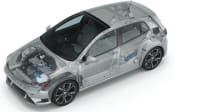
Automotive Engineering
Novelis Creates First Aluminum Sheet Battery Enclosure for Mass Electric Vehicle Production
Automotive Engineering
Simulation Rules: Scrubbing Heat, Sound and Dirt from Autonomous EVs
Battery Technology
Advancing Battery Technology: THE 2021 BATTERY SHOW Preview
Battery & Electrification Technology
Battery Innovation Key for Commercial and Off-Highway EVs
Automotive Engineering
Innovative ‘Afreecar’ Wins SAE’s 2021 Create the Future Design Award
Automotive Engineering
GM: Ultium Heat-Pump System Boosts EV Range, Reduces Charge Times
Power Electronics INSIDER
Reused car batteries rev up electric grid
Battery & Electrification Technology
The End of the Beginning: Why the EV Market Will Overcome the Loss of Tax Credits
Power Management INSIDER
Used Nissan LEAF Batteries Given “Second Life”
Tech Briefs
Machine Learning Method for Battery Development
Tech Briefs
Ganaio High-Output Regenerative Damper
Automotive Engineering
Using CAE to Assess Whining Noise of Electric Powertrains
Tech Briefs
Charging EVs as they Travel on Highways


Power Electronics INSIDER
New Smart Charger May Pave the Way for More EVs
Battery & Electrification Technology
Volvo Trucks’ Battery Chemistry of Choice: NCA
Power Electronics INSIDER
An Electrifying Collaboration: From the Lab to the Marketplace
Battery & Electrification Technology
48V Electrical Systems: A Key to Meeting Evolving Industry Demands
Automotive Engineering
FEV and the Art of EV Testing
Off-Highway Engineering
Israeli Startup REE Reinvents the Wheel with a Modular Approach to Future EV Design
Battery & Electrification Technology
Overcoming Challenges and Boosting Productivity for EV Battery and E-Axle Testing
Automotive Engineering
SAE WCX 2022: EV Cybersecurity Threats


Battery & Electrification Technology
Advancing Battery Technology: The 2023 Battery Show Preview
Battery Technology
Using Electric Vehicle Batteries for Solar Energy Farms
Off-Highway Engineering
ABS Ramps up Commercial-Vehicle Battery-Pack Assembly
Battery Technology
An Immersive Solution for Thermally Safer EV Batteries
Top Stories
INSIDERManufacturing & Prototyping
 How Airbus is Using w-DED to 3D Print Larger Titanium Airplane Parts
INSIDERManned Systems
 FAA to Replace Aging Network of Ground-Based Radars
NewsTransportation
 CES 2026: Bosch is Ready to Bring AI to Your (Likely ICE-powered) Vehicle
NewsSoftware
 Accelerating Down the Road to Autonomy
EditorialDesign
 DarkSky One Wants to Make the World a Darker Place
INSIDERMaterials
 Can This Self-Healing Composite Make Airplane and Spacecraft Components Last...
Webcasts
Defense
 How Sift's Unified Observability Platform Accelerates Drone Innovation
Automotive
 E/E Architecture Redefined: Building Smarter, Safer, and Scalable...
Power
 Hydrogen Engines Are Heating Up for Heavy Duty
Electronics & Computers
 Advantages of Smart Power Distribution Unit Design for Automotive...
Unmanned Systems
 Quiet, Please: NVH Improvement Opportunities in the Early Design...
