




Volvo Trucks Tests Hybrid Powertrain for Long-Haul Transport in Concept Truck

With improvements in aerodynamics, rolling resistance and reduced weight, Volvo Trucks has developed and enhanced the Volvo Concept Truck. First unveiled in 2016, the new version of the truck features a hybrid powertrain that the company claims is one of the first of its kind for heavy-duty trucks in long-haul applications. In combination with the vehicle’s other improvements, the total reduction in fuel consumption and CO2 is reported to be around 30%.

“We strive to be at the forefront of electromobility and to constantly push the limits when it comes to reducing fuel consumption and emissions," said Volvo Trucks' CEO Claes Nilsson, in a release statement. “Over the coming years, as society moves more and more towards renewable energy, we strongly believe that electromobility and hybrid technology will become increasingly important. The powertrain in our concept truck has been developed to improve transport efficiency and thereby help the industry towards sustainable transport. With the concept truck we will gain valuable knowledge and experience, which will help us develop the technology further.”
According to Volvo Trucks, the hybrid powertrain works by recovering energy when driving downhill on slopes steeper than 1%, or when braking. The recovered energy is stored in the vehicle’s batteries and used to power the truck in electric mode on flat roads or low gradients. An enhanced version of Volvo Trucks’ driver support system I-See has been developed specifically for the hybrid powertrain. It analyzes upcoming topography to calculate the most economical and efficient choice between the diesel engine and the electric motor, as well as the optimal time to use the recovered energy.
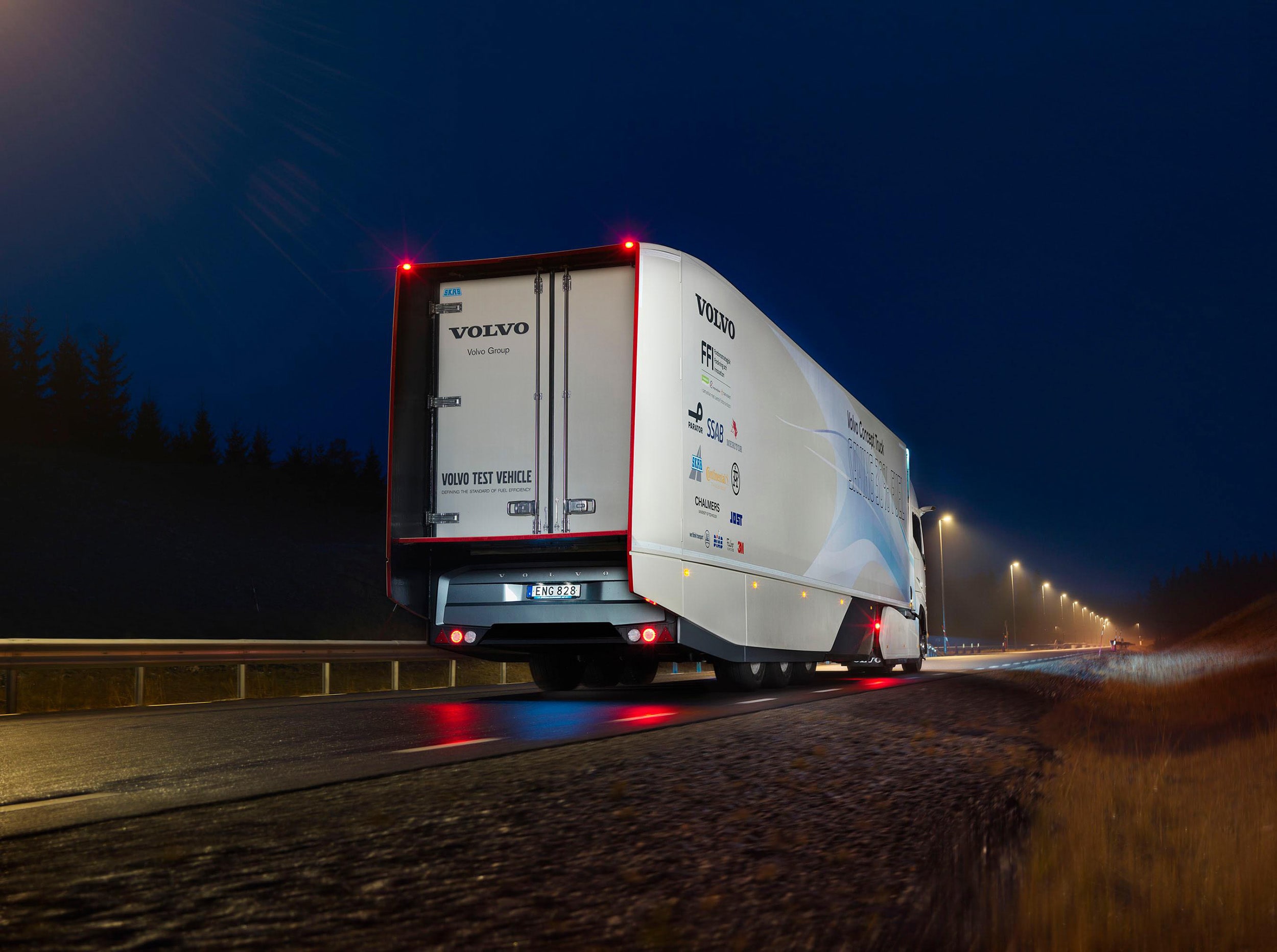
In long-haul transportation, it is estimated that the hybrid powertrain will allow the combustion engine to be shut off for up to 30% of the driving time. This will save between 5-10% in fuel, depending on the vehicle type or specification, and its drive cycle. Additionally, it offers the ability to drive in full electric mode for up to 10 km (6.2 mi), enabling the vehicle to operate with zero emissions and low noise.
“This is a platform for verifying several new technologies for increasing transport efficiency,” said Åke Othzén, Chief Project Manager, Volvo Trucks. “Some of these developments have already been introduced to our trucks, and some will be introduced in the near future. The hybrid powertrain is partly based on knowledge and experience from Volvo Buses’ hybrid and electric buses.”
The Volvo Concept Truck is the result of the Swedish part of a bilateral research project involving both the Swedish energy authority Energimyndigheten and the U.S. Department of Energy.
More From SAE Media Group
Off-Highway Engineering
Cummins Unveils PowerDrive Hybrid-Electrics, Euro 7 Diesel Concept
Automotive Engineering
Dealing with the BEV ‘Concavity’
Aerospace & Defense Tech Briefs
Hybrid Auxiliary Propulsion System
Automotive Engineering
AVL Transmission Aims at Best-In-Class PHEV Performance
Off-Highway Engineering
Nikola Looks to Accelerate Production, Hydrogen Infrastructure
Off-Highway Engineering
Many ICE Paths Lead to Reduced Emissions
Off-Highway Engineering
Electric Machines Find Their Niche
Off-Highway Engineering
Combustion Engines Carry on in Construction
Automotive Engineering
Suppliers Face the Electrified Future
Automotive Engineering
Volvo XC90 Line-Up Keeps Hybrid Futures Safe
Automotive Engineering
ZF Introduces Complete E-Drive System for Passenger, Commercial Vehicles
Automotive Engineering
Magna Shows off Electric Offroad Powertrain, In-Cabin Tech
Automotive Engineering
Mazda’s 2024 CX-90 Offers Turbo I-6, PHEV Propulsion
Automotive Engineering
48V Is Coming, and Not Just for EVs
Off-Highway Engineering
Danfoss Targets Excavators with New Digital-Hydraulics System
Automotive Engineering
Bosch Debuts New CV-Specific Electric Motor and Inverter
Automotive Engineering
New Zapp Electric Scooter Just 200 Pounds, 200 Components
Automotive Engineering
Hub-Motoring in Lordstown’s Novel Endurance
Automotive Engineering
Wheel-Hub-Motor Innovations in Flux

Off-Highway Engineering
Medium-Duty Engines, Transmissions Shift Focus to Software
Off-Highway Engineering
JCB Debuts Clean-Sheet Hydrogen Combustion Engine
Aerospace & Defense Tech Briefs
Electric Hybrid Propulsion System

Automotive Engineering
2019 Chevrolet Blazer: Sharply Styled and Right-Sized for the Voracious SUV Market
Automotive Engineering
Schaeffler Builds an E-Motor Powerhouse
Tech Briefs
SAE WCX™ Digital Summit Preview
Off-Highway Engineering
Can Hybrid-Electric Drivelines Be a Solution for Off-Highway Vehicles?
Automotive Engineering
EV Motor Development Is on the Move
Tech Briefs
High-Power Direct Borohydride Fuel Cells
Top Stories
INSIDERManufacturing & Prototyping
 How Airbus is Using w-DED to 3D Print Larger Titanium Airplane Parts
INSIDERManned Systems
 FAA to Replace Aging Network of Ground-Based Radars
NewsTransportation
 CES 2026: Bosch is Ready to Bring AI to Your (Likely ICE-powered) Vehicle
NewsSoftware
 Accelerating Down the Road to Autonomy
EditorialDesign
 DarkSky One Wants to Make the World a Darker Place
INSIDERMaterials
 Can This Self-Healing Composite Make Airplane and Spacecraft Components Last...
Webcasts
Defense
 How Sift's Unified Observability Platform Accelerates Drone Innovation
Automotive
 E/E Architecture Redefined: Building Smarter, Safer, and Scalable...
Power
 Hydrogen Engines Are Heating Up for Heavy Duty
Electronics & Computers
 Advantages of Smart Power Distribution Unit Design for Automotive...
Unmanned Systems
 Quiet, Please: NVH Improvement Opportunities in the Early Design...
