




ECU Advances Take Many Paths
Controllers are evolving rapidly, with a range of microcontrollers distributed throughout the vehicle.
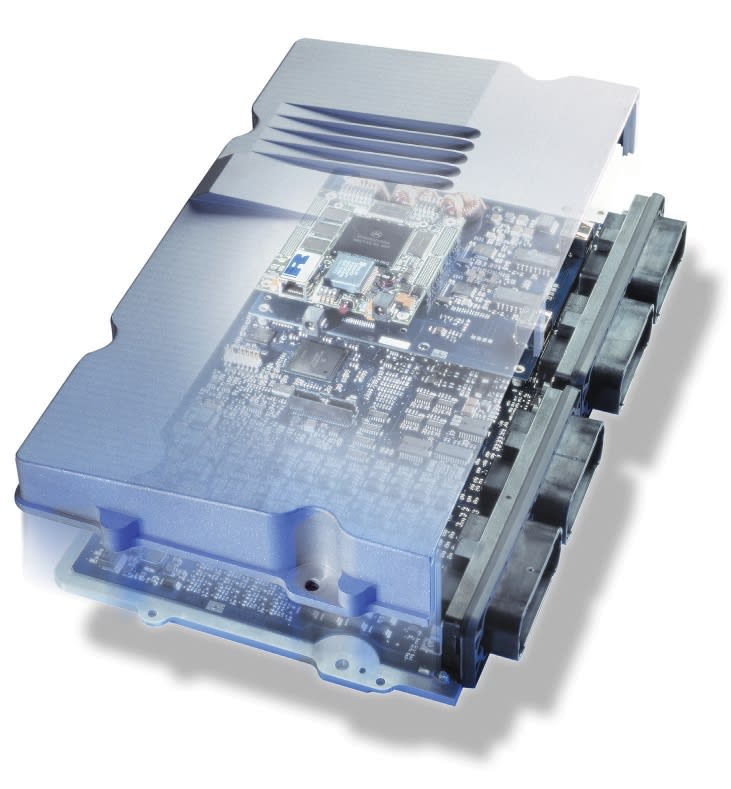
The demand for automated features and functions is prompting electronic engineers to alter their design strategies, distributing intelligence throughout the vehicle. As more electronic controls are added, the mix of 8-, 16-, and 32-bit microcontrollers is also evolving.
Most vehicles today feature a range of electronic control units (ECUs) in applications as diverse as powertrains, instrument clusters, and electrohydraulics. Every successive generation features more ECUs distributed throughout the vehicle, some with fast 32-bit central processing units (CPUs) and others with 8- or 16-bit microcontrollers.
“Smaller ECUs are required for distributed electronic architectures,” said Christiana Seethaler, Director of Product Development at TTControl. “When the information processing is located close to the actuators and/or sensors, for example on a drilling rig or on a crane outrigger, it is necessary to have small ECUs (typically I/O modules) with fewer I/Os to keep the costs down and also to be able to mount the modules in limited space.”
Distribution evolution

The boundaries between centralized controls and distributed intelligence continue to evolve. The number of ECUs for functions like hydraulics and human-machine interfaces are not changing much, but the amount of intelligence distributed in sensors, actuators, and elsewhere is growing. Many factors are driving design teams to locate microcontrollers in or near valves and other equipment.
“There’s a move to distributed computing, which has a lot to do with cost and modularity,” said Christopher Kolbe, Sales & Marketing Vice President at HED. “For something like a crane with long distances and swivels, you don’t want long wiring runs. Wiring is expensive. Another factor is that a smart device gives you more information. If you bring everything back to a central controller, you don’t know if you’ve got a wiring problem or a problem out on the boom.”
Harsh off-highway environments prevent engineers from using the latest semi-conductor technologies. Embedded microcontrollers in remote equipment lets these distributed nodes handle actions based on commands from the central controller. For example, most hydraulic components now have onboard CPUs.
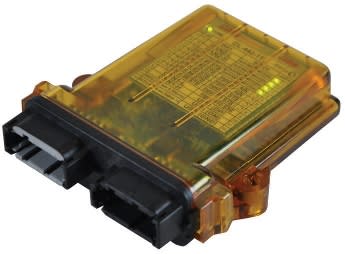
“More powerful ECUs allow for faster and better control of the hydraulic components as each ECU can be dedicated to control of a particular hydraulic component, allowing it to work smarter and more efficiently,” said Kirk Lola, Business Development Manager for Parker Hannifin’s Electronic Controls Division. “In addition, by spreading out the ECUs across the whole machine, the overall machine intelligence goes up.”
The trend to spread computing power throughout the vehicle isn’t universal. Some types of equipment can operate efficiently with just a few ECUs.
“Centralized architectures are predominantly used in physically smaller machines like rollers or compactors,” Seethaler said. “A single ECU controls the function of a whole vehicle or implement, requiring higher processing power. On such large ECUs, 32-bit CPUs are now widely used instead of 16-bit chips.”
A bit of a challenge
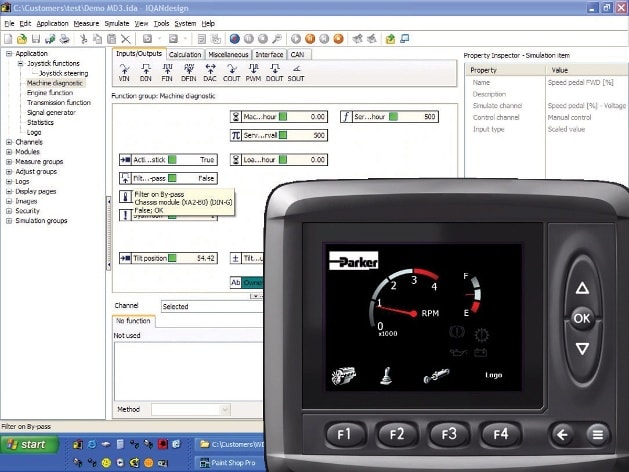
These distributed systems use a range of CPUs. In remote nodes such as sensors and actuators, 8- and 16-bit controllers still see solid acceptance. But in larger system controllers and low-volume specialty applications, most engineers say the trend is inescapable.
“There’s a major shift to 32-bit CPUs; the auto industry helped drive their cost down,” Kolbe said. “You practically get the extra speed for free.”
Low cost coupled with large memory sizes and fast clock rates make these devices an easy choice for many applications. Though the pricing difference between 16- and 32-bit chips is minimal, there are still several applications where the smaller devices are being used.

“When you go to 32 bits, you get floating point and more computational power for next to nothing,” said Ali Maleki, Business Unit Director, Hybrid & Electrical Systems, at Ricardo. “The trend is clearly to 32 bits. Still, the split for us is about half 16 bits and half 32 bits. The 16-bit CPUs are used in local controls, which are more widely used than main controllers.”
These mid-range 16-bit processors have the capability needed in many remote nodes. They cost a bit less than 32-bit devices, though they’re more expensive than 8-bit devices, which often cost well under $1. The 16-bit CPUs have become an important tool for many engineers.
“Right now we’re doing more 16-bit work than we expected; we’re doing a lot of fixed point work for actuators,” said Jason McConnell, Business Unit Director at IAV Automotive Engineering. “When you do closed loop control, you need the higher resolution and higher speed of 16-bit processors to execute the functions. If you need higher resolution, you need to use 16-bit CPUs; 8-bitters stay in limited areas because they lack resolution.”
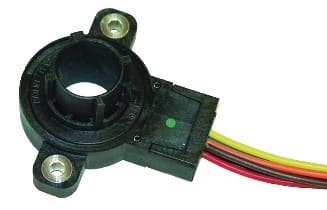
Those limited areas still represent a solid design opportunity. Programming 8-bit devices is often pretty straightforward, making them attractive for simple applications. Their pricing is a major reason for continued usage.
“There’s still a need for 8-bit chips, but they need to be dirt cheap,” Maleki said. “They are used for smart I/O and on sensors. They’re also used for watchdogs and to satisfy functional safety requirements.”
Design teams will generally opt for less-expensive 8- and 16-bit chips to save a few cents per module. Those savings can add up over the span of a controller’s lifetime, especially if the board is used on a number of vehicles. But in low-volume applications, throwing computing power at a task can be more attractive than saving a few cents on a CPU.
“When we’re doing smaller volumes, we lean toward 32-bit chips to reduce overall cost,” McConnell said. “Engineering costs are lower with 32-bit chips; you can design quicker because there’s more power to handle the challenge.”
More From SAE Media Group
Off-Highway Engineering
Regulatory Landscape Challenges Commercial-Vehicle Engine Development
Automotive Engineering
Suppliers Prepare for a Drop in EV Market Share
Aerospace & Defense Tech Briefs
SAE International Extends Call for Abstracts, Seeks Submissions for AeroTech Conference
Automotive Engineering
Tension and the Electric Takeover
Off-Highway Engineering
ZF, Freudenberg Developing Integrated Fuel-Cell and E-Drive System
Automotive Engineering
Toyota Promising Big Battery, EV Action, but Circumspect on Absolutes
Off-Highway Engineering
Deutz Equips Telehandlers with Hybrid and Fully Electric Powertrains
Automotive Engineering
2019 HEICE Symposium Kicks off Week of Valuable Engineering Insights
Battery & Electrification Technology
Ultracapacitor Solutions to Address Energy-Storage Needs of Vehicles
Off-Highway Engineering
Lightning EMotors Adapts to Changing Electrification Market
Off-Highway Engineering
How Battery Technology Will Drive Truck Electrification
Battery & Electrification Technology
Developing a Better Way to Recycle Lithium-Ion Batteries
Off-Highway Engineering
Daimler Trucks Launches First All-Electric Truck in Series Production
Automotive Engineering
The Battle over EV Value-Add Has Begun
Automotive Engineering
GM EVs Will Soon Provide V2H Backup Power During Blackouts
Aerospace & Defense Tech Briefs
Connected Aircraft Technologies Benefit Manufacturers, Airlines, and Travelers
Aerospace & Defense Tech Briefs
Bye Aerospace’s Sun Flyer Is Now the “EFlyer”
Automotive Engineering
Mercedes-Benz Concept CLA Class Updates VISION EQXX Tech for a 466-Mile EV
Automotive Engineering
BMW Takes Multi-Modal Route to Manufacturing
Automotive Engineering
Kymco’s New Ionex BMU, BaaS Will Boost Electric Scooter Adoption
Off-Highway Engineering
Battery Innovation Key for Commercial and Off-Highway EVs
Off-Highway Engineering
GM Nikola Tie-Up Sparks Worldwide Hydrogen Fuel Cell Interest
Automotive Engineering
Is GaN the Future for EV Chips?

Off-Highway Engineering
Nikola Producing Battery-Electric Trucks, Fuel-Cell EVs Coming
Automotive Engineering
Fuels to Transition the Global Legacy Fleet
Off-Highway Engineering
Hydrogen ‘Inevitable’ for Commercial Vehicles

Battery & Electrification Technology
Manufacturing Advances in Solid-State Batteries
Automotive Engineering
Electric-Vehicle Legislation in California – Third Time the Charm?
Top Stories
INSIDERManufacturing & Prototyping
 How Airbus is Using w-DED to 3D Print Larger Titanium Airplane Parts
INSIDERManned Systems
 FAA to Replace Aging Network of Ground-Based Radars
NewsTransportation
 CES 2026: Bosch is Ready to Bring AI to Your (Likely ICE-powered) Vehicle
NewsSoftware
 Accelerating Down the Road to Autonomy
EditorialDesign
 DarkSky One Wants to Make the World a Darker Place
INSIDERMaterials
 Can This Self-Healing Composite Make Airplane and Spacecraft Components Last...
Webcasts
Defense
 How Sift's Unified Observability Platform Accelerates Drone Innovation
Automotive
 E/E Architecture Redefined: Building Smarter, Safer, and Scalable...
Power
 Hydrogen Engines Are Heating Up for Heavy Duty
Electronics & Computers
 Advantages of Smart Power Distribution Unit Design for Automotive...
Unmanned Systems
 Quiet, Please: NVH Improvement Opportunities in the Early Design...
