




Sensory Integration Balance Deficits in Complex mTBI: Can Early Initiation of Rehabilitation with Wearable Sensor Technology Improve Outcomes?
Developing a novel feedback system using wearable sensors to provide physical therapists with realtime information about quality of head and trunk movement during exercise could improve patient rehabilitation practices.
Mild traumatic brain injury (mTBI) is common both in civilian and military populations and can be debilitating if symptoms do not resolve after injury. Balance problems are one of the most common complaints after sustaining an mTBI and often prevent people from returning to their previous quality of life. However, clear guidelines are currently lacking on when to initiate physical therapy rehabilitation and it is unclear if early physical therapy is beneficial.
It is believed that the underlying problem of imbalance results from damage to parts of the brain responsible for interpreting sensory information for balance control. It is hypothesized that retraining the brain early, as opposed to months after injury, to correctly interpret sensory information will improve recovery. It is also believed this retraining is limited when rehabilitation exercises are performed incorrectly, and that performance feedback from wearable sensors, can improve balance rehabilitation.
There are three of objectives of this research:
- To determine how the timing of rehabilitation affects outcomes after mTBI;
- To determine if home monitoring of balance exercises using wearable sensors improves outcomes;
- To develop a novel feedback system using wearable sensors to provide the physical therapist with information, in real-time during training, about quality of head and trunk movements during prescribed exercises.
A total of 83 participants were recruited and screened with 53 meeting inclusion criteria. At the project’s conclusion, 29 subjects had completed the rehabilitation intervention with 9 still receiving rehabilitation. Seven completed a 6-month follow up test after their rehabilitation with 19 subjects still waiting for 6-month follow up testing. In terms of outcomes, the following was learned.
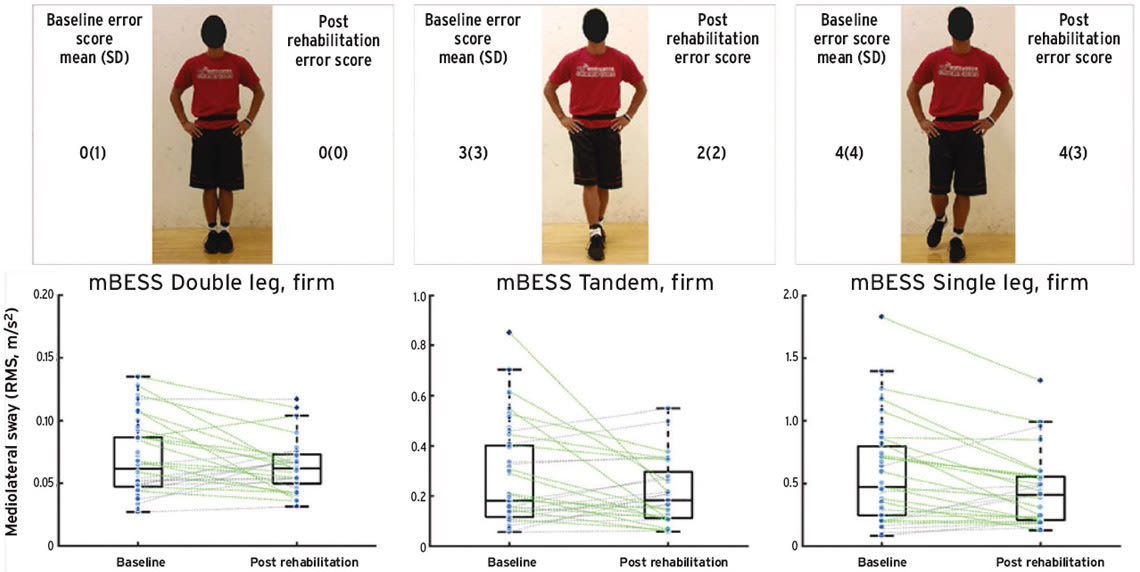
Balance: Balance impairments are a common complaint after mTBI. Preliminary analysis of postural sway data indicated that sway in the mediolateral plane while performing the modified Balance Error Scoring System (mBESS; Figure 1) becomes less variable over time and following rehabilitation. No changes occurred from baseline to post rehabilitation using the clinical subjective scoring of balance coordination across the mBESS testing conditions (top numbers across Figure 1). Objective measures of postural sway and balance impairments using sensors are needed to quantify subtle changes in balance outcomes otherwise undetected by clinical evaluations.

Cognition: Cognitive dysfunction is common following mTBI and preliminary results indicated that cognitive function improves over time and following rehabilitation (Figure 2). Cognition was assessed using the Automated Neuropsychological Assessment Metric (ANAM). The ANAM assessed simple reaction time, processing speed, visual memory, working memory, and visual-spatial ability. Participants improved their visual spatial processing ability (assessed by the match to sample task reaction time) following rehabilitation (Figure 2) and were within a normative range (indicated by the orange lines).
Symptoms: Initial results indicated improvement in symptoms over time for the participants in the study. Preliminary qualitative assessment of descriptive data also suggests a decrease in the dizziness handicap inventory (DHI) total score following rehabilitation.
Preliminary retest-reliability analysis of wearable sensors measuring head movement: Eighteen healthy controls were tested at three different time points on a series of conditions involved in the rehabilitation program. A total of eight different conditions were tested:
2 Standing Balance: horizontal and vertical, eyes closed
2 Vestibular-Ocular Reflex: horizontal and vertical, eyes fixated while head moves
2 Visual Motion Sensitivity: horizontal and vertical, eyes and head move together
2 Walking (dynamic) Balance: horizontal and vertical, eyes and head move together
Participants wore an inertial sensor on their forehead and sternum, reflecting what is used during the rehabilitation program. One of the research team’s physical therapists instructed participants which condition to perform for 30 seconds. For each trial, the two measures collected were the rotational velocity and range of motion (RoM) for the forehead and sternum in the primary movement axis.
This work was done by Dr. Laurie King (PI); Dr. Lucy Parrington; Dr.Kody Campbell; and Shelby Martin of Oregon Health & Science University and the Veteran Affairs Portland Health Care System for the Army Medical Research and Materiel Command. For more information, download the Technical Support Package below. ARL-0237
This Brief includes a Technical Support Package (TSP).
Sensory Integration Balance Deficits in Complex mTBI: Can Early Initiation of Rehabilitation with Wearable Sensor Technology Improve Outcomes?
(reference ARL-0237) is currently available for download from the TSP library.
Don't have an account?
More From SAE Media Group
Aerospace & Defense Tech Briefs
Evaluation of Environmental Sensors in Training: Performance Outcomes and Symptoms during Airborne and Combatives Training

Medical Design Briefs
AI-Enabled Optical Fiber Sensor Device Monitors Brain Injury
Medical Design Briefs
Wearable Head Scanner Allows Mobility During Brain Scans
Medical Design Briefs
Smart Wearable Sensors for Parkinson’s Disease
Medical Design Briefs
Algorithms, Wearables Help Monitor Parkinson’s
Aerospace & Defense Tech Briefs
Real Time Physiological Status Monitoring
Tech Briefs
Electronic Skin Reacts to Pain
Medical Design Briefs
Magnetic Brain Waves to Detect Injury and Disease

Medical Design Briefs
Wearable Device Monitors Jaundice-Causing Bilirubin and Vitals in Newborns
Medical Design Briefs
Wearable Sensor Monitors Health Using Saliva and Tears
Tech Briefs
A Smartwatch-Based System Detects Heat Strain
Tech Briefs
Portable Brain Imaging System
Medical Design Briefs
Wearable Skin Patch Monitors Hemoglobin in Deep Tissues
Medical Design Briefs
Assistive Audio Signal Stimulation Offers Relief for Parkinson’s Patients
Medical Design Briefs
Biosensor Could Help Detect Brain Injuries During Heart Surgery
Medical Design Briefs
Soft Robotic, Wearable Device Improves Walking for Individual with Parkinson’s
Medical Design Briefs
Wearable Device Combines Multiple Sensors

Sensor Technology
What’s New in MEMS Sensors for Wearables
Medical Design Briefs
Wearable Sensors Measure Body Position



Medical Design Briefs
Wearable Belt with Sensors Accurately Measures Heart Failure 24/7
Overview
The document is an annual report for a research project titled “Sensory Integration Balance Deficits in Complex mTBI: Can Early Initiation of Rehabilitation with Wearable Sensor Technology Improve Outcomes?” led by Dr. Laurie King at Oregon Health & Science University. The report covers the period from September 30, 2018, to September 29, 2019, and outlines the project's objectives, methodologies, and preliminary findings.
The primary aim of the project is to investigate the effects of early rehabilitation interventions using wearable sensor technology on patients with complex mild traumatic brain injuries (mTBI). The research focuses on understanding how early intervention can influence recovery outcomes compared to standard care practices. The use of wearable sensors is intended to provide more accurate measurements of gait and balance, both in clinical settings and during daily activities.
The report details the dissemination of research findings, which have been shared through various platforms, including ClinicalTrials.gov, ResearchMatch.org, and Fitbir.nih.gov. The team has published two manuscripts, with another in press, and has presented their findings at conferences and community outreach events. Dr. King also presented the study's progress to the Complex TBI Rehabilitation Research Program in October 2019.
In terms of future plans, the research team aims to enhance recruitment efforts for the study by building relationships with physicians who can refer mTBI patients. They also plan to utilize various recruitment methods, including text and email outreach, and continue using EPIC’s Best Practice Advisory feature. The team is focused on completing data collection for healthy control participants and identifying physical therapists and patients for evaluating the feedback system.
The report highlights the potential impact of the project on the field of physical therapy, suggesting that it could significantly influence treatment approaches for mTBI patients. The findings may lead to improved clinical practices through the integration of wearable technology, which could enhance the assessment and monitoring of patient recovery.
Overall, the report emphasizes the importance of this research in advancing knowledge and practices related to mTBI rehabilitation, with the goal of improving patient outcomes through innovative technology and early intervention strategies.
Top Stories
INSIDERManufacturing & Prototyping
 How Airbus is Using w-DED to 3D Print Larger Titanium Airplane Parts
INSIDERManned Systems
 FAA to Replace Aging Network of Ground-Based Radars
NewsTransportation
 CES 2026: Bosch is Ready to Bring AI to Your (Likely ICE-powered) Vehicle
NewsSoftware
 Accelerating Down the Road to Autonomy
EditorialDesign
 DarkSky One Wants to Make the World a Darker Place
INSIDERMaterials
 Can This Self-Healing Composite Make Airplane and Spacecraft Components Last...
Webcasts
Power
 E/E Architecture Redefined: Building Smarter, Safer, and Scalable...
Power
 Hydrogen Engines Are Heating Up for Heavy Duty
Automotive
 Advantages of Smart Power Distribution Unit Design for Automotive...
Transportation
 Quiet, Please: NVH Improvement Opportunities in the Early Design...
AR/AI
 A FREE Two-Day Event Dedicated to Connected Mobility
Power
 Powering America’s EV Future: Connect, Collaborate, Innovate