




Developing IR Materials as Signaling Tools for Military Operations
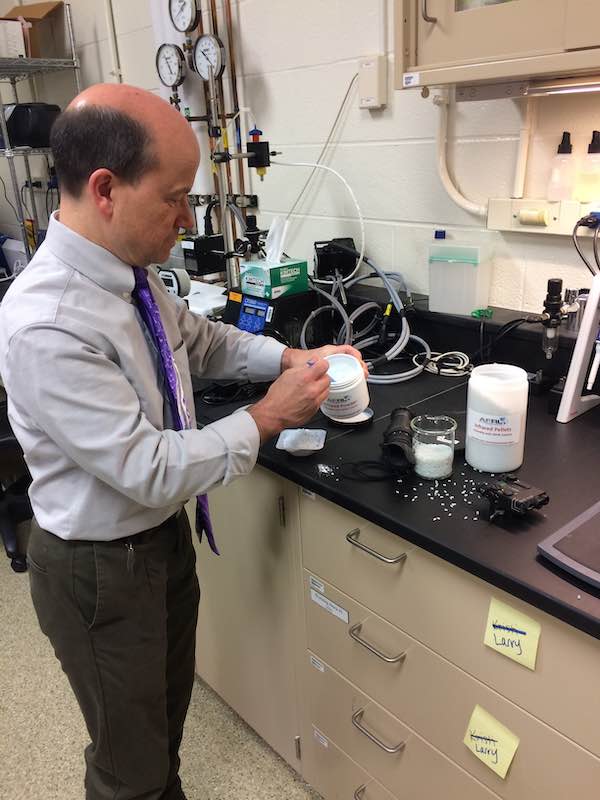
Battle Sight Technologies has acquired a second patent license related to infrared materials as signaling tools for nighttime military operations.
A year ago, Dr. Larry Brott of the Air Force Research Laboratory, along with his co-inventors, licensed a technology to BST for a pressure-activated marker that allows troops to communicate with written messages in low or no-light conditions (with or without night vision devices). A second patent by Dr. Brott and his team involving infrared phosphor technology has recently been licensed to BST, which expands to their existing collection of infrared technologies. This technology works similarly to the dials on a watch, absorbing ultraviolet light during the day, and emitting an infrared light at night.
This suite of infrared products, such as glow sticks or patches and packs displaying glow-in-the-dark reflective strips, are all used for battlefield communication and training. Additionally, these products are used to identify U.S. militaries’ locations to friendly ground forces and aircraft. Identification is a must when troops are partnering with foreign forces, including ununiformed soldiers using civilian trucks.
In March, the Air Force awarded Battle Sight Technologies $165,000 to continue developing products based off the core patches, tapes and molded parts to support low-light/no-light communication. The next steps include learning how to scale-up the production process. “We are used to making small, lab-scale batches where we can produce 15 crayons per day, said Brott. “We are getting such interest in this product that we are now being asked to make 200 crayons daily.”
Various “flavors” of crayons are also being requested that match different scenarios. Infrared crayons that leave no trace, and crayons that glow visibly at night while leaving a bright pink pigment mark for daytime viewing are a few examples. These variations are for first responders who might answer to a night-time train wreck. After searching a train car, they would mark it so that it would be visible at night, and also apparent once the sun rises. The future may hold a non-toxic version for home use; perhaps even as sidewalk chalk.
More From SAE Media Group
Photonics & Imaging Technology
Researchers Generate Terahertz Laser with Laughing Gas
Photonics & Imaging Technology
Harnessing SWIR Line Scan Imaging Technology

Photonics & Imaging Technology
Sussex Researchers Combine Lasers, Computers & THz Waves to Build Camera That Sees ‘Unseen’ Details
Electronics & Sensors INSIDER
Ultra-Thin Terahertz Source Paves the the Way to Next Generation of Communication Tech


Photonics & Imaging Technology INSIDER
This OLED Device is Thinner Than a Human Hair

Photonics & Imaging Technology INSIDER
Infrared Imaging by Ultrathin Nanocrystal Layers
Photonics & Imaging Technology
INRS Researchers Design the World’s Fastest UV Camera
Medical Design Briefs INSIDER
Product Demonstration: Curing Systems for Medical Device Assembly
Photonics & Imaging Technology
New Products
Tech Briefs
4 NASA Breakthroughs in Photonics and Optics
Imaging Technology
Imaging Filters

Photonics & Imaging Technology
Terahertz Energy Focused by Credit Card-Sized Device to Generate High-Resolution Images
Photonics & Imaging Technology
On-Chip Optical Filter Processes Wide Range of Light Wavelengths

Tech Briefs
Magazine Archives
Photonics & Imaging Technology
Shortwave Infrared Cameras for High-Temperature Manufacturing and R&D Processes
Photonics & Imaging Technology
How Corning’s Hyperspectral Imaging in the Sky Sees the Unseen
Photonics & Imaging Technology
How Indium Gallium Arsenide (InGaAs) Improves SWIR Sensing
Aerospace & Defense Tech Briefs
Combating Infrared Threats on the Battlefield
Photonics & Imaging Technology INSIDER
Seeing the World Through Different Eyes
Aerospace & Defense Tech Briefs
Industry Invited to Participate in AeroTech Aerospace and Defense Technical Program

Top Stories
INSIDERManufacturing & Prototyping
 How Airbus is Using w-DED to 3D Print Larger Titanium Airplane Parts
INSIDERManned Systems
 FAA to Replace Aging Network of Ground-Based Radars
NewsTransportation
 CES 2026: Bosch is Ready to Bring AI to Your (Likely ICE-powered) Vehicle
NewsSoftware
 Accelerating Down the Road to Autonomy
EditorialDesign
 DarkSky One Wants to Make the World a Darker Place
INSIDERMaterials
 Can This Self-Healing Composite Make Airplane and Spacecraft Components Last...
Webcasts
Defense
 How Sift's Unified Observability Platform Accelerates Drone Innovation
Automotive
 E/E Architecture Redefined: Building Smarter, Safer, and Scalable...
Power
 Hydrogen Engines Are Heating Up for Heavy Duty
Electronics & Computers
 Advantages of Smart Power Distribution Unit Design for Automotive...
Unmanned Systems
 Quiet, Please: NVH Improvement Opportunities in the Early Design...
