




Robot’s Speed-of-Light Communication Could Protect You From Danger
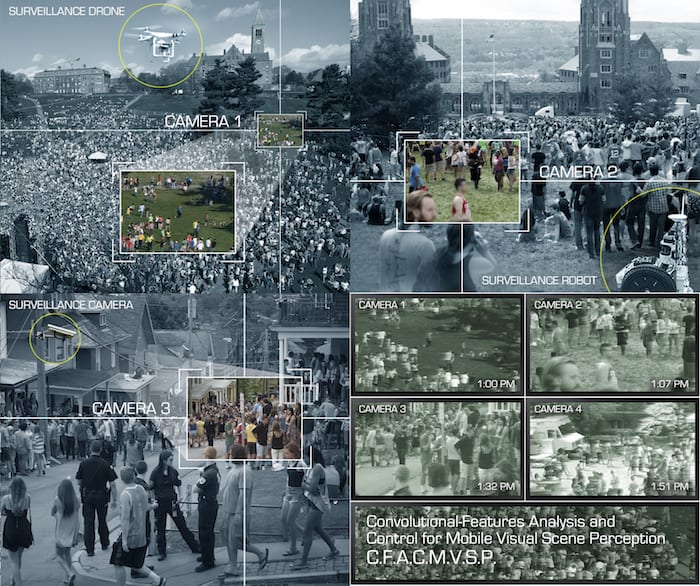
Cornell University researchers are developing a system to enable teams of robots to share information as they move around, and if necessary, interpret what they see. This would allow the robots to conduct surveillance as a single entity with many eyes. Beyond surveillance, the new technology could enable teams of robots to relieve humans of dangerous jobs such as disposing of landmines, cleaning up after a nuclear meltdown or surveying the damage after a flood or hurricane. The project, called “Convolutional-Features Analysis and Control for Mobile Visual Scene Perception,” is supported by a four-year, $1.7 million grant from the U.S. Office of Naval Research.
The researchers will call on their extensive experience with computer vision to match and combine images of the same area from several cameras, identify objects and track objects and people from place to place. The work will require groundbreaking research because most prior work in the field has focused on analyzing images from just a single camera as it moves around. The new system will fuse information from fixed cameras, mobile observers and outside sources.
The mobile observers might include autonomous aircraft and ground vehicles and perhaps humanoid robots wandering through a crowd. They will send their images to a central control unit, which might also have access to other cameras looking at the region of interest, as well as access to the internet for help in labeling what it sees. What make of car is that? How do you open this container? Identify this person. Knowing the context of a scene, robot observers may detect suspicious actors and activities that might otherwise go unnoticed. A person running may be a common occurrence on a college campus but may require further scrutiny in a secured area.
Researchers plan early tests on the Cornell campus, using research robots to “surveil” crowded areas while drawing on an overview from existing webcams. This work might lead to incorporating the new technology into campus security.
More From SAE Media Group

Photonics & Imaging Technology
Designing the Next Generation of Event-Based Sensing and Vision for Edge Applications

Tech Briefs
Robot Senses Hidden Objects
Motion Design
CAD Model Offers Robots Precise Pick-and-Place Solutions

Photonics & Imaging Technology
Researchers Develop New and Improved Camera Inspired by the Human Eye
Motion Design INSIDER
Physics-Aware Neural Networks Improve Camera-Based Machines


Motion Design INSIDER
Simulated Humanoid Robots Learn to Hike Rugged Terrain Autonomously
Motion Design
AR-Enhanced Rescue Robot for Disaster Response

Robotics & Automation INSIDER
Autonomous Aerial Robots Prioritize Rooms in Multiroom Exploration
Robotics & Automation INSIDER
Robots Learn from Videos
Tech Briefs
An AI-Powered Robodog Is Here to Save the Day!
Tech Briefs
A Step Toward More Accurate 3D Object Detection

Tech Briefs
Artificial Intelligence in Design Engineering
Defense INSIDER
Army Technique Enhances Robot Battlefield Operations
Robotics & Automation INSIDER
AI Yields ‘Athletically Intelligent’ Robotic Dog
Robotics & Automation INSIDER
New Vision-Based System Teaches Machines to Understand Their Bodies
Motion Design
AI-Powered Training Method to Train Robots

Robotics & Automation INSIDER
Humans in the Loop Help Robots Find Their Way

Top Stories
INSIDERManufacturing & Prototyping
 How Airbus is Using w-DED to 3D Print Larger Titanium Airplane Parts
INSIDERManned Systems
 FAA to Replace Aging Network of Ground-Based Radars
NewsTransportation
 CES 2026: Bosch is Ready to Bring AI to Your (Likely ICE-powered) Vehicle
NewsSoftware
 Accelerating Down the Road to Autonomy
EditorialDesign
 DarkSky One Wants to Make the World a Darker Place
INSIDERMaterials
 Can This Self-Healing Composite Make Airplane and Spacecraft Components Last...
Webcasts
Defense
 How Sift's Unified Observability Platform Accelerates Drone Innovation
Automotive
 E/E Architecture Redefined: Building Smarter, Safer, and Scalable...
Power
 Hydrogen Engines Are Heating Up for Heavy Duty
Electronics & Computers
 Advantages of Smart Power Distribution Unit Design for Automotive...
Unmanned Systems
 Quiet, Please: NVH Improvement Opportunities in the Early Design...
