




Micro-Composite Fabrication via Field-Aided Laminar Composite Processing
This fabrication process is used to create multifunctional micro-composites that can be tailored for specific end-use applications.
Much work has been accomplished since the discovery that particles in a dielectric fluid experience forces when placed in an electric field, including mathematical descriptions of the forces and resulting motion of particles of differing shapes, particle separation and segregation for use in drug delivery, and even the manipulation of long-chain molecules of certain polymers.
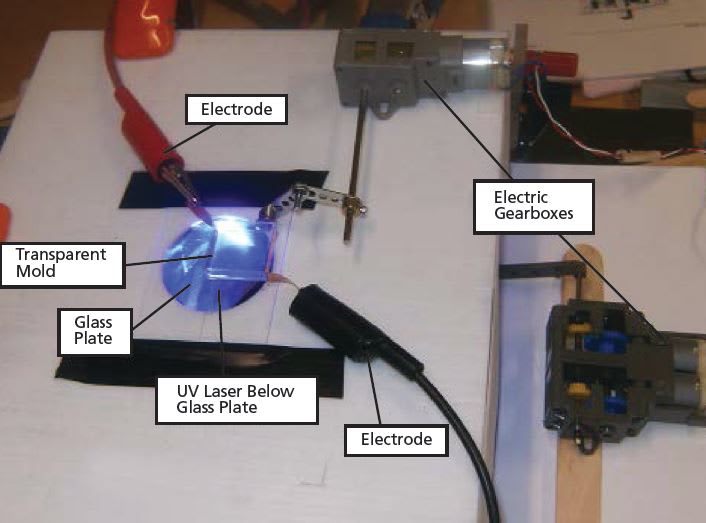
The research presented here builds upon the FAiMTa technology in the design of a processing system that allows for nano- to micro-scale fillers to be aligned and oriented in a liquid photopolymer solution before being locked in place by the laser curing of the photopolymer matrix. The Field-Aided Laminar Composite (FALCom) processing technology is the realization of this research. Using FALCom processing, fillers are aligned into pseudo-fibers that can be arranged by design. Systems can then be designed with structural, thermally conductive, or electrically conductive fillers for multifunctional applications that will allow for the production of three-dimensional composites for structural, electrical, or heat sink applications.
A combination of properly controlled electric fields and accurate material selection can lead to functionally graded composite materials with locally tailored filler modifications by design. The experimental FALCom process has shown the capability to fabricate multilayered particulate reinforced polymer composites with controlled filler orientation. It has been shown that the selected fillers can be aligned in order to create pseudo-fiber support structures. In future experimentation, these structures may be used for structural, electrical, or thermal manipulation of a polymer composite.
This work was conducted to facilitate a proof of concept for the FALCom technology, and therefore a limited number of specimens were fabricated for each sample set. In the future, an indepth study will be conducted into the mechanical properties of FALCom fabricated composite structures. Preliminary results from mechanical characterization of the composite samples with the bidirectional alignments have shown to increase the flexural modulus by up to 24% over those with randomly oriented fillers. Photoelastic response of FALCom specimens will also be evaluated in the future.
The work was conducted with a benchtop version of the FALCom processing technology, with a fabrication envelope of approximately one cubic inch. A large-scale FALCom machine is being constructed currently that will have a working volume of approximately one cubic foot. This machine will be used to determine if the technology is applicable for the fabrication of three-dimensionally reinforced rapid prototype composites, and will continue to support research and analysis of micro-composites.
This work was done by Larry R. Holmes, Jr. of the Army Research Laboratory. ARL-0153
This Brief includes a Technical Support Package (TSP).
Micro-Composite Fabrication via Field-Aided Laminar Composite Processing
(reference ARL-0153) is currently available for download from the TSP library.
Don't have an account?
More From SAE Media Group
Tech Briefs
Stretchable Thermoelectric Generators
Tech Briefs
Conductive Carbon Fiber Polymer Composite
Tech Briefs
Precision CNT Cutting Mechanism

Tech Briefs
Macroflash Cup Cryostat

Tech Briefs
3D-Printed Composites for High-Temperature Uses
Aerospace & Defense Tech Briefs
Design of New Piezoelectric Composites Using Nanocellulose
Tech Briefs
Self-Healing, Recyclable, Shape Memory Polymers

Tech Briefs
Automated Tow/Tape Placement System

Tech Briefs
Miniscule Robots of Metal and Plastic
Medical Design Briefs
Streamlining Medical Device Development and Manufacturing Using Silicone Elastomers
Aerospace & Defense Tech Briefs
Designing Sensory and Adaptive Composite Materials
Tech Briefs
Self-Healing, Highly Adhesive Elastomers
Aerospace & Defense Tech Briefs
‘Nanostitches’ Enable Lighter and Tougher Composite Materials
Medical Design Briefs
Medical Plastics: Understanding Ultrasonic Welding, Part 1
Medical Design Briefs
Particle Distribution on Webs or Cloths

Tech Briefs
Fiber-Metal Laminate Manufacturing Technique

Aerospace & Defense Tech Briefs
How to Select the Right Silicone for Space Applications
Aerospace & Defense Tech Briefs
Fabrication of Carbon Nanotube Channels on Three- Dimensional Building Blocks
Tech Briefs
Process for Preparing Aerogels from Polyamides
Overview
The document titled "Micro-Composite Fabrication via Field-Aided Laminar Composite (FALCom) Processing," authored by Larry R. Holmes, Jr., presents a novel approach to creating multi-functional micro-composites tailored for specific applications. The report, published in September 2012 by the U.S. Army Research Laboratory, details the innovative FALCom process, which utilizes focused electric fields to align nano- to micro-sized particles into chain-like structures known as pseudo-fibers. These pseudo-fibers are subsequently frozen in place through laser curing of a photopolymer matrix, allowing for the design and creation of three-dimensional composite structures.
The research evaluates various filler particles, including multi-walled carbon nano-tubes, aluminum micro-particles, and alumina micro-particles, assessing their alignment and orientation within an acrylic photopolymer matrix. The document includes experimental processing examples and discusses the implications of these findings for future work in composite fabrication.
The report emphasizes the significance of the viscosity of the liquid photopolymer when mixed with different filler materials, providing data on the viscosity changes observed with 1.0 weight-percent filler mixtures. This information is crucial for understanding how the addition of fillers affects the processing and performance of the resulting composites.
The FALCom process represents a significant advancement in composite manufacturing, offering potential applications in various fields, including defense, aerospace, and advanced materials engineering. The ability to create tailored micro-composites with specific properties opens new avenues for innovation in material science.
The document is unclassified and approved for public release, ensuring that the findings can be shared with a broader audience interested in composite processing and fabrication techniques. It serves as a comprehensive resource for researchers and practitioners in the field, providing insights into the methodologies and experimental results that underpin the FALCom process.
In summary, this report outlines a cutting-edge fabrication technique that enhances the capabilities of micro-composites, highlighting the importance of material selection and processing conditions in achieving desired performance characteristics. The findings contribute to the ongoing development of advanced composite materials, with implications for a wide range of applications.
Top Stories
INSIDERManufacturing & Prototyping
 How Airbus is Using w-DED to 3D Print Larger Titanium Airplane Parts
INSIDERManned Systems
 FAA to Replace Aging Network of Ground-Based Radars
NewsTransportation
 CES 2026: Bosch is Ready to Bring AI to Your (Likely ICE-powered) Vehicle
NewsSoftware
 Accelerating Down the Road to Autonomy
EditorialDesign
 DarkSky One Wants to Make the World a Darker Place
INSIDERMaterials
 Can This Self-Healing Composite Make Airplane and Spacecraft Components Last...
Webcasts
Defense
 How Sift's Unified Observability Platform Accelerates Drone Innovation
Automotive
 E/E Architecture Redefined: Building Smarter, Safer, and Scalable...
Power
 Hydrogen Engines Are Heating Up for Heavy Duty
Electronics & Computers
 Advantages of Smart Power Distribution Unit Design for Automotive...
Unmanned Systems
 Quiet, Please: NVH Improvement Opportunities in the Early Design...
