




Five Approaches to Cooling Military Electronics
Seventy-one degrees C is the temperature of a steak done medium-well. It is also the temperature of an oven used to test thermal characteristics of military electronics. Electronic components in the COTS industry often have temperature limits of 85°C, leaving 14°C of thermal potential to move the heat generated by the components away. Among various cooling approaches, the correct solution for your application depends on meeting your requirements at the lowest possible cost and complexity.
Approaches to Thermal Management
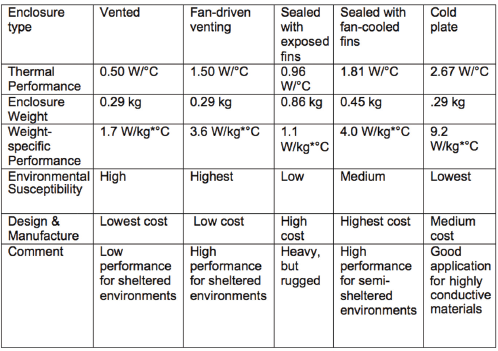
The enclosure type identifies the cooling approach used. A vented approach encloses the CCA with a sheet metal box with holes provided in the top and bottom to allow air to directly cool the CCA. An example of a vented enclosure is a television. Fan-driven venting adds forced air to the enclosure, as used in laptop computers. Sealed with exposed fins means that the CCA is separated from external environments by the enclosure. Fins are added to the exterior of the box. Computers in armored fighting vehicles often use this approach. Sealed with fan-cooled fins adds forced air to the exterior of the enclosure. This approach shares popularity with fandriven open venting in aircraft electronics. Cold-plate presumes that cooling happens away from the enclosure, with heat moving through the material of the enclosure to a cooler temperature. The possible sources of the cool temperature are not included here.
Other factors to be considered in the evaluation of appropriate technologies for military electronics include thermal performance, enclosure weight, weight-specific performance, environmental susceptibility, and design and manufacture. The higher the thermal performance rating, the better. Thermal performance is the amount of heat in watts dissipated for each degree C that the CCA increases in temperature. Enclosure weight, measured in kilograms, depends on the substances used to create the enclosure. Simple sheet metal is the lightest component. A sealed box with large external fins can become impractically heavy. Weight-specific performance divides the performance number by the weight added to the CCA simulation by the cooling enclosure. Environmental susceptibility includes factors such as mechanical shock, electro-magnetic disturbances, and airborne contaminants. Design and manufacture takes into consideration the complexity of the design including a parts count and ease of procurement/ assembly.
Simulation
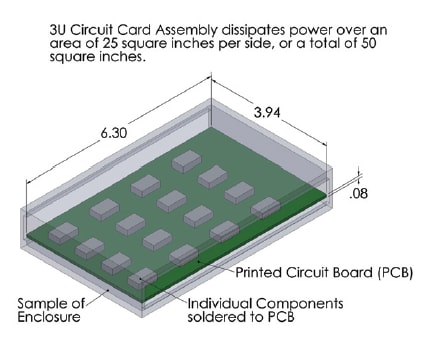
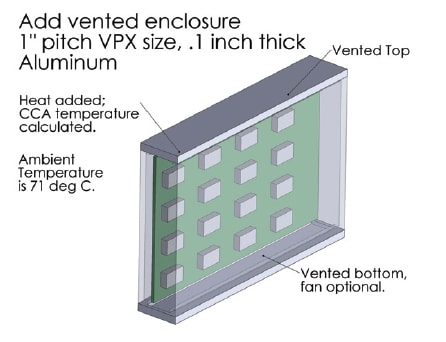
The vented design shown in Figure 2 is as simple to design and build as possible. The air in direct contact with the CCA heats up, creating air movement. After factoring in weight, a free-air vented system provides superior performance per pound of enclosure when compared to the sealed free-air system. However, at an ambient temperature of 71°C, most 3U CCAís dissipate more heat than this design can handle.
A sealed enclosure with exposed fins is shown in Figure 3. It was constructed from the previous enclosure by sealing the vents and adding external finning. Minimal environmental susceptibility is expected from this design, as the CCA is protected from exposure to environmental contamination and the lack of a cooling fan eliminates moving parts. The trade-offs are weight, parts count, and parts complexity. Although the highest power CCA can be kept cool with this design, the amount of cooling surface needed becomes impractically large.

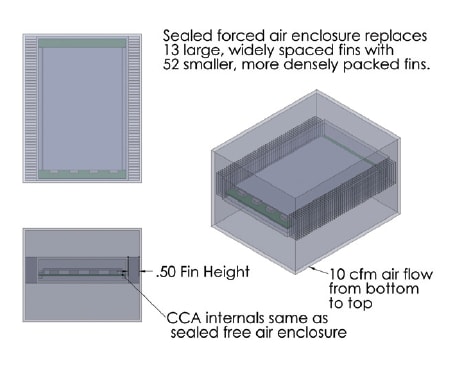
The fan-cooled version of the sealed enclosure is shown in Figure 4. It shares all aspects of the previous design regarding parts complexity and adds a fan to the parts count and to environmental susceptibility. The payoff is in thermal performance. This finning approach weighs one tenth of the previous version, has only one sixth of the cooling area, but still performs twice as well. It performs 4 times better than the previous version if weight is factored in.
The trade-off is dependency. Implied in this approach is a separate heat sink, whether it be a vehicle, the hull of a ship, or a refrigeration system.
No matter what the application in military electronics, available thermal technologies can accommodate the heat generated and dissipated. If the next breakthrough in electronic hardware technology is significant, every enclosure would ideally be a vented box. Until the creation of such revolutionary technology, thermal engineers need to evaluate their options in selecting a cooling method on cost, complexity and weight to keep todayís electronics from damaging applications.
This article was written by Mark Dimick, Mechanical Engineer, Curtiss-Wright Electronic Systems (Santa Clarita, CA). For more information, visit http://info.hotims. com/34459-502.
More From SAE Media Group
Aerospace & Defense Tech Briefs
Dispensable Gels vs Gap Filler Pads
Aerospace & Defense Tech Briefs
Thermal Analysis Tool
Aerospace & Defense Tech Briefs
Thermal Management Techniques for Military Embedded Computers

Aerospace & Defense Tech Briefs
Optimizing Thermal Management to Meet SWaP-C Requirements

Aerospace & Defense Tech Briefs
Trends in Military System Thermal Management
Aerospace & Defense Tech Briefs
Thermal Management Techniques in Avionics Cooling
Aerospace & Defense Tech Briefs
Making a Material Difference in Aerospace & Defense Electronics
Aerospace & Defense Tech Briefs
Robotic Rotational Molding Creates New Opportunities for Military and Aerospace Applications
Aerospace & Defense Tech Briefs
Acceleration Resistant HiK Heat Spreader
Aerospace & Defense Tech Briefs
Submersion and Directed Flow Cooling Technology for Military Applications

Aerospace & Defense Tech Briefs
Taming the Thermal Behavior of Solid-State Military Lasers
Aerospace & Defense Tech Briefs
Novel Whisker Mitigating Composite Conformal Coat Assessment
Aerospace & Defense Tech Briefs
Specifying Components for Space Applications
Aerospace & Defense Tech Briefs
Design Guidelines for Military and Aerospace PCBs
Aerospace & Defense Tech Briefs
New Cryogenic Shape Memory Alloy Designed for Outer Space
Aerospace & Defense Tech Briefs
Controlling Heat Spikes in Electric Aircraft at Takeoff
Aerospace & Defense Tech Briefs
Using Heat Pipes to Cool Embedded Computers

Aerospace Manufacturing and Machining
Does Your Coating Thickness Meet Spec?
Aerospace & Defense Tech Briefs
Infusing Lightweight Composite Structures
Aerospace & Defense Tech Briefs
Testing EMI Materials for Battlefield Applications
Aerospace & Defense Tech Briefs
Using System Simulation to Manage Increasing Thermal Loads on Aircraft Fuel Systems
Aerospace & Defense Tech Briefs
Thermal Ground Planes Optimizing Heat Transfer in Aerospace and Defense Applications
Aerospace & Defense Tech Briefs
The Science of Joining Dissimilar Metals in Aerospace Manufacturing
Aerospace Manufacturing and Machining
Aerospace Work Platforms — More than Meets the Eye
Aerospace & Defense Tech Briefs
Computer Simulation’s Role in Advancing Composite Aircraft Structures
Aerospace & Defense Tech Briefs
Active Thermal Management for Cooler Body Armor
Top Stories
INSIDERManufacturing & Prototyping
 How Airbus is Using w-DED to 3D Print Larger Titanium Airplane Parts
INSIDERManned Systems
 FAA to Replace Aging Network of Ground-Based Radars
NewsTransportation
 CES 2026: Bosch is Ready to Bring AI to Your (Likely ICE-powered) Vehicle
NewsSoftware
 Accelerating Down the Road to Autonomy
EditorialDesign
 DarkSky One Wants to Make the World a Darker Place
INSIDERMaterials
 Can This Self-Healing Composite Make Airplane and Spacecraft Components Last...
Webcasts
Defense
 How Sift's Unified Observability Platform Accelerates Drone Innovation
Automotive
 E/E Architecture Redefined: Building Smarter, Safer, and Scalable...
Power
 Hydrogen Engines Are Heating Up for Heavy Duty
Electronics & Computers
 Advantages of Smart Power Distribution Unit Design for Automotive...
Unmanned Systems
 Quiet, Please: NVH Improvement Opportunities in the Early Design...
