




White PaperTest & Measurement
Synchronized Combustion and NVH Measurements on an Engine Test Bench
SPONSORED BY: ![]()

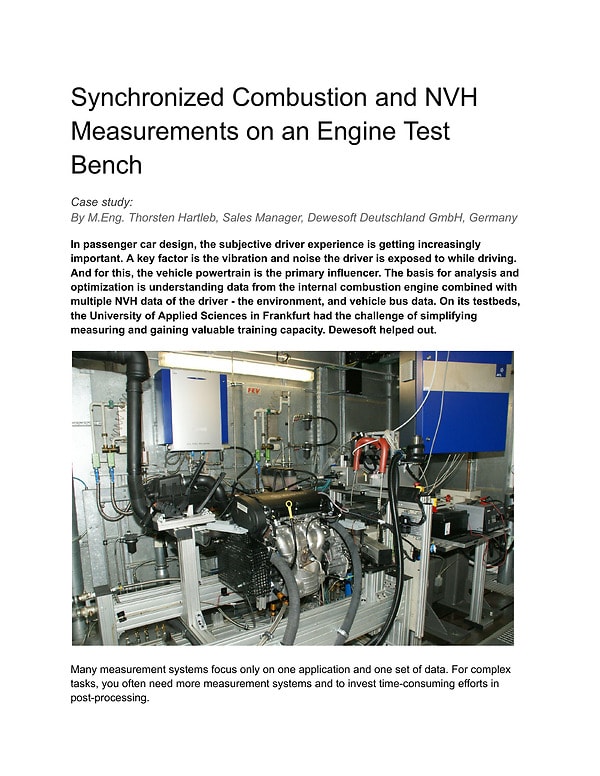
In passenger car design, the subjective driver experience is getting increasingly important. A key factor is the vibration and noise the driver is exposed to while driving. And for this, the vehicle powertrain is the primary influencer. The basis for analysis and optimization is understanding data from the internal combustion engine combined with multiple NVH data of the driver — the environment, and vehicle bus data.
On its testbeds, the University of Applied Sciences in Frankfurt had the challenge of simplifying measuring and gaining valuable training capacity. In this case study, learn how Dewesoft helped the University address this challenge and more.
Many measurement systems focus only on one application and one set of data. For complex tasks, you often need more measurement systems and to invest time-consuming efforts in post-processing. For the data analysis and optimization, you typically need to use three to six exports in different software packages. You will have to check the acquired data for plausibility and synchronization. Using Dewesoft, you need just one measurement file for various exports. And you can still do analysis and optimization in whatever software.
The Dewesoft solution helped the university establish synchronized measurement with direct visualization as a standard approach. The issue, in this case, is only one example of various situations requiring different specialized measurement systems. OEMs, Tier 1 suppliers, and all others designing or verifying more than a single component face such challenges of synchronization and immediate visualization.
Don't have an account?
Overview
The document presents a case study on the use of Dewesoft technology for synchronized combustion and noise, vibration, and harshness (NVH) measurements on engine test benches at the University of Applied Sciences Frankfurt (Frankfurt UAS). The study highlights the growing importance of driver experience in passenger car design, particularly how vibrations and noise from the vehicle powertrain affect this experience.
Traditionally, automotive engineers have relied on multiple specialized measurement systems to evaluate various aspects of vehicle performance, such as combustion analysis, vibration analysis, and acoustic measurements. However, these systems often operate independently, leading to challenges in data synchronization and alignment, which can be time-consuming and complex. The document outlines how the Dewesoft solution addresses these issues by enabling the acquisition of all necessary data through a single measurement system, thus simplifying the testing process.
Ingo Behr, a laboratory engineer at Frankfurt UAS, faced significant challenges in demonstrating the interactions between in-cylinder pressure and NVH parameters to students. The existing setup required separate systems that hindered live visualization and increased post-processing time. The Dewesoft approach allowed for immediate visualization of data, facilitating direct verification and reducing the likelihood of invalid measurements caused by external influences.
The DewesoftX software supports various visualization options, allowing users to monitor combustion, vibration, acoustic measurements, and bus data in real-time. This integrated approach not only streamlines data acquisition but also enhances the educational experience for students learning about testbed operations. The university's engine laboratory, which focuses on combustion engine research and student training, benefits from reduced complexity in its measurement systems, leading to a more stable testing environment and fewer testbed hours.
The document concludes that the Dewesoft solution has simplified the data acquisition process without requiring adjustments to established analysis methods. It emphasizes the importance of having a lean setup that minimizes the number of measurement systems while still supporting comprehensive data analysis and optimization through various export formats. Overall, the case study illustrates how Dewesoft technology can enhance both educational and practical applications in automotive engineering, ultimately contributing to improved vehicle design and driver comfort.