




White PaperAerospace
eBook: The Engineer’s Guide to Low Outgassing Adhesives
SPONSORED BY: ![]()

The ASTM E595 standard, developed by NASA, serves as a critical benchmark for evaluating outgassing characteristics in adhesive systems. Learn how to select adhesive systems that meet stringent outgassing requirements and ensure reliability in demanding applications. Explore more here.
Don't have an account?
Overview
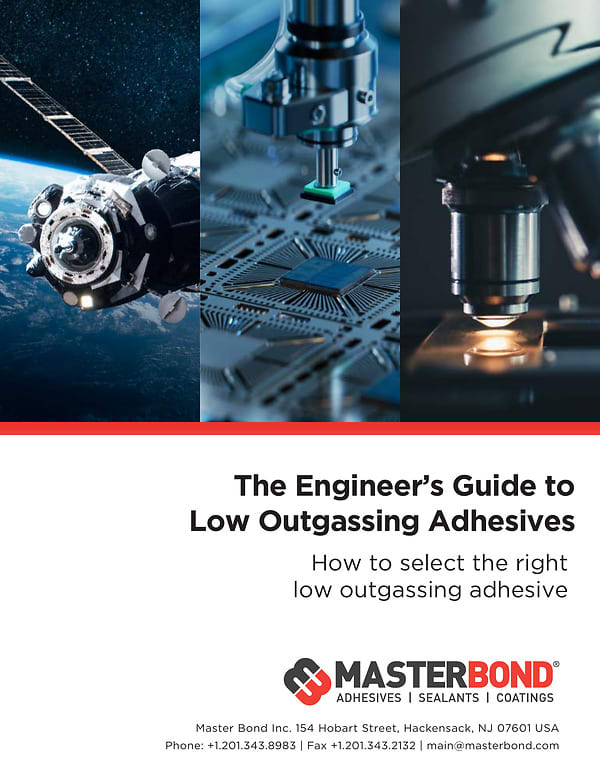
The white paper titled "The Engineer’s Guide to Low Outgassing Adhesives" serves as a comprehensive resource for design engineers seeking to understand and select low outgassing adhesives for critical applications, particularly in aerospace, electronics, and optical industries.
Low outgassing adhesives are essential in environments where minimal volatile emissions are crucial, such as space missions. The document outlines the significance of low outgassing materials and introduces the ASTM E595 standard, developed by NASA, which assesses the outgassing characteristics of materials. This standard measures Total Mass Lost (TML) and Collected Volatile Condensable Materials (CVCM) from adhesives in a vacuum environment, ensuring their reliability and compatibility in sensitive applications.
The guide emphasizes the importance of selecting the right adhesive based on specific application requirements. It categorizes various adhesive chemistries, including silicones, UV curing compounds, and epoxies, highlighting their unique properties such as flexibility, thermal stability, moisture resistance, and chemical resistance. The performance properties of these adhesives are also discussed, covering mechanical, electrical, chemical, optical, and thermal characteristics.
Among the featured products, Supreme 10HT is highlighted as a toughened, high-strength epoxy system suitable for structural bonding in demanding environments. It offers exceptional shear and peel strength, resists mechanical and thermal shocks, and has a wide service temperature range.
The white paper concludes by showcasing a variety of low outgassing adhesive formulations available from Master Bond, emphasizing the company's commitment to developing new solutions to meet industry demands. It encourages engineers to engage with adhesive specialists for personalized support throughout the design and manufacturing processes.
Overall, this guide equips engineers with the knowledge needed to make informed decisions about low outgassing adhesives, optimizing the performance and reliability of their designs in critical applications.